

2026 stands as one of the most decisive years in the recent history of the Amazon. Humanity has already crossed six planetary boundaries, and the world’s largest tropical rainforest has reached a tipping point. Beyond it, vast areas risk losing their ecological functions, with devastating consequences for the climate, the regulation of water cycles, and life in all its forms.
This is not an isolated or accidental crisis. At its core, it reflects a crisis of values and identity. The global economy continues to reinforce the paradigms that brought us here, treating humanity as separate from the living world, competitive rather than relational. Neocolonialism operates not only through extraction, but also by narrowing our collective imagination, undermining the possibility of futures beyond overproduction, dispossession, and domination.
As global markets for meat, oil, gold, cocaine, so-called critical minerals, and rare earths expand, Amazonian territories are increasingly treated as sacrifice zones in service of an economic model incompatible with planetary stability. Against this logic, Indigenous Peoples are not only resisting. They are defending territories and sustaining ways of relating within the web of life that challenge the dominant model at its roots. They offer not only alternative approaches to governance and security, but other ways of being human.
Below are seven interconnected challenges that Amazon Watch considers central to understanding what is at stake. What happens in 2026 will determine whether climate justice remains possible, or becomes an empty slogan.
1. Geopolitics, multilateralism, or renewed interventionism
The Amazon stands at a crossroads between multilateral cooperation and renewed interventionism. Regional frameworks such as the Belém Declaration and the Bogotá agreements signal an unprecedented effort by Amazonian governments to address shared challenges collectively, including deforestation, organized crime, and climate collapse, rooted in international law.
At the same time, rising security-driven approaches, often shaped by external powers, threaten to militarize the region, commodify nature, and undermine sovereignty. The recent U.S. kidnapping of Nicolás Maduro exposes the growing risks of interventionist doctrines. The possibility of security strategies modeled on Plan Colombia, aimed at extending external control over the Amazon and its resources, is very real.
History shows that militarization does not protect forests. It displaces violence, deepens conflict, and erodes Indigenous and community governance. The future of the Amazon depends on rejecting colonial forces as a governing principle and reaffirming sovereignty, cooperation, and rights-based approaches.
2. Oil and path of transition
Oil remains one of the most destructive forces in the Amazon, driving contamination, conflict, and long-term social and ecological harm. In 2025, new oil plans advanced in Brazil and Ecuador, while Indigenous resistance once again halted Block 64 in Peru. In 2026, Ecuador’s Sub-Andean and Southern oil rounds threaten to reignite regional conflicts with Indigenous nations defending their territories.
Governments face a choice, deepen fossil fuel dependence, or listen to those protecting the forest from irreversible damage. There is no just energy transition built on Indigenous dispossession or ecological sacrifice zones.
But resisting new projects is not enough. Decades of oil exploitation, much of it enabled by billions of dollars in funding from international financial institutions, have left deep environmental and human rights debts that remain unresolved. In Colombia, the government still has an obligation to implement the ruling of the Inter-American Court of Human Rights on oil-related damage, an opportunity that could mark a turning point in how the region confronts and repairs historical injustices. Meanwhile, corporations such as Chevron continue to evade responsibility for massive contamination.
After COP30, the world cannot pretend that expanding oil is compatible with climate safety. Real security means rapidly reducing dependence on coal, oil, and gas. The First International Conference on the Progressive Phaseout of Fossil Fuels, to be held in Santa Marta, Colombia, will be a decisive test of political will. California, a major importer of crude sourced from the Amazon, has the choice to be part of this process, both internationally and at home as the state senate moves forward implementing SR51, calling for an investigation into CA’s outsized role consuming Amazonian crude and pathways to phase out imports.
3. Elections and political will, democracy under pressure
Presidential elections in Brazil, Colombia, and Peru will decisively shape the Amazon’s future. Colombia has declared the Amazon a no-go zone for new extraction, yet implementation remains fragile. Brazil has strengthened some environmental protections while promoting new fossil fuel and mining projects. Peru has systematically weakened environmental governance and facilitated the expansion of illicit economies.
These elections will determine whether governments strengthen protection and regional cooperation, or deepen deregulation and extraction.
The Amazon has become a test of democracy itself, whether governments act in the public interest, or in service of extractive power and even illicit economies.
4. Organized crime, false solutions, and environmental security
Illegal mining, logging, land grabbing, and drug trafficking are among the fastest-growing threats to the Amazon. Recognition alone is not enough. Militarized and securitized responses have repeatedly failed, often increasing violence while leaving criminal networks intact.
Sustainable solutions must center Indigenous territorial governance, community control, and regional cooperation. The commitments made in Belém and Bogotá offer a roadmap, but 2026 will determine whether governments move beyond rhetoric and confront environmental crime as a structural political, economic, and ecological crisis, not merely a security problem.
This will require the Amazon Cooperation Treaty Organization to lead a participatory process to build holistic regional security strategies, strengthen Indigenous territorial governance, and support economic alternatives.
At the global level, negotiations under the United Nations Convention against Transnational Organized Crime offer a chance to treat environmental crimes as serious transnational offenses. In 2026, a concrete roadmap toward a protocol against crimes that affect the environment must advance, with Indigenous Peoples at the table.
5. Critical minerals and new extractive frontiers
As global demand for so-called critical minerals and rare earths accelerates, pressure on the Amazon is intensifying. Under the banner of the green transition, new sacrifice zones are being mapped across the region, extending the same extractive logic that has historically driven dispossession, displacement, and violence.
This is not a break from the past, but the expansion of green capitalism, an economic model that repackages extraction as climate action while shifting its social and ecological costs to the Global South. Without strong safeguards, free, prior, and informed consent, and full protection for Indigenous territories and defenders, the so-called transition risks deepening injustice.
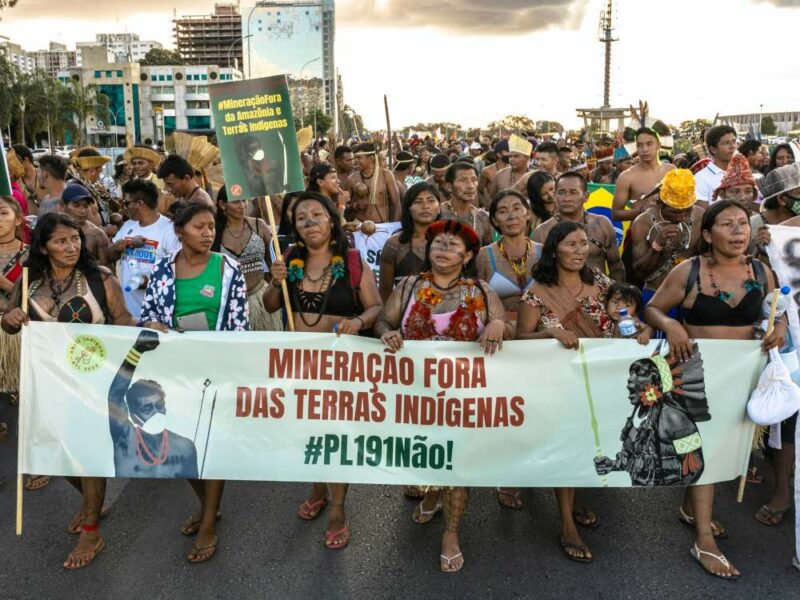
A just transition in 2026 cannot be built on imposed mining concessions. It must confront overconsumption, reduce material demand, and center Indigenous self-determination as a non-negotiable foundation of climate solutions.
6. Agribusiness, soy, and infrastructure expansion
Industrial agribusiness, particularly soy and cattle supply chains, remains one of the most powerful and least challenged drivers of Amazon destruction, especially in Brazil. Framed as development or food security, agribusiness expansion is inseparable from land grabbing, deforestation, and violence against Indigenous Peoples and traditional communities.
Mega-infrastructure projects such as Ferrogrão, alongside industrial waterways and export ports, are designed to serve global commodity markets. They flatten forests, poison rivers, and entrench an economic model that treats the Amazon as a logistics corridor rather than a living territory.
Without confronting the political power of agribusiness and its influence over land-use policy, while advancing economic models that prioritize people over profit, any claim to protect the Amazon remains incomplete. The “Answer Caravan” to Belém for COP30 marked a crucial milestone in building a united front that will continue to grow in 2026.
7. Fires and the politics of prevention
Fires remain an immediate and visible threat. They are not natural disasters, but political outcomes driven by land grabbing, illegal burning, and weak enforcement. Prevention, through land titling, early warning systems, strong enforcement, and support for Indigenous and community fire brigades, will determine whether 2026 marks a turning point or another year of avoidable catastrophe.
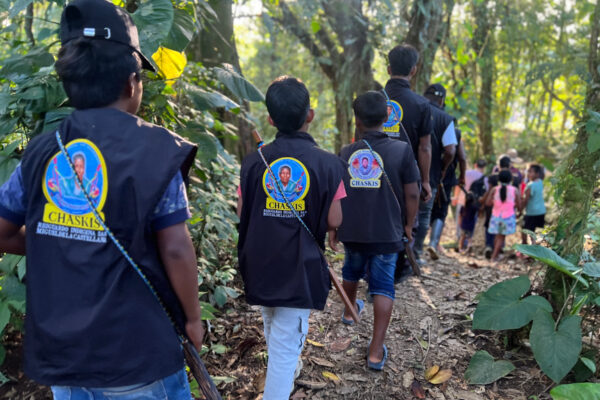
All these challenges converge on a central truth. Indigenous knowledge and governance systems are among the most effective barriers against deforestation, violence, and extractive expansion. Protecting the Amazon depends on the full recognition and guarantee of Indigenous rights, autonomy, and self-determination.
This requires more than symbolic commitments. It demands secure land rights, protection for land defenders, sustained political and economic support, and genuine respect for Indigenous institutions. Without these conditions, any response to the Amazon crisis will remain partial and fragile.
2026 is a year of decision for the Amazon.