
In the November 16 referendum, Ecuadorians rejected President Daniel Noboa’s attempt to rewrite the Constitution and expand the militarized approach that has defined his government. The result showed that people want real public safety, not increased repression, and that they are ready to defend democracy when it comes under threat.
For Amazon Watch, this is a significant victory for efforts to confront violence, organized crime, and expanding extractivism in ways that respect human rights and the Rights of Nature. It aligns closely with our Amazon Crime campaign, which calls for rights-based strategies that protect Indigenous territories and respond to illegal economies and territorial threats through community-led solutions.
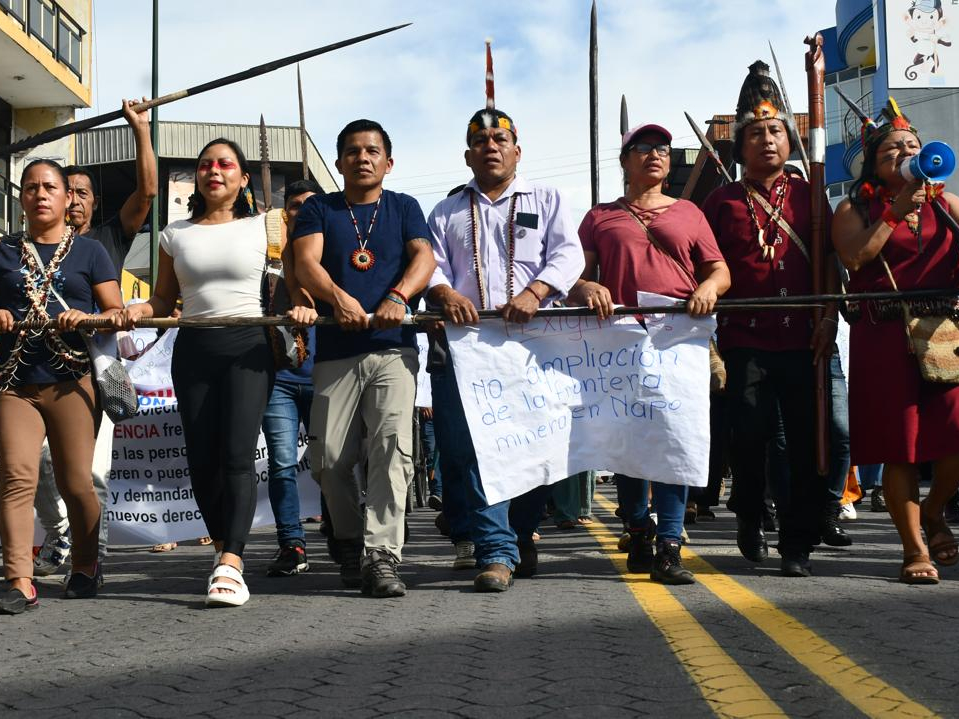
Over the last two years, Ecuador has experienced an unprecedented escalation of militarization. The government declared an “internal armed conflict,” broadened the military’s policing role, and used force against nationwide protests. Other violence surged as well. By November 2025, Ecuador had recorded 8,272 intentional homicides, marking one of the most violent periods in its history. Human rights organizations documented arbitrary detentions, excessive force, intimidation, and investigations targeting Indigenous leaders and environmental defenders.
Many of these concerns appear in Amazon Watch’s recent report In the Shadows of the State, which illustrates how militarization deepens insecurity in Amazonian regions and leaves Indigenous communities vulnerable to both state and criminal violence.
International concern grew as more than 130 organizations joined Amazon Watch in condemning the government’s actions. When soldiers killed three civilians, including Kichwa community member Efraín Fueres, calls for accountability intensified. The referendum made clear that Ecuadorians would not accept this path.
This vote confirms what Indigenous nations, community organizations, and human rights groups have long argued. Militarization does not address the root causes of violence in the Amazon. Illegal mining, land trafficking, drug trafficking, and violence against on Indigenous defenders continue to expand. Military operations often push criminal groups deeper into Indigenous territories or enable collaboration with illegal actors. Meanwhile, Indigenous guards, women’s collectives, and community patrols – who successfully protect forests and people – are threatened or ignored.
Amazon Watch’s Amazon Crime campaign highlights that real security requires territorial governance, land rights, community monitoring, women-led safety networks, and local economies that strengthen resilience. Protecting the Amazon depends on strengthening intercultural democracy, where Indigenous self-governance is treated as an essential partner in territorial and environmental protection.
By rejecting Noboa’s militarized reforms, Ecuadorians chose solutions that protect life and dignity instead of policies based on repression.
Ecuadorians refused to let those protections be weakened. Their vote confirmed that the Constitution of Montecristi and the Rights of Nature remain in effect. This matters for every future struggle, from resisting illegal mining to preventing criminal groups from taking over Indigenous lands.
Ecuador’s vote reinforces the message of Amazon Watch’s recent call for an immediate end to state violence. The public does not accept the claim that human rights must be sacrificed to address the security crisis. They demand solutions that respect communities, not policies that put them at greater risk.
The world should pay attention. The Amazon is experiencing a dangerous rise in organized crime, illegal mining, and land invasions. Governments across the region often respond with militarization, even though evidence shows it does not work. This referendum shows that people want a different approach – one centered on rights, justice, and community leadership.
Ecuador now faces the challenge of rebuilding trust. The government must investigate human rights abuses, end the criminalization of defenders, and guarantee the right to protest. It must work with Indigenous nations, women’s groups, and rural communities to create real solutions to insecurity. It must also invest in community led systems that protect forests, monitor territory, and address illegal activities without putting people at risk.
Ecuador’s vote does not solve the crisis on its own, but it creates a clear mandate. The public wants a country where human rights matter, where communities have power, and where safety is not used as a justification to weaken democracy.