The Administration designated a dozen Latin American criminal cartels as terrorist organizations and launched Operation Southern Spear in September.
Brazil
Indigenous Women Occupy Federal Agency to Demand Suspension of Belo Sun Mining’s License
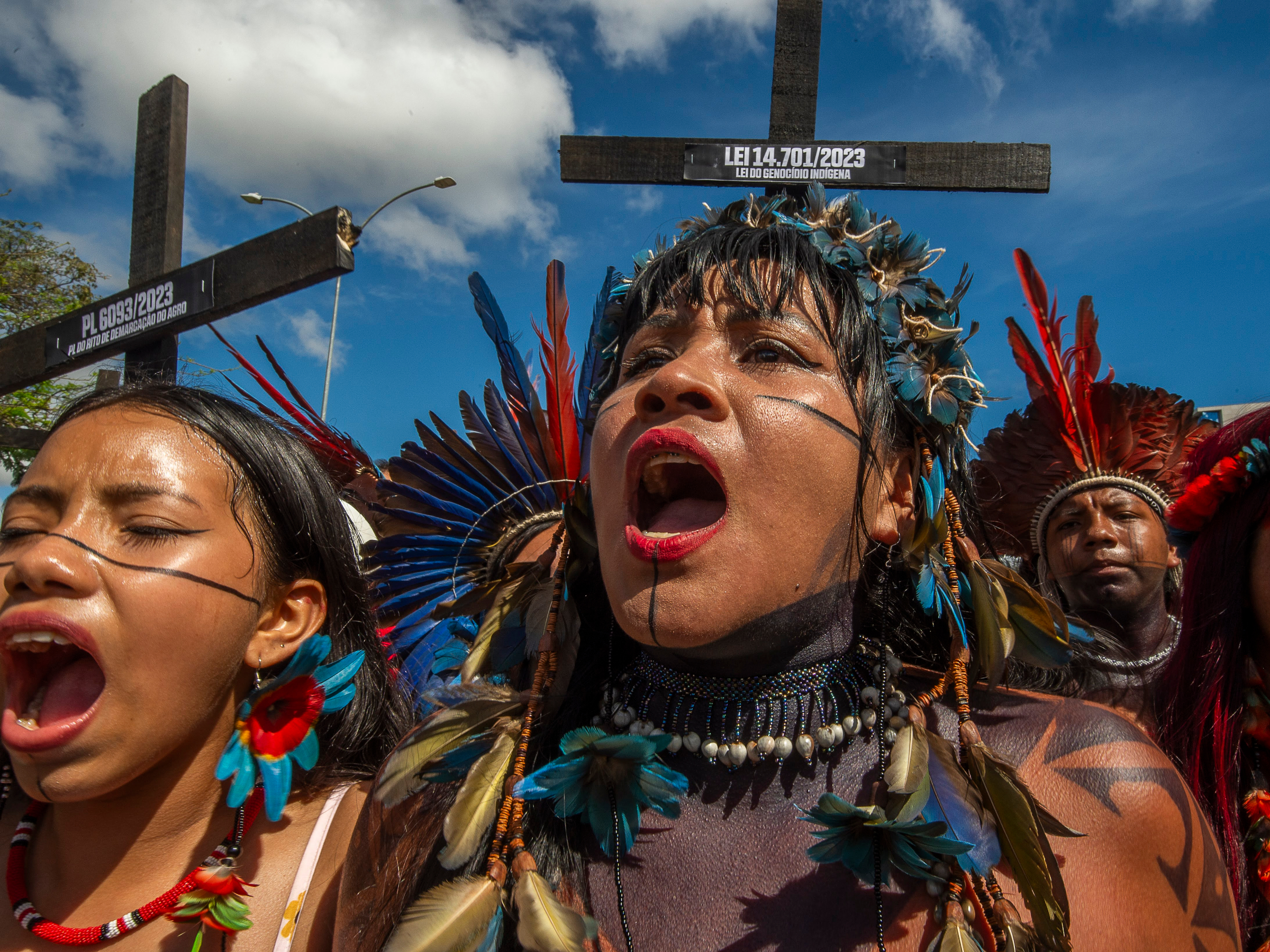
One month into their occupation of the Altamira headquarters of Brazil’s National Foundation for Indigenous Peoples (FUNAI), Indigenous women from the Middle Xingu region led a peaceful action.
Bringing Down a Decree: Inside the Indigenous Victory on the Tapajós River
On January 30, I witnessed the inauguration of the Munduruku people’s Pariri Association headquarters at the Praia do Mangue Indigenous Reserve.
Indigenous Women Occupy Federal Agency to Demand Suspension of Belo Sun Mining’s License
More than 140 Indigenous people have occupied the Brazilian federal Indigenous agency FUNAI’s regional office to demand the suspension of Belo Sun’s mining license for its “Volta Grande” gold mine on the banks of the Xingu River.
‘The river won’: how campaigners in Brazilian Amazon stopped privatisation of waterway
The Guardian | "A victory for life.” That was the triumphal message from Indigenous campaigners in the Brazilian Amazon this week after they staved off a threat to the Tapajós River by occupying a grain terminal operated by Cargill, the biggest privately owned company in the United States.
Amazon Watch is building on more than 28 years of radical and effective solidarity with Indigenous peoples across the Amazon Basin.
Brazil Court Revives Belo Sun’s Controversial Amazon Gold Mine
“We are already suffering the impacts of the Belo Monte dam.. If another project of this scale comes, the Volta Grande will not withstand it.”
Indigenous Resistance Forces Brazil To Revoke Amazon Waterway Decree
“This proves that life – the river – has no price. It cannot be sold, it is not negotiable. That’s why we will never back down.”
From Pandora to the Amazon, Indigenous Leadership Is Protecting Life on Earth
More than a decade after Avatar brought global attention to the destruction of Indigenous lands, Amazon Watch has released a new short video.
Indigenous Leaders Defending the Amazon Take Center Stage in New Amazon Watch Video
New short video narrated by Avatar star Oona Chaplin features director James Cameron, legendary Chief Raoni Metuktire, and Goldman Environmental Prize winner Alessandra Korap Munduruku
Indigenous Protesters Intercept Grain Barge, Escalating Demands to Repeal Decree Privatizing Amazonian Rivers
Today, 400 Indigenous peoples in four boats intercepted a grain barge on the Tapajós River in the city of Santarém (PA).
Indigenous Peoples Maintain Indefinite Blockade of Cargill on the Tapajós River
Today the Indigenous occupation at Cargill’s grain terminal in Santarém entered its 20th day, deepening the movement’s standoff with the Lula administration over plans to dredge the Tapajós and privatize Amazonian rivers.
Indigenous Peoples Block Access to Santarém Airport in Protest of Tapajós River Dredging
Indigenous Peoples from the Tapajós region blocked the main access road to Santarém International Airport today, escalating a mobilization ongoing since January 22.
Indigenous Brazilians Protest Amazon River Dredging for Grain Exports
AFP | Hundreds of Indigenous people have been protesting in northern Brazil for two weeks outside the port terminal of U.S. agribusiness giant Cargill, angered over the dredging and development of Amazonian rivers for grain exports.
Indigenous Protest Enters Second Week as Brazil Faces Pressure Over Amazon Waterway Decree
Munduruku leaders join growing Indigenous blockade against Amazon River dredging and privatization
On the 13th day blockading Cargill’s grain terminal in Santarém, Indigenous protestors are demanding in-person dialogue with Brazil's federal government, following its failure to send representatives to a meeting last week.
Amazonian Indigenous Blockade of Key Cargill Terminal Reaches One Week
For the past week, Indigenous peoples representing 14 ethnicities from the Lower and Middle Tapajós River region have blockaded facilities operated by agribusiness multinational Cargill in Santarém, protesting industrial interventions designed to accelerate agro-commodity exports.
Indigenous Protesters Block Cargill Facility in Brazil Over President Lula’s Decree
Associated Press | Hundreds of Indigenous people have been protesting for almost a week at a Cargill facility in Brazil against a decree allowing the federal government to consider private concessions for waterways.
What Brazil’s New Legal Landscape Means for the Amazon and Its Peoples
Despite clear warnings from research institutions, Brazil is moving closer to licensing a mega-project based on incomplete and flawed environmental studies.
2026: A Year of Decision for the Amazon
The Amazon has reached an ecological tipping point. What happens in 2026 will help determine whether climate justice remains possible or becomes an empty slogan.
Indigenous Leadership and Collective Power in 2025
As climate denial gained renewed political traction and governments moved to restrict civic space, Indigenous peoples and grassroots movements across the Amazon advanced bold, collective visions for the future.
Amazonian Indigenous Peoples Void Belo Sun’s Consultation, Threatening Mega-mine’s Approval
Juruna and Arara peoples formally revoke consultations used by Canadian company to justify licensing of its Volta Grande gold mine in Brazil’s Xingu region
“Prior consultation is a binding requirement established by the Federal Regional Court and an indispensable condition for the environmental licensing process to move forward.“
Brazil’s Senate Rams Through Constitutional Amendment Imperiling Indigenous Lands and Communities
Mining companies stand to benefit as Indigenous organizations warn of impending human rights and environmental disaster
Brazil’s largest Indigenous organizations warn that the amendment dismantles the country’s constitutional framework for territorial protection.
This Is What True Climate Leadership Looks Like
Indigenous women and the grassroots Amazonian movement carried COP30 on their shoulders
“We’re very happy that our lands advanced in the demarcation process, but there are so many lands that still need to be recognized and demarcated in Brazil.”
Ferrogrão Reignites Conflict Between the Government and Indigenous Peoples at COP30
AFP | “We are not going to allow it, because this is our home, our river, our forest.”
Protect the Amazon, Tax the Polluters: Climate Activists Demand Action at COP30 in Belém, Brazil
Democracy Now! | The Brazilian government said, "We’re going to put a hold on Ferrogrão. We’re not going forward on this soy railway for Cargill and ADM and Bunge and all these multinational corporations to feed animals, not people. We’re not going forward with this without people’s consent.”
The Answer Caravan Brings the Amazon’s Voice to COP30
“The forest lives because we are here. If they remove the people, the forest will die with them."
Amazon Free from Extraction: Ending Oil, Gas, Mining, and Agribusiness on Indigenous Lands
COP30 press conference featuring Amazonian Indigenous leaders from Brazil, Ecuador, and Peru
As COP30 enters its second week of negotiations, Amazonian Indigenous leaders arrive in Belém after leading powerful and courageous actions.
Major River Mobilization from the Amazon Arrives at COP30
More than 200 boats carrying Indigenous, riverine, and social movement leaders occupied Guajará Bay in a historic act for the Amazon and climate justice. Chief Raoni Metuktire reminded the world of a simple truth: “The forest lives because we are here. If they remove the people, the forest will die with them.”
“The presence of Indigenous Peoples at COP30 is very important, but the struggle doesn’t end here."
Global Artists and Cultural Influencers Support Historic Indigenous Declaration
The peaceful protest was a powerful statement from Indigenous and traditional communities about the impacts of Brazil’s grain export corridors on rivers, fisheries, territories, and local livelihoods.
Indigenous Peoples Intercept Soy Barges on the Tapajós River
“There can be no real climate solution while Amazonian rivers are treated merely as grain corridors and the peoples of the Tapajós continue to be denied their right to free, prior, and informed consent.”
The peaceful protest was a powerful statement from Indigenous and traditional communities about the impacts of Brazil’s grain export corridors on rivers, fisheries, territories, and local livelihoods.