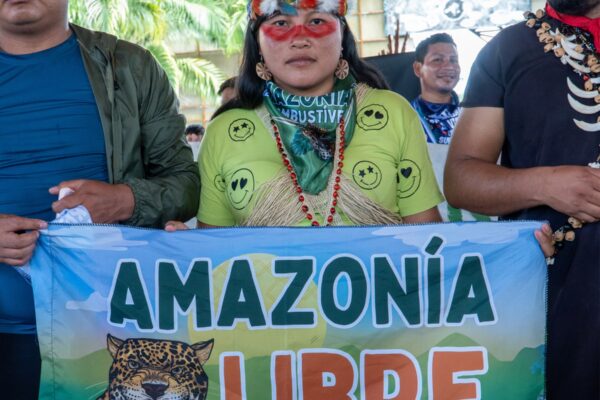

Across the Amazon and the world, Indigenous women, queer, and two-spirit people are at the forefront of the struggle to protect their ancestral territories and rematriate the land. Along the Tapajós River in the Brazilian Amazonian state of Pará, Maria Leusa Munduruku has emerged as a powerful defender of Munduruku territory against a conflux of extractive pressures and projects such as dams, mining, illegal logging, and the Ferrogrão mega-railway.
First and foremost a mother and nurturer of future generations, Leusa is also a law student and a co-founder of the Wakoborũn Women’s Association, which builds solidarity among Munduruku women and young people to fight for environmental and climate justice.
Leusa reminds us that Indigenous women are central to this struggle because their health and the health of their children are disproportionately impacted by centuries of ongoing genocidal violence inflicted by the expansion of the settler frontier into Indigenous territories.
As invaders encroach further into Munduruku territory, they increase the prevalence of various diseases, such as COVID and malaria. “Those who suffer with their children are women,” she laments.
This health injustice is compounded by mercury contamination that bioaccumulates in local fish populations and contaminates waterways, threatening the food sovereignty and water supply of several villages in the community. A deepening of extractivist activities in this region – already burdened by cumulative exposure – would be catastrophic to the health of the Munduruku people and the rainforest.
Leusa sees intergenerational leadership as a key to fortifying the movement for Indigenous land rights and demarcation in Brazil, ensuring that the Munduruku’s communal health and ancestral territories are protected in perpetuity.
Young Munduruku women are empowering themselves and each other by reclaiming their traditional roles as cultural bearers and weavers in their community. Through the Wakoborũn’s audiovisual collective, youth are harnessing the power of digital media and storytelling to connect their struggles to anti-colonial movements worldwide.
Their growing global influence is critical on the path to COP30 later this year, which will be held in their home state of Pará. As Brazil prepares to host world leaders to engage in critical decision-making on global climate change, Brazil’s agroindustrial sector in the country’s Congress and Senate are simultaneously waging an assault on Indigenous rights and territories through the attempt to advance Law 14.701, which contains the notorious Marco Temporal thesis.
Marco Temporal is an ad hoc constitutional interpretation mechanism that limits the rights of Indigenous peoples to their ancestral lands by applying an arbitrary, restrictive, and legally unfounded temporal cutoff. According to the thesis, the right of Indigenous peoples to their ancestral lands only applies to territories they effectively occupied at the time of the declaration of the Federal Constitution of Brazil in October 1988.
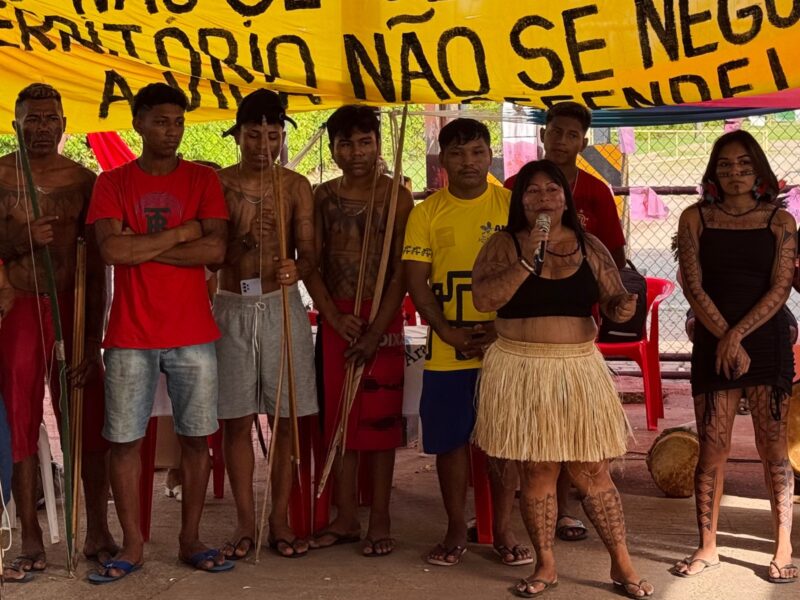
As government officials gathered yesterday, March 26, 2025, to resume debates on Indigenous land rights, Munduruku community members blocked the BR-230 highway for the second day, demanding that the law be repealed. In a very real symbol of the physical and political violence perpetrated against Indigenous peoples, the Munduruku were met with police repression and rock-hurling truckers, who attacked the blockade with impunity, injuring several people.
“That is our role [as women]: to teach future generations to ensure their leadership,” Leusa emphasizes.
As the Munduruku and Amazonian Indigenous peoples continue to rise against these converging extractivist and governmental threats, we will continue to stand in principled and material solidarity with Indigenous women and youth leaders.