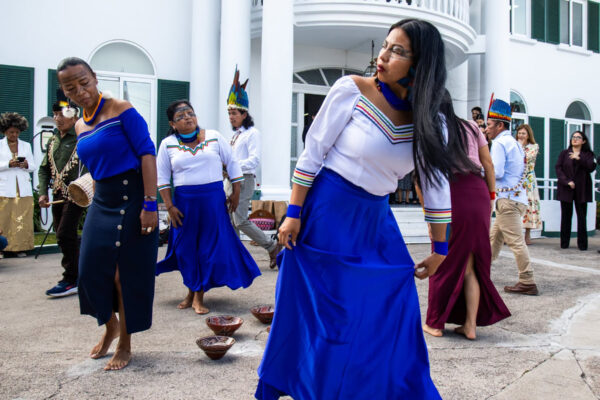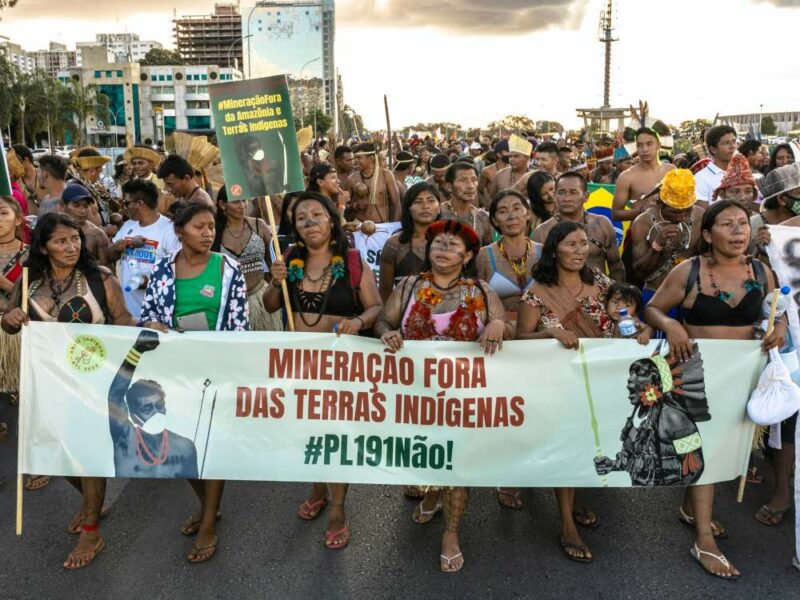

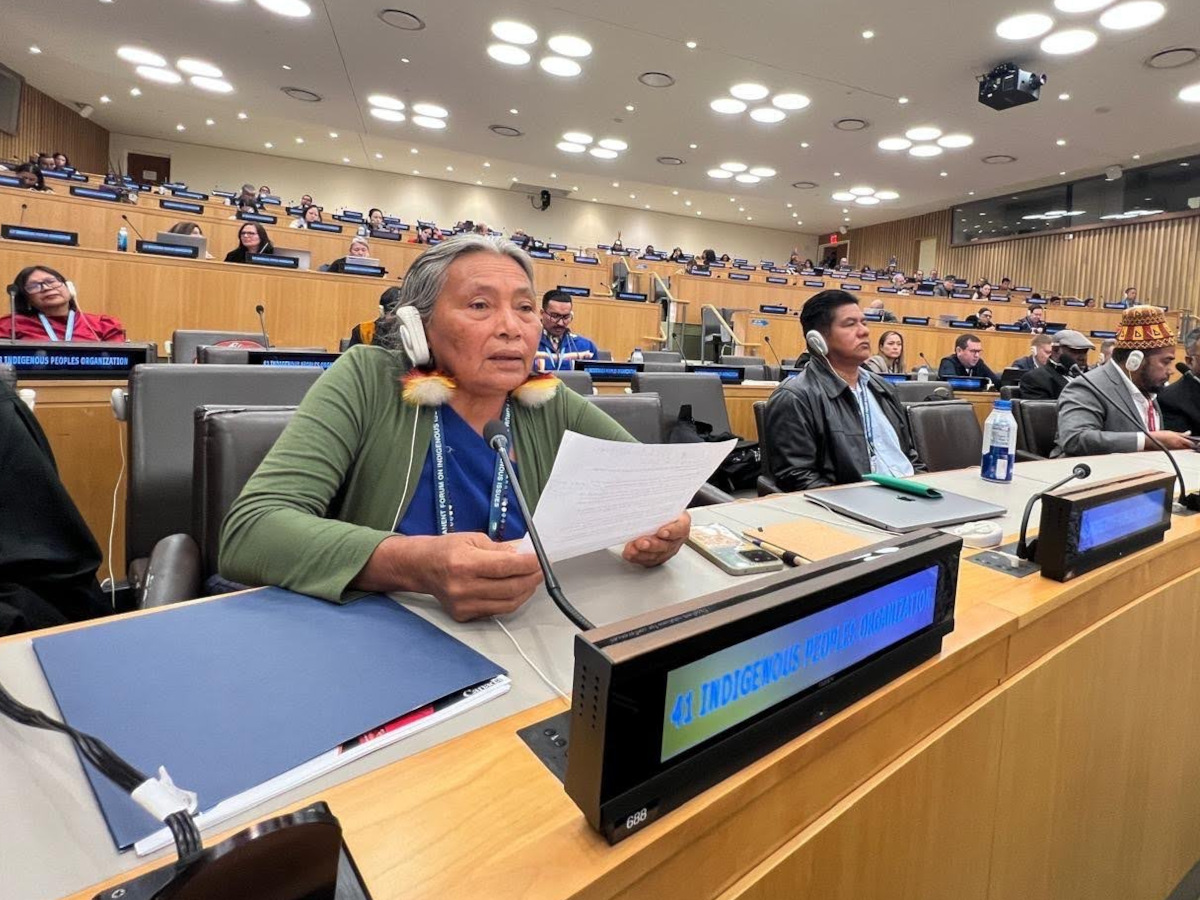
New York, NY – Indigenous organizations from across the Amazon and Latin America have issued a joint communication to United Nations bodies warning that the rapid expansion of organized crime and illicit economies is driving a worsening human rights, security, and environmental crisis in their territories. They stress that this expansion is directly linked to extractive economies, weak state protection, and, in some cases, direct or indirect state complicity.
The organizations are calling for urgent action from the international community, as Indigenous Peoples continue to face this crisis without meaningful support. At the same time, they assert their role not as victims, but as political authorities with proven systems of governance capable of protecting both their communities and the Amazon.
The call comes alongside a new report, Amazon Under Siege: How Crime and Militarization Threaten Indigenous Peoples, which documents how criminal networks are consolidating territorial control, intensifying violence, and undermining Indigenous governance across the region.
Organized Crime Driving a Regional Crisis
The report finds that the Amazon has become a key hub for transnational organized crime, where illegal mining, drug trafficking, logging, and other illicit economies operate as interconnected systems that control land, resources, and populations.
Across the region, criminal groups are establishing parallel systems of governance that displace Indigenous authority. Communities face violence, forced displacement, and threats against leaders. Militarized state responses fail to address root causes and actively increase risks for communities.
These dynamics represent a direct threat not only to Indigenous Peoples but to global climate stability, given the Amazon’s outsized ecological role.
Indigenous Leaders Speak Out
Leaders from major Indigenous organizations emphasized that solutions must center Indigenous rights, governance, and participation.
COICA Vice President Jamner Manihuari, representing the Indigenous Peoples of the Amazon Basin, stated:
“The expansion of organized crime in the Amazon is not only a security issue – it is a direct attack on our territories, our systems of governance, and our very survival as peoples. Indigenous Peoples are not merely victims; we are resisting and we have solutions. We are essential to protecting the Amazon and must be recognized as such.”
CONAIE Vice President Ercilia Castañeda stated:
“Militarization has not brought security to our territories. On the contrary, it has deepened violence and exclusion. States must move beyond repressive approaches and guarantee the participation of Indigenous Peoples in decisions that affect land, water, and life.”
Miguel Guimaraes, Vice-President, AIDESEP (Asociación Interétnica de Desarrollo de la Selva Peruana) stated:
“Our communities are facing the combined pressures of drug trafficking, illegal mining, and a State response that has failed to address the root causes of these problems. This is why we are calling on the international community – especially importing countries – to change course. Strengthening our livelihoods and systems of territorial governance is essential to stopping the expansion of organized crime in the Amazon.”
Herlin Odicio, Vice-President, ORAU (Organización Regional AIDESEP Ucayali) said:
“Indigenous patrols, community monitoring, and ancestral knowledge are already protecting our territories. What we need is recognition, protection, and support. Without this, there will be no military solution to the expansion of organized crime in our territories.”
A Call for Urgent and Structural Change
In their communication to U.N. Member States, the United Nations Office on Drugs and Crime (UNODC), the Office of the United Nations High Commissioner for Human Rights (OHCHR), and the Permanent Forum, Indigenous organizations call for a fundamental shift in global responses to organized crime in the Amazon, away from militarized approaches that have failed to deliver security, and toward strategies rooted in Indigenous rights, governance, and leadership.
They urge:
- Rights-based responses that avoid militarization and instead promote solutions grounded in human rights, territorial governance, and effective participation
- Recognition of Indigenous Peoples as central actors in territorial security and environmental protection
- The establishment of a dedicated UN mechanism for dialogue and consultation on the impacts of organized crime, including at the UN Conference on Transnational Organized Crime
- The full inclusion of Indigenous perspectives in anti-corruption frameworks and policies addressing environmental crime
“Security in the Amazon cannot be imposed from outside,” the coalition states. “It must be built with Indigenous Peoples – grounded in our rights, our governance systems, and our relationship with our territories.”
A Critical Moment for the Amazon
As organized crime expands across the Amazon, Indigenous Peoples continue to lead frontline efforts to defend forests, biodiversity, and global climate stability. The report makes clear that supporting these efforts is not optional, it is essential. Without urgent action, the convergence of organized crime, environmental destruction, and militarized responses will continue to deepen a crisis with global consequences.