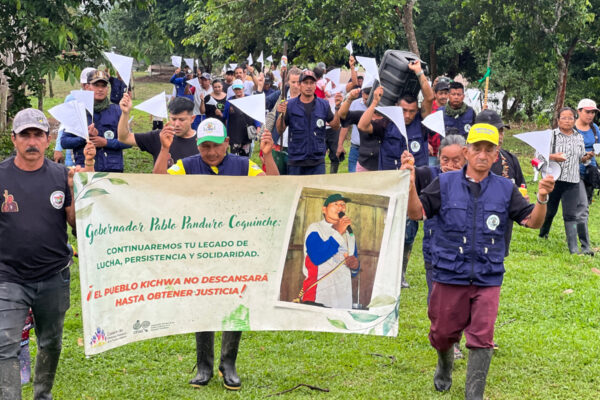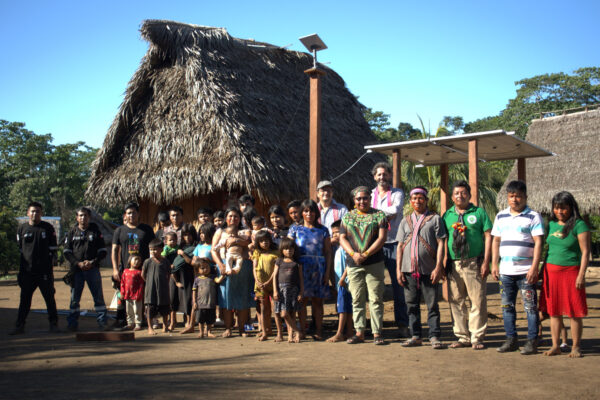

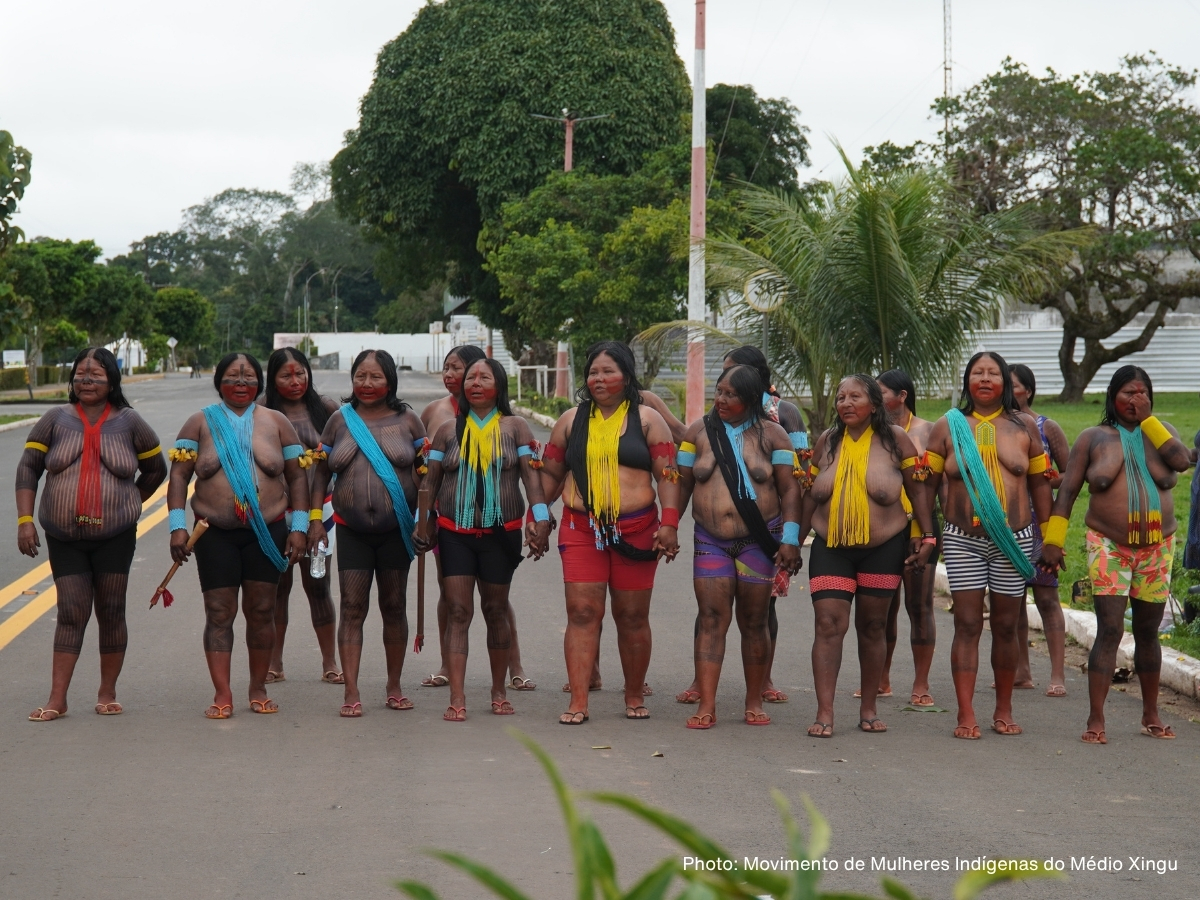
Altamira, Brazil – One month into their occupation of the Altamira headquarters of Brazil’s National Foundation for Indigenous Peoples (FUNAI), Indigenous women from the Middle Xingu region led a peaceful action yesterday to demand the cancellation of the Canadian mining company Belo Sun’s installation license for its Volta Grande mega-mine. More than 200 protesters marched to the Altamira city council, where they called on council members to stand publicly in defense of the rights of Indigenous peoples, riverine communities, fisherfolk, and traditional communities threatened by the project.
The Middle Xingu Indigenous Women’s Movement organized the demonstration, bringing together Parakanã, Xipaya, Arara, Kuruaya, Juruna, Xikrin, and other Indigenous peoples from the region, along with representatives from fisherfolk and riverine communities, Black women’s movements and urban periphery women’s movements, cultural collectives, and the teachers’ union. Carrying signs that read “They want gold, we want life” and “Life is worth more than gold,” the protest centered the FUNAI occupation’s month-long denunciations concerning attempts to ram forward another mega-project alongside the Belo Monte dam on the Xingu River. Their action called out the failure to thoroughly address the project’s risks, the flaws in its licensing process, and the exclusion of threatened communities from its planning process.
“We have been camped at the FUNAI office for a month in very difficult conditions, without tents, without sleeping mats, and without enough food for our people. It is painful to have to fight for our rights without receiving the support we need. That is why we are asking for solidarity from the people of Altamira. This project will impact the entire territory and directly harm our communities. We want Belo Sun out and its license annulled,” said Ngrenkarati Xikrin, one of the occupation’s leaders.
Belo Sun’s Cumulative Impacts with the Belo Monte Dam
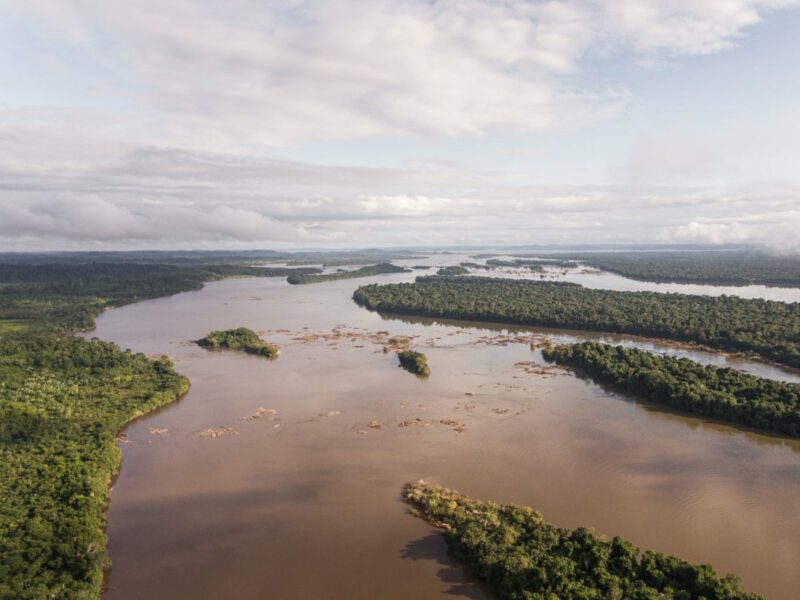
The mobilization is taking place in a region where Belo Monte’s lasting impacts continue to devastate daily life, depleting fish stocks, disrupting water flows, blocking river navigation, and displacing traditional families from their territories. For the organizations that joined the protest, the promise of “progress” associated with Belo Sun repeats a familiar pattern in Altamira: large-scale projects sold as development, but implemented at the cost of severe social, environmental, and territorial harm, as occurred with the Belo Monte mega-dam.
“After a month of occupation, what should shame the public authorities is not only the fact that we women remain at the FUNAI office, but that we are still being forced to take to the streets to demand answers the state should have provided long ago. The Volta Grande do Xingu already bears the scars of Belo Monte. Pushing Belo Sun forward with outdated environmental studies, a contested Indigenous consultation process, and the exclusion of Indigenous and riverine communities is repeating, on the scale of a mining project, a history of destruction that Altamira knows all too well,” said Sol Juruna, from Paquiçamba village, who is part of the movement.
On Monday, FUNAI’s Directorate of Environmental and Territorial Management sent an official letter to Belo Sun, the Pará State Secretariat for Environment (Semas), and the Brazilian Institute of Environment and Renewable Natural Resources (IBAMA). The letter reiterates the need for a complementary analysis of the cumulative impacts of Belo Sun’s Volta Grande Project alongside Belo Monte. In the document, FUNAI states that it has issued complementary terms of reference for the preparation of a Cumulative Impacts Assessment within the Indigenous component of the licensing process. The assessment will focus on the Paquiçamba, Arara da Volta Grande do Xingu, Trincheira-Bacajá, and Ituna-Itatá Indigenous Territories, as well as the Jericoá Indigenous Reserve and other communities with an Indigenous presence in the Volta Grande do Xingu.
FUNAI states that this new study must measure how the mine’s impacts, alongside those of other current, planned, or foreseeable projects, accumulate across Indigenous territories in the region over time. FUNAI itself notes that the results of this analysis will support its final position on the viability of the Volta Grande Project from the perspective of Indigenous peoples’ rights. The letter also recalls earlier warnings from Belo Monte’s operator Norte Energia, which raised concerns in 2022 about the overlap between the mine and Belo Monte, citing an “incompatibility between the hydroelectric and mining projects.”
Recent studies reinforce the gravity of this case. The report Mining Rights Away: The Impacts of Mining on Indigenous Peoples and the Climate, released by the Ministry of Indigenous Peoples (MPI) at the COP30 summit, argues that the Volta Grande Project cannot be treated in isolation. According to researchers, Belo Sun’s mining interests in the region cover 186,491 hectares — an area equivalent to about 261,000 soccer fields — including exploration requests, exploration authorizations, and mining applications. This territorial expansion threatens at least 20 Indigenous villages. The project itself includes two open-pit mines, explosive blasting, reservoirs, and a large tailings dam directly on the banks of the Xingu River.