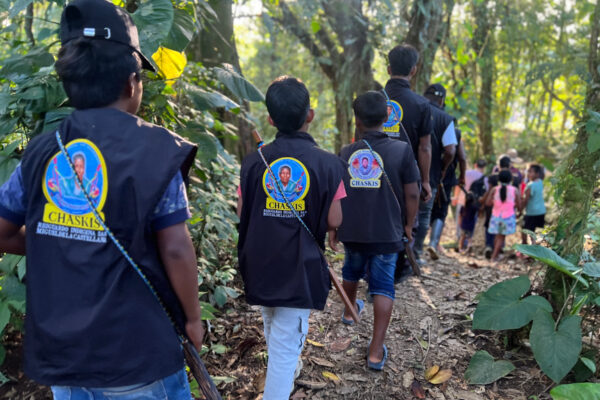

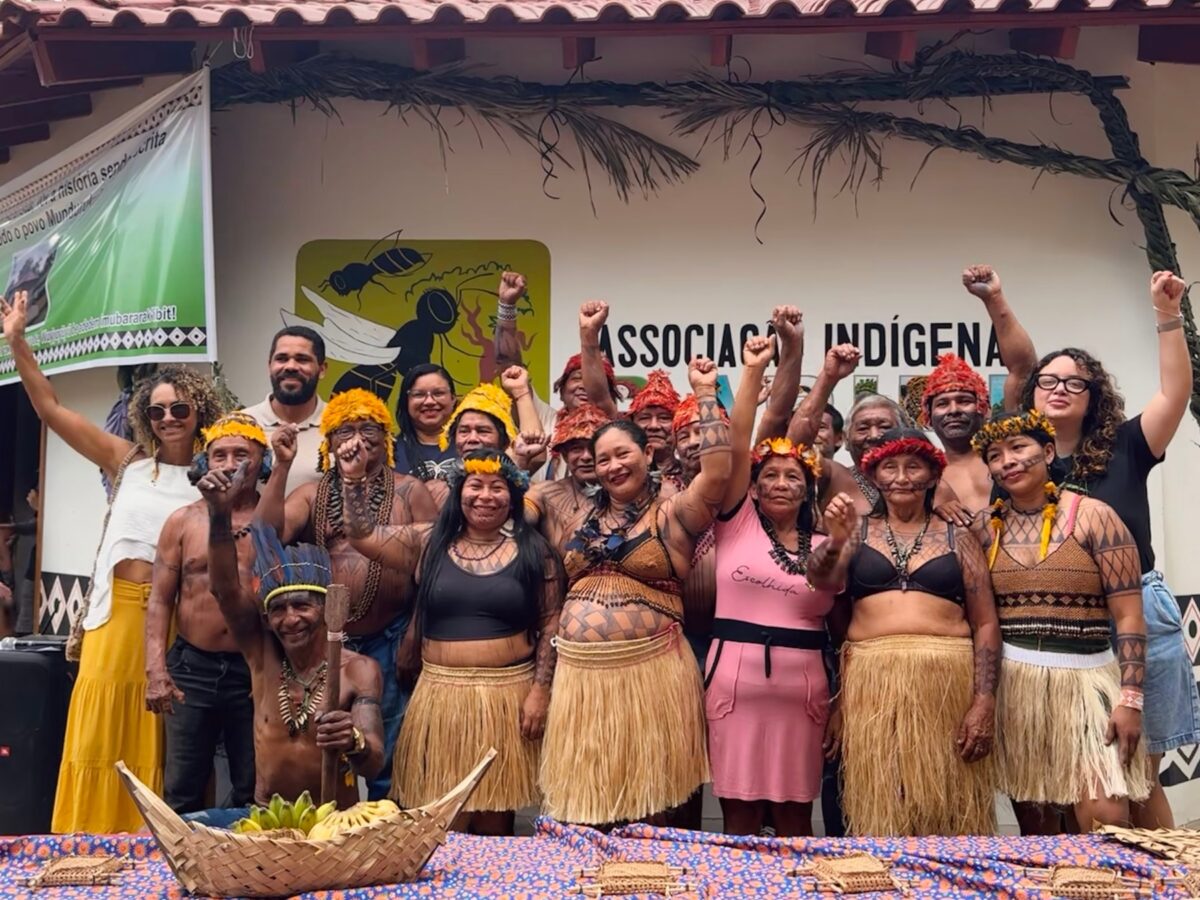
On January 30, I witnessed the inauguration of the Munduruku people’s Pariri Association headquarters at the Praia do Mangue Indigenous Reserve on the banks of the Tapajós River. The atmosphere was alive with joy. The spacious new structure embodied hard work, collective effort, and a long history of persistence. Munduruku community members and their allies walked through the space with the pride of people who knew the effort behind this achievement. But even in that moment of celebration, the struggle did not stand still. That victory already coexisted with the next urgent fight.
As Pariri’s headquarters was unveiled, conversations quickly turned to Santarém, where Indigenous relatives from the Lower Tapajós had spent a week blockading Cargill’s grain terminal to protest Decree 12,600. Signed by President Lula in 2025, the decree privatized stretches of the Tapajós, Madeira, and Tocantins Rivers, allowing destructive dredging to expand commodity export logistics corridors while denying threatened Indigenous communities their right to Free, Prior, and Informed Consultation. Transnational agribusiness corporations like Cargill would greatly benefit from reduced logistics costs and increased soy exports to global markets, while Indigenous peoples and their territories would pay the price.
The day after the inauguration, the celebratory mood had already given way to preparation. It was time to collect food, clothing, and money, arrange transportation, and gather the strength needed to hit the road. Traveling from Itaituba to Santarém, the Munduruku left behind one concrete achievement and stepped into a struggle that was uncertain, exhausting, and with no end in sight.
When I arrived at the blockade on February 1, one word best described what I encountered: collectivity. It was everywhere, in the way people organized themselves, in their refusal to accept partial solutions, and in their understanding that defending one river while abandoning others made no sense. When the government tried to defuse pressure with proposals that ignored the core problem, leaders from the Tapajós made clear they would not leave without full revocation of the decree and real respect for their right to consultation. Maintaining unified demands for Tapajós, Madeira, and Tocantins Rivers was both a political and ethical choice.
But it was also a choice that came at a cost.
Some days brought brutal sun, heat trapped in the concrete, and little shade or rest. Under the tarps and tents, the heat felt far more intense than any weather report could capture. There were also the days of rain, when it seemed like the sky was falling all at once. Strong winds and endless downpours soaked clothes and mattresses and ripped tarps loose. Each morning, the work began again. The blockade had to be reorganized, what could be dried had to be dried, what had fallen had to be raised, and the struggle had to continue.
There is nothing romantic about this. Many people got sick, myself included. The body never lies. One of the most remarkable things was seeing that the movement did not hide its hardship, but refused to let anyone face it alone. Volunteer medical students and teams from the Indigenous Special Health District (DSEI) in Santarém helped care for those who needed treatment.
At the same time, people built a temporary settlement where there had once been nothing but a concrete loading bay. Week by week, the space took shape. There was a food tent, where meals were prepared and distributed; a health tent, with medical and dental care; a communications tent, where Indigenous and non-Indigenous communicators – like me – could produce content; and the assembly space, where people gathered to make collective decisions. Areas for hammocks and tents were also set up, allowing for a bit of rest. A daily network of support sustained it, with donations from partners, organizations, and ordinary people who understood the struggle had to remain standing to survive.
More relatives kept arriving. People paused work, farming, family life, and daily routines in order to be there. Munduruku from the Middle Tapajós came, then from the Upper Tapajós, along with contingents of Kayapó and Panará peoples from distant Mato Grosso state, among others. What began with around 50 Indigenous people from the Lower Tapajós grew to nearly 2,000 from four river basins.
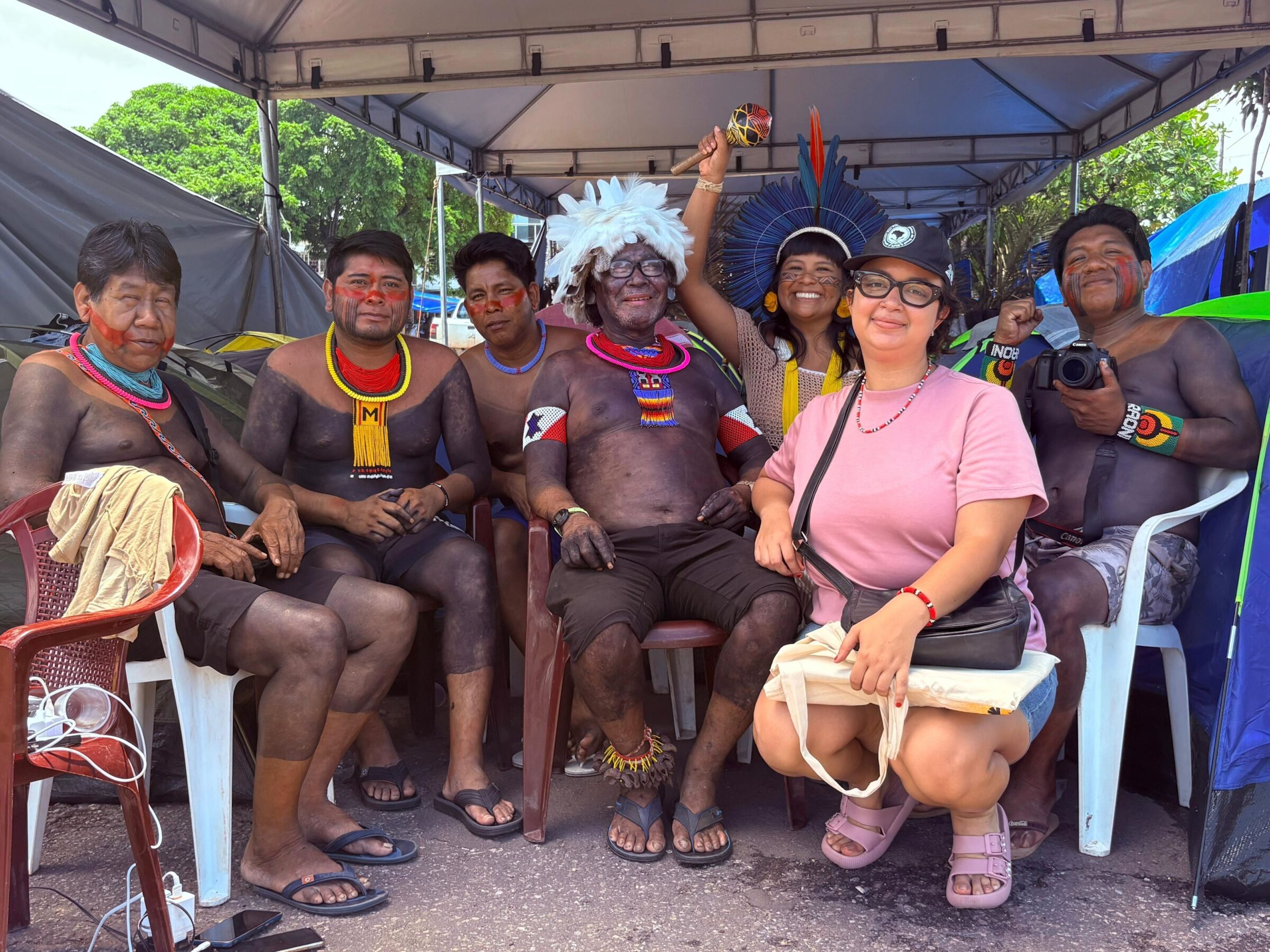
Those who could not join the mobilization in person found other ways to show up. Social media feeds were full of statements, videos, campaigns, and calls for Lula to revoke Decree 12,600. Little by little, the blockade stopped being seen as a “local cause” and became what it truly was, a dispute over who decides the fate of Amazonian rivers and whose voice is heard.
Understanding the broader implications of the Cargill blockade increased public pressure. Indigenous and non-Indigenous people, researchers, artists, influencers, singers, and even chefs whose work depends on clean rivers began echoing the same question: who benefits when a living river becomes an industrial export corridor?
In the early hours of February 21st, when a group of protesters entered the Cargill facility to intensify the movement’s pressure upon the government, the atmosphere shifted again. Tension rose, along with the risk of state repression and mounting efforts to criminalize the movement. From that point on, any misstep could justify police violence or attempts to delegitimize the peaceful protest. Still, the movement did not retreat. Once again, collectivity held strong.
Soon after, when some key leaders needed to travel to Brasília for meetings that would determine the future of the mobilization, I witnessed one of the clearest expressions of the shared sense of responsibility. Instead of emptying Santarém of leadership, the movement collectively decided who would travel and who would remain. No one wanted to leave those staying behind unsupported. No one wanted to weaken the encampment at its most tense moment. The choice was strategic, advancing both fronts, local action and national level dialogue, at once.
And then came February 23rd.
While some leaders were in Brasília, those who remained at Cargill were taking part in a ritual to reconnect spiritually and ask for protection. There were rumors that police forces were on their way. The atmosphere was heavy. Everyone’s body seemed braced for the worst. Then, Chief Dada Borari, who was leading the ritual, asked for silence.
It was during that silence that the news arrived: the federal government announced it would revoke the decree, backing down in the face of determined Indigenous mobilization while reaffirming its commitment to conducting free, prior and informed consultation with Indigenous peoples.
What happened next remains hard to describe without emotion. The atmosphere changed instantly. The tense space was suddenly overtaken by relief and elation. Where for weeks there had been fear, exhaustion, fever, tears, and anguish, there were now shouts, embraces, and a joy that is hard to convey to anyone who was not there in person. Everywhere I looked, Indigenous people jumped, hugged one another, and cried, this time with tears of happiness.
For me, the weight of that scene was even greater because it took place in a space burdened by historical violence. Cargill’s massive grain terminal in Santarém was built illegally on top of the Porto archaeological site, where many ancestors were laid to rest. In that moment, a sacred place holding Indigenous memory became a territory of political and spiritual celebration. Even in the face of economic giants, state omission, and extreme conditions, Indigenous peoples remain capable of reshaping our moment.
Legally, revoking Decree 12,600 halted the advance of destructive river dredging and acknowledged the failure to consult Indigenous communities threatened by the projects, as required by International Labor Organization Convention 169. Politically, the victory showed the government could not offer insufficient solutions to peoples who had already made their position clear. Emotionally, it gave the movement something essential, the confidence that steadfast unity can force the government to reverse errant decisions.
But perhaps the most important legacy lies in what comes next. The month-long blockade of Cargill’s grain terminal did not result in only one decree being repealed. It also made it crystal clear that community consultations cannot take place after a decision has already been made; that the construction of infrastructure is not a neutral act; that vital Amazonian rivers should not be viewed as empty logistics corridors; and that the region’s Indigenous movement is now more connected, more experienced, and more aware of its own strength.
As a result, the Brazilian government and the corporate sector now face a more challenging landscape, one that requires them to truly listen to those affected by their plans and decisions. And for those of us who stood together during that month of blockade, one thing became even clearer: we can never let go of one another’s hands, much less now.