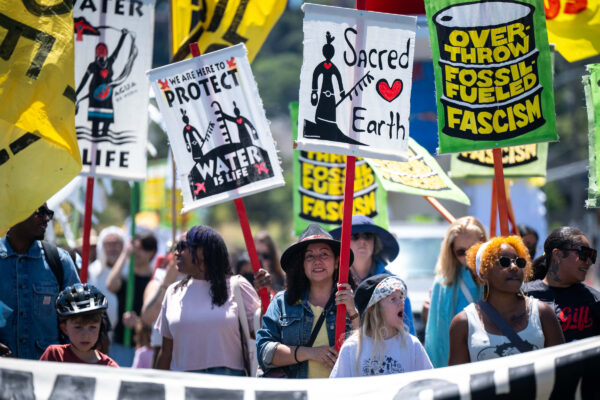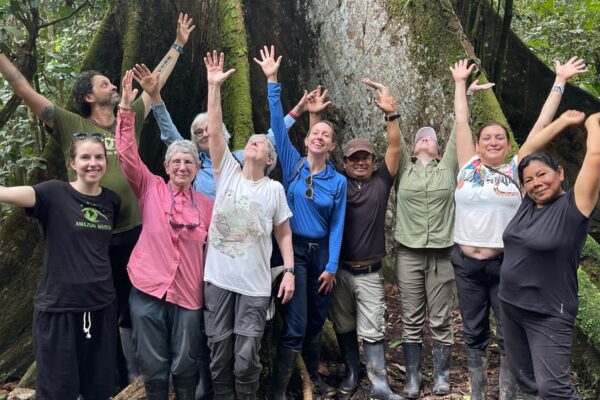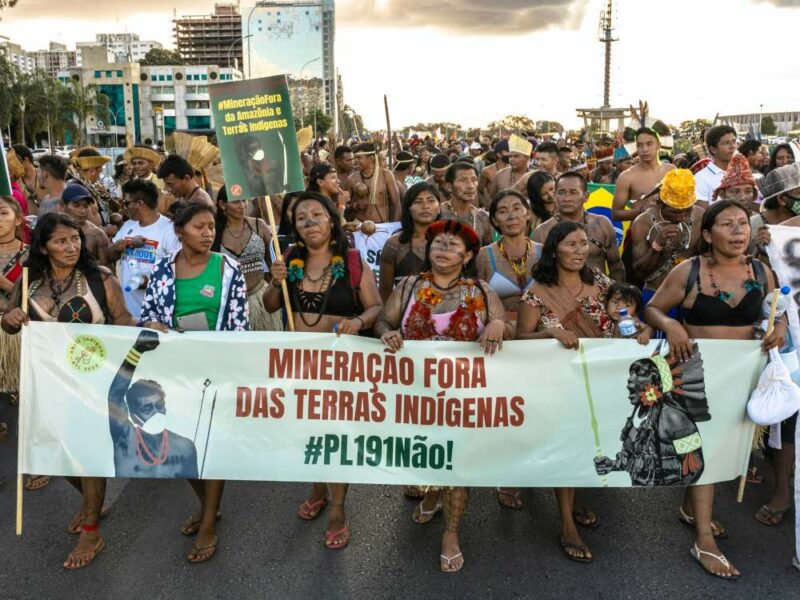

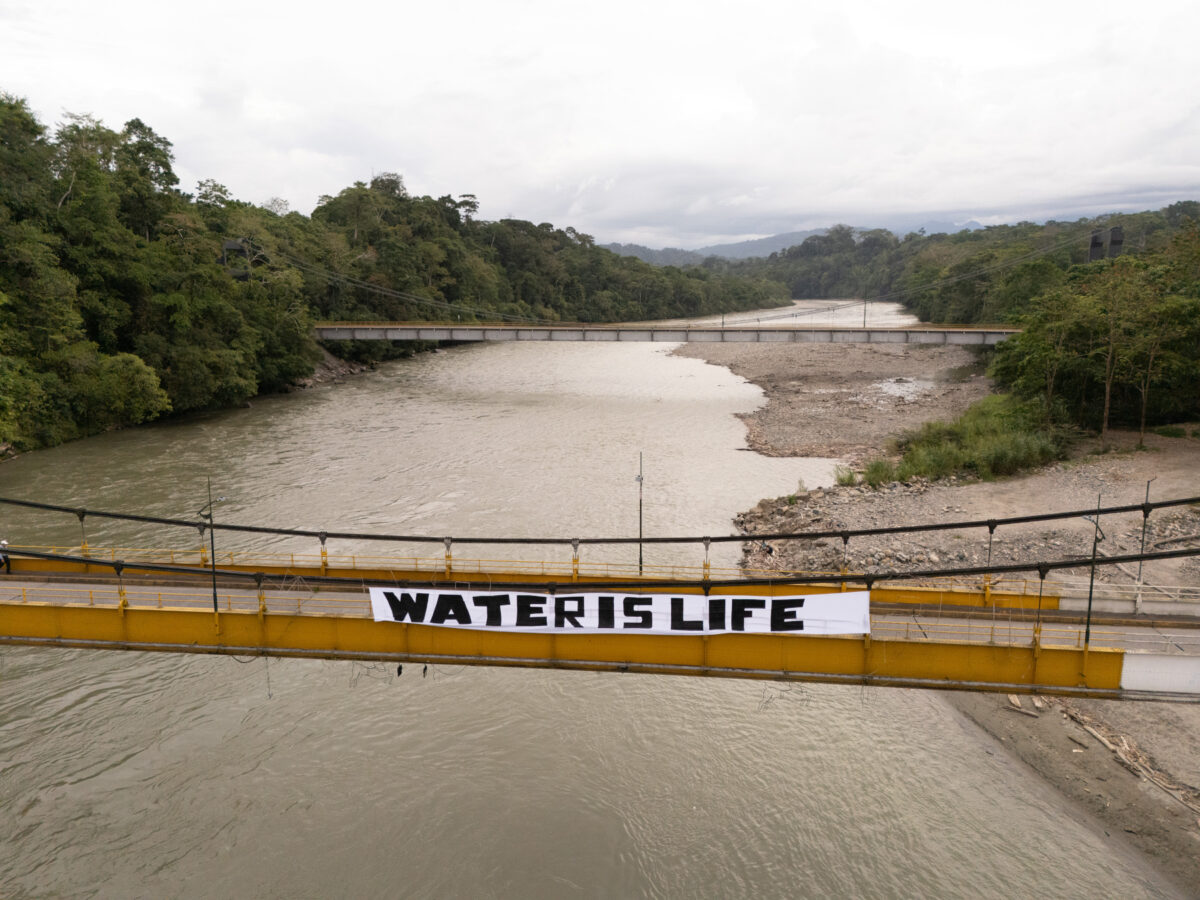
Photos available here (Credit: Karen Toro)
Napo, Ecuador – On Monday, the Federation of Indigenous Organizations of Napo (FOIN), the Kichwa communities of Serena and Tzawata, and social collectives from across the province held an event in defense of their territories as part of the XII Pan-Amazonian Social Forum (FOSPA), taking place in Ecuador from August 16 to 21, 2026.
Held under the banner “Adoke Öme – One Territory, Free from Extractivism,” FOSPA brings together Indigenous peoples, Afro-descendant communities, social movements, and civil society organizations from the nine Amazonian countries – with international allies from more than 25 countries participating. For the first time, Indigenous peoples and civil society organizations are formally co-leading the forum.
On the Jatunyaku River, community representatives unfurled two banners bearing the messages that have echoed for years: “Water is life” and “Love the Amazon.” The action brought together FOIN, the umbrella organization representing Napo’s Kichwa peoples and communities; Serena, a community of the Shakan Amarun Kachi people; Tzawata; and social organizations that defend the Amazon from extractive expansion.
A territory that resists
Serena forms part of a network of seven communities that collectively protect at least 17,000 hectares from mining in Napo. It remains one of the few places in the province where mining companies have failed to gain a foothold That act of resistance gave rise to Yuturi Warmi, an Indigenous guard whose 35 women have since monitored access to the territory.
“We are organizing against the systematic attack of illegal mining. Since the miners arrived, we have lost our sense of peace,” said María José Andrade Cerda, a member of Yuturi Warmi, the Indigenous women’s guard that protects Serena’s territory.
Through the event, FOIN and the participating communities sought to show that alternatives to extractivism exist despite the mining pressure on Napo’s Amazonian territories.
In February 2026, the national government ordered the suspension of mining activities in the province as part of its efforts to combat pollution and illegal mineral extraction. In June 2026, the Armed Forces intervened against illegal activities in the Jatunyacu River sector, within the Colonso Chalupas Biological Reserve, destroying eight dredges and three camps. Nevertheless, illegal mining continues in the province.
“In just three years, everything changed. Mining has poisoned the land. Only contaminated fish remain. People eat them and fall ill every day,” said Yuturi Warmi member Nashly Tanguila, describing the expansion of mining.
The Amazon at a point of no return
For FOIN, Serena, and Tzawata, this activity responds to an alarm that scientific and social organizations place at the center of the FOSPA agenda. Cumulative deforestation has already affected nearly 18% of the Amazon rainforest, while degradation has affected another 38%, according to the Science Panel for the Amazon. Together, these pressures increase the risk of irreversible ecological and social collapse in the region and across the planet.
“We do not set out to conquer, but to connect – so that the world finally hears the voices of the Amazon,” said Leo Cerda, a Kichwa activist from Napo, describing the international significance of the region’s territorial struggles. Serena, Tzawata, FOIN, and the participating social collectives brought that same call to FOSPA.
Organizers selected Serena as one of the venues for the official FOSPA program. Through the event, FOIN, Serena, Tzawata, and the social collectives supporting them called for authorities to prioritize the defense of water and Napo’s Amazonian territories. They also demanded that the province’s suspension of mining activities lead to effective, permanent protection.
“We have identified a legal strategy of dispossession underway in Napo. The Ecuadorian government drives this strategy through its persistent, systematic failure to fulfill its obligations to protect ancestral territories, water, and nature, all of which sustain dignified lives today and for future generations,” said Vivian Idrovo, coordinator of the Human Rights Alliance Ecuador.
Why this matters for climate justice and a just transition
The stand taken by FOIN, Serena, and Tzawata speaks to a tension at the heart of the global climate movement. As governments and industries move away from fossil fuels, growing pressure to extract gold and so-called “critical minerals” is falling on the same Amazonian headwaters and Indigenous territories that help stabilize the regional and global climate. A transition cannot be considered just if it merely relocates extraction onto the lands of communities least responsible for the climate crisis and most essential to addressing it.
The Andes-Amazon headwaters protected by Serena, Tzawata, and neighboring communities sustain biodiverse forests, rivers, and water systems on which the wider Amazon basin depends. Genuine climate justice requires recognition of Indigenous peoples as guardians of these ecosystems and calls for climate finance, legal protections, and free, prior, and informed consent to reach their communities directly.
FOIN, Serena, and Tzawata are calling on the international climate movement to support Indigenous-led territorial defense, make climate policy conditional on respect for Indigenous rights, and invest in community-led, forest-based economies, including ecotourism, artisanal production, and sustainable agriculture, that sustain livelihoods without destroying the ecosystems on which climate stability depends.
Part of a region-wide mandate
The Napo action reflects the broader agenda adopted during FOSPA by the Coordinator of Indigenous Organizations of the Amazon Basin (COICA), its national member organizations, Indigenous peoples, and territorial governments from across the Amazonian countries. Their “Mandate of the Indigenous Peoples and Nations in Puyuk 2026” declares the Amazon in a state of emergency and warns that mining, oil extraction, agribusiness, drug trafficking, infrastructure expansion, and deforestation are pushing the region toward an irreversible point of no return.
Among its central demands, the mandate calls on states, companies, and financial institutions to:
- Guarantee legal recognition, demarcation, and protection of Indigenous territories, and suspend extractive concessions and other threats.
- Respect Indigenous peoples’ right to Free, Prior, and Informed consent and reject its use to legitimize or divide communities.
- Ensure climate and development finance flows directly to Indigenous organizations and their own life plans.
- Protect Indigenous peoples in isolation and initial contact (PIACI), including the intangibility of their territories and the principle of non-contact.
- End the criminalization, violence, and killing of Indigenous authorities, communicators, and territorial defenders.
The mandate also recognizes Indigenous and territorial economies, including chagra farming systems, as alternatives to deforestation and extractivism. It calls for renewable-energy and alternative-economic projects to be developed with and led by Indigenous peoples, rather than imposed on them. Follow-up will be coordinated through COICA and its member organizations, reinforcing the principle voiced on the Jatunyaku River: decisions about Amazonian territories must rest with the peoples who have protected them for generations.
More information on the FOSPA program is available at fospaecuador.com