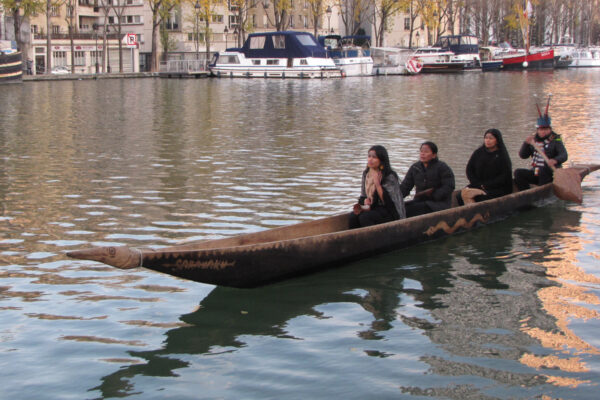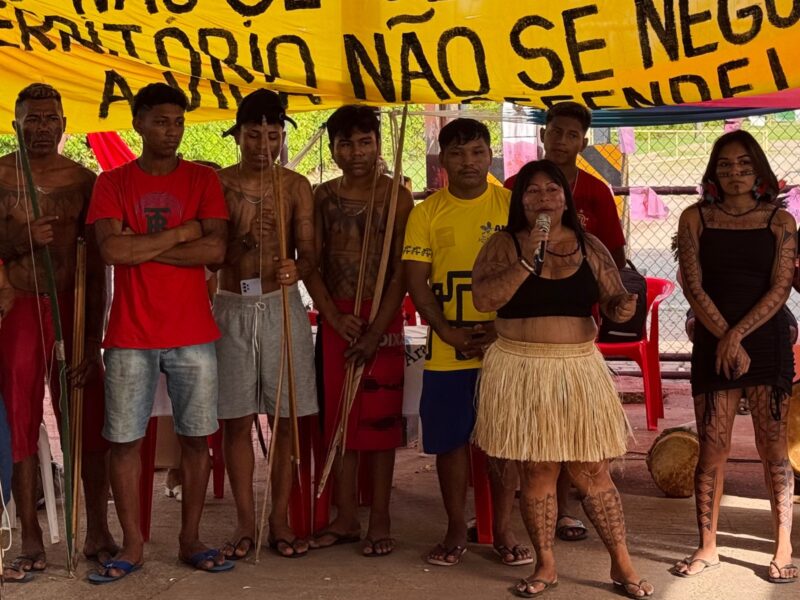


Santarém, Pará, Brazil – Today, 400 Indigenous peoples in four boats intercepted a grain barge on the Tapajós River in the city of Santarém (PA). The peaceful action aimed to draw attention from the federal government and the broader public to the impacts of transforming Amazonian rivers into export corridors. Indigenous protesters approached the vessel on the urban stretch of the river while it was docked at the multinational commodity trader Cargill’s port. The barge is part of the soy supply chain operating through the “Arco Norte” (Northern Arc) logistics corridor. Cargill’s grain terminal has been blockaded by Indigenous peoples since January 22 and today’s action expanded pressure to its riverside loading facilities.
As the police impeded boats from approaching the grain barge, many protesters jumped into the river and managed to board the massive ship, unfurling signs stating “The Tapajós River isn’t for sale” and “Revoke the Decree of Death.”
Indigenous protesters are calling for the repeal of Decree 12,600/2025, which included the Madeira, Tapajós, and Tocantins Rivers in Brazil’s National Privatization Program, as well as the annulment of immediate plans to dredge the Tapajós River. According to Indigenous leaders, Decree 12,600 opens the door to privatizing “navigation maintenance” on Amazonian rivers, authorizing destructive dredging and structural interventions to accelerate the export of commodities such as soy and corn.
“This river is our road. It is our source of food, the home of our fish, and essential to the balance of the forest and the climate. How can this richness be turned into a corridor for soy? And worse, without listening to the peoples who live in and from it? That is why we are here — because we want Brazil to respect ILO Convention 169 and consult us before decisions are made. This decree was signed first, and now they want to discuss how to consult us? That is not consultation; it is an attempt to legitimize what has already been decided. And decided by whom? For whom? To benefit a handful of foreign companies, like Cargill, that profit from human rights and environmental violations in the Amazon,” said Auricélia Arapiuns, a leader from the Lower Tapajós region.
The weeks-long blockade occurs amid the expansion of the Northern Arc logistics corridor, which includes the Ferrogrão mega-railway, planned to greatly increase grain exports via the city of Sinop in Mato Grosso state to the Tapajós River ports in Miritituba, Pará. The auction of the railway’s concession is scheduled for September, despite the project remaining under injunction in Brazil’s Supreme Court.
Impacts of the Northern Arc Corridor
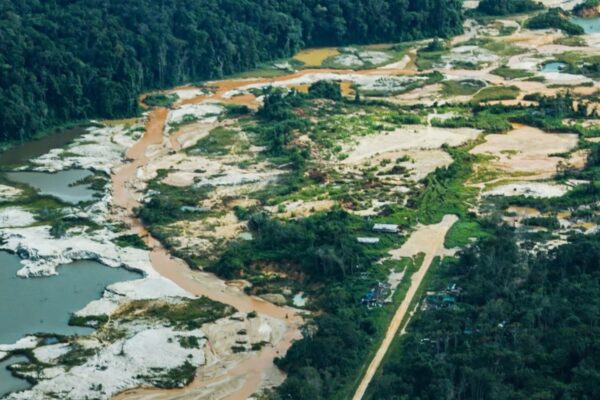
Socio-environmental organizations and studies warn that turning the Amazon’s major rivers into industrial waterways to increase agribusiness profits carries high costs for traditional territories and communities, biodiversity, and the climate. Among the impacts cited are pressure on Indigenous communities, quilombos, and other local communities; land speculation and land grabbing; soy expansion deeper into the Amazon; water contamination; changes in river flow dynamics; and escalating violence along soy transport routes.
For Alessandra Korap Munduruku, a leader from the Middle Tapajós region, the impacts are already being felt. In front of the Praia do Mangue Indigenous Reserve, irregular ports and soy silos have displaced fish populations and polluted waters used by Munduruku communities.
“With the increase in soy exports through the Tapajós came more dredging, more ports, and heavier barge traffic. We are already seeing fish with abnormalities, fish disappearing, fish contaminated, with their bellies full of grain. While outsiders focus only on the economy, they forget about food security. If this expands, that poison will increasingly enter the food chain of nearby cities,” warned the 2023 Goldman Environmental Prize winner.
Maria Leusa Munduruku highlighted the natural limits of Amazonian rivers, which she says are being disregarded by dredging operations that alter their natural flow. “The river has its own timing — its flood season and its dry season. When they deepen, widen, and force navigation year-round, they break that cycle. Our people have always taught that we must respect the river’s limits. When those limits are ignored, extreme droughts and imbalance follow. And in this case, it is not only the Tapajós that suffers, but the entire region,” she said.
“It is essential to take a critical look at the cumulative impacts of the Northern Arc project. Ferrogrão, the expansion of private grain ports, and the Tapajós waterway together could increase soy volumes by five to seven times, intensifying pressure on traditional territories. The consequences go beyond impacts on the Tapajós River, driving further deforestation and threatening Brazil’s own climate commitments to reduce forest loss,” said Renata Utsunomiya, transportation policy analyst at GT Infraestrutura, a coalition of civil society organizations.
Peoples from the Madeira, Tocantins, and Xingu Basins
This week the Cargill blockade, led by Indigenous peoples from the Tapajós River, gained reinforcements from Kayapó and Panará contingents that traveled from the Xingu River basin in Mato Grosso and Pará, bolstering their numbers to 1,200 and broadening the representation of the region’s Indigenous peoples. The mobilization is also backed by Indigenous peoples and social movements from the Madeira and Tocantins, whose rivers are also threatened by Decree 12,600.
The presence of peoples from the Xingu underscores that this conflict extends beyond the Santarém blockade. In Mato Grosso, there is growing concern over soy expansion near Indigenous territories, especially following the recent slashing of the Amazon Soy Moratorium. The Panará people also carry the historical trauma of the Cuiabá–Santarém highway construction, which led to the death of 66% of their population, according to Brazil’s National Truth Commission.
“We are not here only for the Tapajós, but against the privatization of Amazonian rivers. The soy advancing around Capoto-Jarina territory is pushed along the BR-163 highway and down the Tapajós. If the government privatizes these rivers, it accelerates the same machinery that threatens our territories. That is why we have come to stand with the Tapajós,” said Takakpe Mektutire of the Raoni Institute.