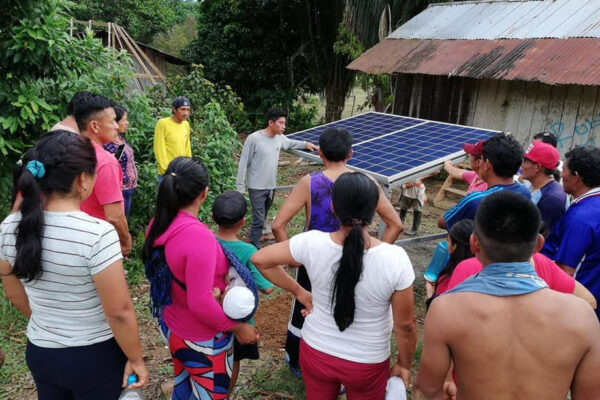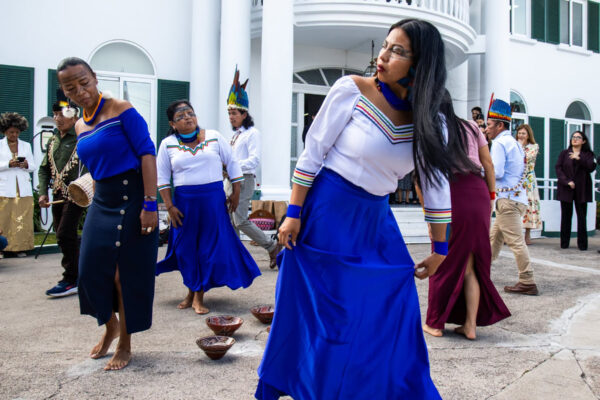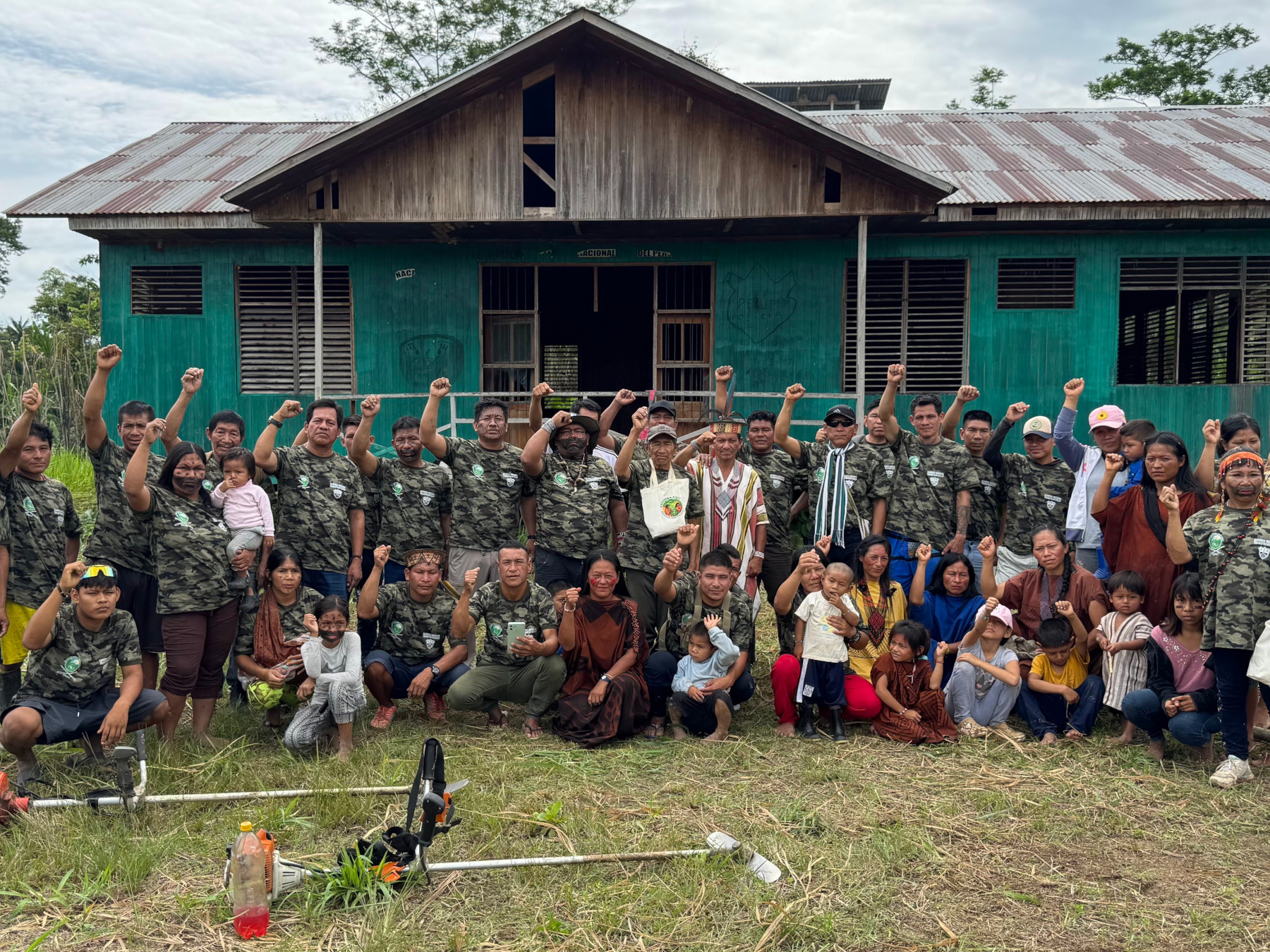

This month, Amazon Watch and the Autonomous Territorial Government of the Chapra Nation (GTANCH) fulfilled a dream years in the making. Working alongside GTANCH president Olivia Bisa, we brought solar energy, freezers, and internet connectivity to 12 communities across Chapra territory, reaching in Olivia’s own words, “80 percent of their territory.” In a region facing mounting pressures from extractive industries and organized crime, this is a meaningful and hard-won achievement – one that helps secure not only the Chapra territory, but the future of the Amazon rainforest.
Our relationship with Olivia and the Chapra people began with an oil spill. In September 2022, the North Peruvian Pipeline, owned by the state oil company Petroperú, ruptured due to corrosion, spilling hundreds of barrels of oil right into Chapra territory, contaminating the streams and lagoons that families depend on for water. Olivia sought allies to report what had happened and demand reparations, and that is how our partnership began. But as we worked together, more fundamental needs came into focus. To document violations, call for help, and tell the world what was happening to their lands, the Chapra people needed connectivity and the means to strengthen and diversify their food sources.
New challenges compound this. The El Niño phenomenon and the broader impacts of climate change cause fires and droughts that must be monitored and reported in time. Throughout the Amazon, illicit economies – illegal mining, illegal logging, drug trafficking – are advancing faster than Indigenous peoples’ capacity to stop them, expanding into the most isolated and least monitored areas of the forest. Chapra territory is no exception. To the historical threat of oil, add now the rumors of illicit mining and the increasingly frequent presence of illegal loggers. In the face of this advance, solar energy and internet access are not a luxury, but a concrete tool for territorial protection.
A journey few make
Reaching Chapra territory is not easy. From Lima, Peru’s capital, we flew to Tarapoto, one of the country’s major Amazonian cities. From there we took a propeller plane belonging to the armed forces directly to San Lorenzo, the gateway to the territories of seven Indigenous nationalities, including the Chapra. Seats on the flight are hard to come by, but securing one saved us a 16-hour journey by road and river to San Lorenzo, a route we nonetheless would still have to make on the way back.
In San Lorenzo, we met Olivia and the installation team before setting out on a 10-hour river journey to the first community where we would spend the first night, staying at Olivia`s family’s houses. The next morning we continued, another 10 hours by river to the community where the next installation of the project would take place.
For us, it was an extraordinary journey. For Olivia, this is a monthly journey. Her life flows constantly between very different needs such as, attending to the communities that make up her nation in the rainforest, handling matters in the provincial capital, traveling to Lima for national advocacy events before the State, and reaching international spaces, such as shareholder meetings of banks that invest in Amazonian oil or climate summits. It is precisely that distance – geographic, but also informational – that makes this installation so important. For the first time, Olivia will be able to maintain ongoing coordination with the leaders across her territory without having to make the journey herself.
A river that grows smaller and smaller
The Chapra people have lived in relative isolation for generations. They are known as fierce people; even neighboring nations treat them with great respect, a legacy of wars fought in the past. Colonization never fully conquered the Chapra territory, although oil and religion did impact in the second half of the 20th century. Yet to this day, the Chapra people safeguard a vast expanse of the Peruvian Amazon, where the richness of nature still abounds, despite multiple threats. Olivia says: “We have practiced territorial control for thousands of years, and keep doing that today. But since the oil companies came they have started dividing us”.
The river transformed as we traveled with a wide channel becoming a narrow one, then a stream, then smaller still, the forest pressing closer on both sides. Along the way we were offered abundant food – various wild game animals, fish, wild sprouts. At night, the sky filled with stars, dense, unlike anywhere else. Here people speak mainly Chapra. There are no stores and no plastic. There are soccer matches and community celebrations – the day after the installation, the men of the community went into the forest to hunt; returning with meat to eat at a community lunch, celebrating the arrival of electricity, the freezers, and connectivity.
What being connected means
The need for connectivity is felt in the most urgent and ordinary moments alike. A mother from the community described it plainly: when her children go to school in the neighboring community, she has no way of knowing whether they arrived safely. The community chief Tito James Chico says: “Children could even die, because we could not communicate about any emergency.” Teacher Mariano Tetarico Zunca stated: “We never understood why there was never support for us. With the internet we can do so much more in terms of learning.” Educational needs became especially dramatic after nearly two years of lost classes during the pandemic. Olivia sees it all and looks beyond it. “My dream is to have Chapra professionals, especially women, who can work for the future of our people.”
For Olivia, connectivity is also a tool for territorial control. With around 80% of Chapra territory now online, communities can coordinate in real time and report threats the moment they emerge while no longer waiting days or weeks for someone to travel out and raise the alarm.
“Since I was elected president of the Chapra Nation, I realized that the main problem we had to solve was the lack of communication. In our territory, having internet access saves lives. It helps us communicate when there are medical emergencies. It opens up the possibility for our young people to prepare to be admitted to universities. It helps our patrols be better coordinated when we face invasions by illegal loggers.”
Olivia Bisa
In addition to connectivity, one of the priorities that the Chapra Nation identified was the need for fish refrigeration as a key tool for families’ food security, and for being able to participate in the local economy under fairer conditions. For families whose food security depends on the river, and for women already running their own fish-farming projects as alternatives to environmental destruction, the absence of preservation has long meant loss of food and income. Solar-powered freezers allow the fish to stay fresh and women-led economic initiatives gain the foothold they need to grow.
Twelve communities, one territory
Through Amazon Watch’s Power to the Protectors program, together with our renewable energy partners the Inter-American Institute for Clean Energy, EKOenergy, and Empowered by Light, we completed our seventh community solar project in the Amazon – bringing solar energy, freezers, and satellite internet to 12 communities of the Chapra Nation. The project will be presented at the General Assembly of the Chapra people, where collective decisions are made to seek agreement on its use and raise awareness of its risks.
Amazon Watch does not simply fund solar projects and move on. We accompany Indigenous peoples so that they can put their own solutions for territorial protection and self-determination into practice. In a territory that has faced the oil industry up close – an unresolved spill still awaiting reparation, the threat of new drilling within Lot 64, and the ongoing tension of unresolved land titling – solar panels and internet give the Chapra Nation concrete tools to keep defending their territory, strengthen their economy, and decide their own future on their own terms. Olivia says: “We have risked our lives to evict loggers, act against oil damage or mining invaders. Now, for the first time, we can all react together against the threats against our territories, as we are connected by the internet.”