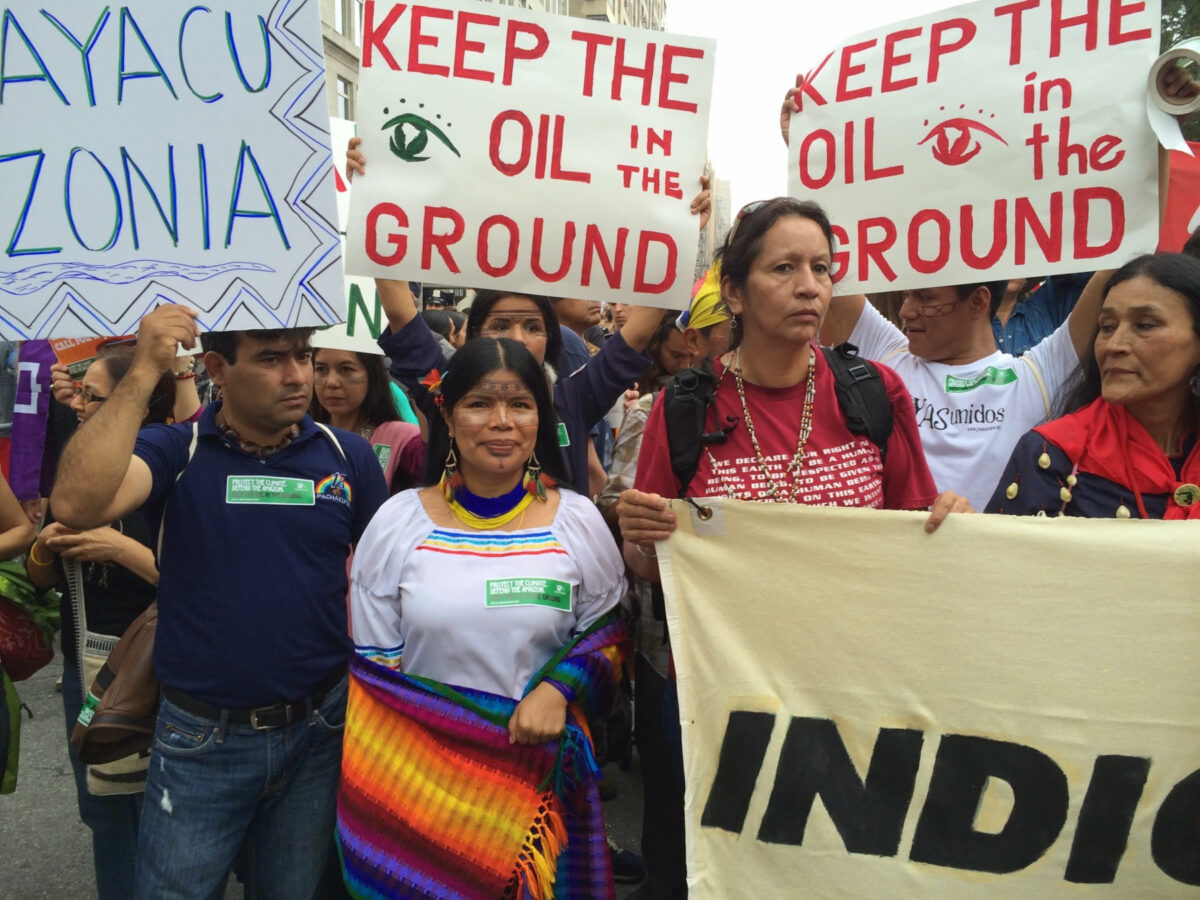
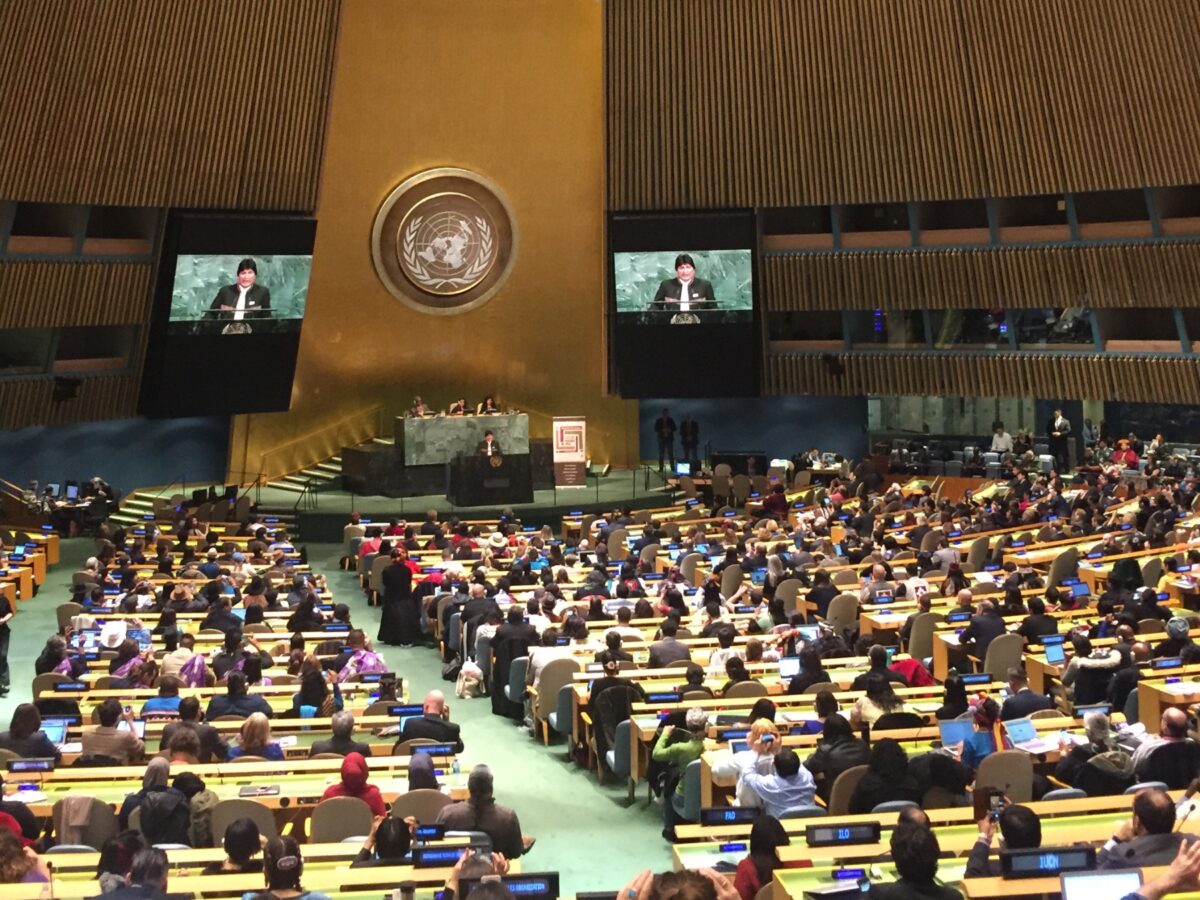
An urgent message is traveling from the Amazon to the United Nations. This week, Amazon Watch will accompany a delegation of Indigenous leaders from Peru and Ecuador to New York for the United Nations Permanent Forum on Indigenous Issues (UNPFII). As part of our Amazon Crime campaign, which works to strengthen Indigenous defense against illegal economies.
Just weeks ago, Indigenous peoples from Brazil, Colombia, Ecuador, and Peru gathered in Pucallpa to confront a rapidly escalating crisis: the expansion of organized crime into Indigenous territories, and the failure of militarized state responses to stop it. Today, criminal networks affect 67% of Amazonian municipalities and have placed 32% of Indigenous territories under dispute between armed actors.
Together, Amazon Watch and more than a dozen Indigenous organizations, including the Coordinator of Indigenous Organizations of the Amazon River Basin (COICA), are launching a new Pan-Amazon report. Amazon Under Siege: How Crime and Militarization Threaten Indigenous Peoples, produced with Indigenous organizations from five countries and a network of independent journalists and researchers, offers one of the most comprehensive analyses to date of how organized crime is transforming the Amazon. Focusing on seven territories across the region, it documents how illicit economies – illegal gold mining, narcotrafficking, logging, and trafficking networks – have evolved into interconnected systems that control land, reshape local economies, and drive unprecedented violence. Since 2012, at least 296 defenders have been killed in the Amazon, with Colombia and Brazil among the most dangerous countries in the world for those who defend it.
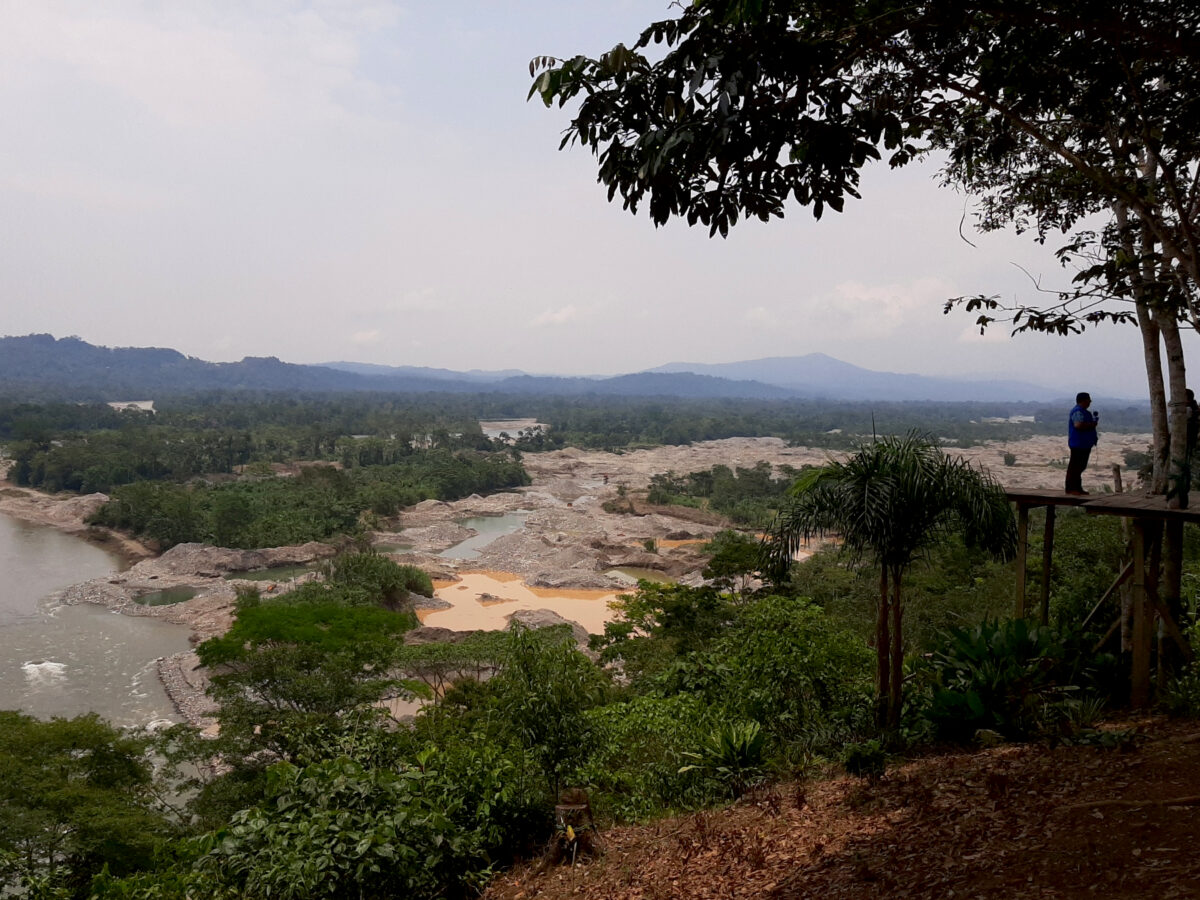
In many areas, criminal networks have established their own forms of governance – regulating movement, controlling rivers and roads, extracting resources, and imposing coercion that undermines both state institutions and Indigenous authority. These dynamics are not isolated incidents. They are deeply embedded in global supply chains, driven by international demand for gold, timber, and drugs, linking violence in the Amazon directly to markets around the world.
Throughout the UNPFII, Amazon Watch and Indigenous leaders will engage with diplomatic missions, the UN Special Rapporteur on the Rights of Indigenous Peoples, and the United Nations Office on Drugs and Crime (UNODC), pushing for Indigenous peoples to be placed at the center of global strategies on security, environmental protection, and organized crime, ahead of the upcoming global conference on Transnational Organized Crime in Vienna.
Indigenous Peoples on the Front Lines
In February 2026, more than 60 Indigenous leaders convened in the Peruvian Amazon to confront the growing convergence of organized crime, extractive pressures, and territorial violence. What emerged was the Pucallpa Declaration – a collective call to defend life, their cultures, Indigenous territorial autonomy, and the future of the Amazon.
Indigenous territories are among the most biodiverse and best-preserved ecosystems remaining on Earth, yet they are increasingly in the crosshairs of criminal networks. Communities face displacement, contamination of rivers, threats, and the assassination of leaders defending their lands.
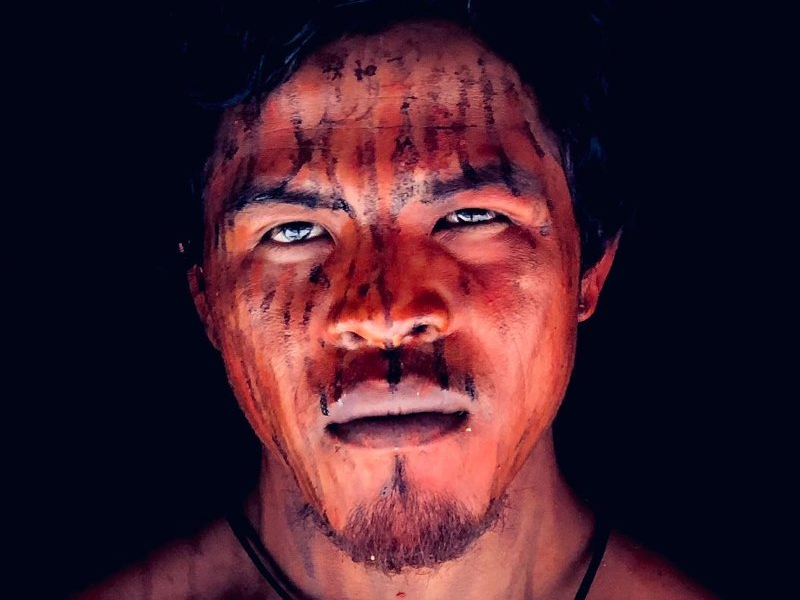
Women, children, and youth bear a disproportionate burden, facing heightened risks of violence, exploitation, and recruitment. Indigenous Peoples in Isolation (PIACI) face existential threats to their survival. And transboundary Indigenous nations are particularly vulnerable as criminal networks exploit porous borders. “The very survival of our peoples is at risk,” warned one leader during the Pucallpa meeting.
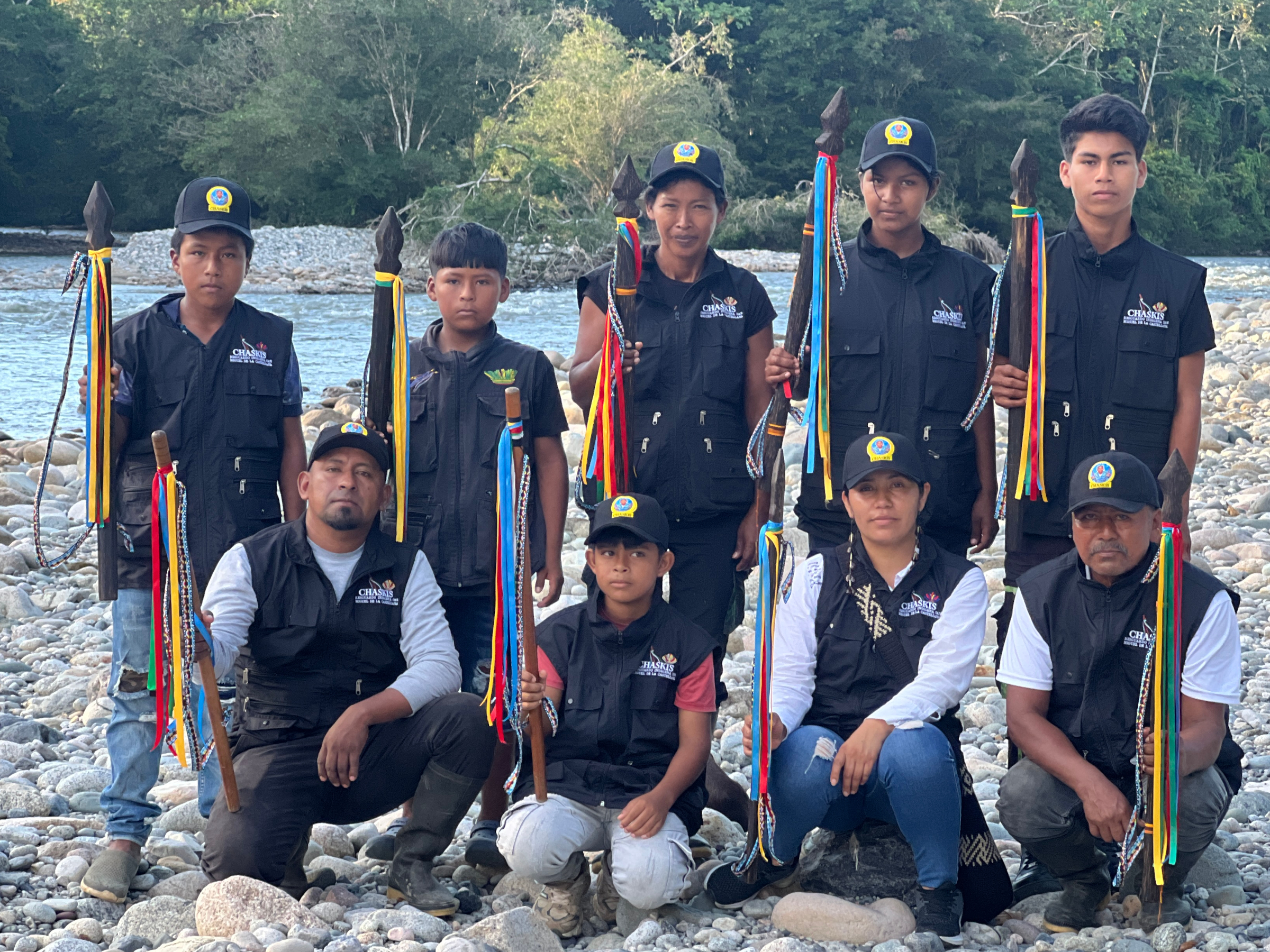
Yet Indigenous peoples are not passive victims. Across the Amazon, they are building their own systems of territorial governance – strengthening community monitoring, Indigenous guards, and autonomous governments that represent some of the most effective and legitimate forms of territorial control in the region. But this resistance comes at a cost. As these efforts collide with powerful armed actors and networks of state corruption and complicity, defenders face violence, threats, and assassination. The Amazon has become one of the most dangerous places on Earth for environmental defenders and Indigenous leaders.
Beyond Militarization: A Different Path Forward
The report exposes a central contradiction: while organized crime has become more complex and entrenched, state responses remain narrowly focused on militarization and short-term enforcement, strategies that have repeatedly failed.
Militarized responses fail to address the structural drivers of illicit economies – inequality, lack of territorial rights, corruption, and global demand. In many cases, they exacerbate violence, criminalize communities, and weaken Indigenous governance, while criminal networks simply adapt and re-emerge. The result is a cycle of ineffective intervention and worsening crisis. Indigenous leaders are demanding a fundamental shift – away from militarization and toward approaches grounded in rights, autonomy, and territorial governance.
The Pucallpa Declaration: A Call to Action
The Pucallpa Declaration lays out a path forward grounded not in militarization but in rights, autonomy, and Indigenous leadership. Its demands are straightforward. Indigenous self-determination and territorial control are essential to confronting organized crime. Protection must be collective and rooted in Indigenous governance systems. States must treat Indigenous authorities as partners, not subordinates, in matters of security and governance. And Indigenous economies must be supported as viable alternatives to illicit markets.
The declaration also calls on governments and the international community to address corruption, protect defenders, and guarantee Indigenous participation in all policies affecting their territories. Underlying every demand is a single truth. “The defense of territory is the defense of life.”
Bringing Amazonian Realities to the Global Stage
At the UNPFII, Indigenous leaders will challenge the international community to rethink its approach to organized crime, climate, and security in the Amazon. There can be no effective strategy to confront organized crime, and no viable path to climate stability, without recognizing and strengthening Indigenous governance and economies. The international community has long known this. The question is whether it will finally act on it.
The Amazon is at a crossroads. As criminal networks tighten their grip and militarized responses continue to fail, Indigenous peoples remain the most effective and legitimate defenders of the forest. Their leadership is not a complement to global climate and security strategies but the foundation upon which they must be built.