

Last year, Indigenous leaders, climate defenders, and allied movements secured important advances in visibility, coordination, and political pressure during the 30th United Nations Climate Change Conference (COP30) in the Brazilian Amazon.
Yet they also witnessed the failure of governments to reach meaningful agreements on a global phaseout of fossil fuels within the COP framework. At the same time, a new diplomatic pathway began to take shape beyond those limits, as 24 countries stepped forward to signal their willingness to move toward a coordinated transition away from fossil fuels. This opening did not emerge from political convenience, but from sustained pressure by frontline communities defending their territories and advancing real solutions where governments have hesitated to act.
Indigenous peoples have demanded for decades that governments come together and commit to getting off fossil fuels. The First Conference on Transitioning Away from Fossil Fuels, taking place later this month in Santa Marta, Colombia, is a manifestation of that demand – a recognition that the warnings of frontline communities can no longer be ignored. For Amazon Watch and our Indigenous partners, who have spent decades fighting to end the extraction of Amazon crude oil, this conference is a critical opportunity to demand real accountability from the governments, industries, corporations, and world’s biggest banks that continue to double down on fossil fuel expansion, driving the destruction of the Amazon and locking in decades of future emissions.
A Transition Without Justice Is Not a Solution
Co-hosted by the Netherlands and Colombia, the willingness of more than 40 countries to gather in Santa Marta is a meaningful sign. But willingness alone is not enough.
In the Amazon, Indigenous peoples have borne the cost of oil extraction for generations. Their rivers have been poisoned, their forests fragmented, and their rights violated, all while contributing the least to the climate crisis. Any global plan that fails to center their leadership, meet their demands, and respect their rights, is not a solution. It is a continuation of the problem.
The story of Block 64 in the northern Peruvian Amazon illustrates this reality with painful clarity. Covering more than 760,000 hectares, the block overlaps with the territories of Indigenous communities who have opposed oil development there for three decades. Their position has always been the same: they were never properly consulted.
Despite ratifying ILO Convention 169 in 1994, committing to seek Free, Prior, and Informed Consent before decisions affecting Indigenous peoples’ lands, the Peruvian government ignored its own obligation, granting the concession the following year without any consultation. In 2011, Peru’s own Constitutional Court confirmed what Indigenous communities had always maintained, that Block 64 was granted without proper consultation in direct violation of their rights.
After a succession of private companies exited the block under pressure, the government handed operations to Petroperú – ensuring that the same government obligated to protect Indigenous rights is now the one violating them.
“For many years, we have stood alert and resisted every attempt by the Peruvian government and Petroperú to encroach on our territory. We are making a difference, and we will not stand idly by in the face of any activity that threatens our territories and our way of life.” – Olivia Bisa Tirko, President of the Autonomous Territorial Government of the Chapra Nation
The Amazon Cannot Be Sacrificed
The Amazon is a living system, home to Indigenous nations and one of the most important regulators of the Earth’s climate. And yet it is still being treated as expendable. Even as this global conference is convened, the contradiction between global rhetoric and national action could not be starker. Ecuador and Peru, two Amazon nations teeming with biodiversity, continue to push forward with plans to expand oil drilling in the Amazon, overriding both Indigenous opposition and, in Ecuador’s case, ignoring a democratic referendum in which citizens voted to keep 847 million barrels of oil in the ground underneath Yasuní National Park. The world’s largest fossil fuel producers – the United States, Saudi Arabia, Russia, China, and India – are absent from Santa Marta entirely, leaving the burden of leadership to fall on the nations that have contributed least to the crisis and stand to lose the most. All the while, international financing continues to fuel expansion, tying economies to fossil fuels and turning ecosystems and Indigenous territories into sacrifice zones for profit.
The consequences are already visible. For three years running, humanity has lived through the hottest temperatures ever recorded, while the Amazon, the most biodiverse biome on Earth, has been gripped by extreme drought, with its rivers at record lows. Scientists warn that large swathes of living forest could shift to degraded savanna, accelerating the climate crisis beyond our ability to contain it. The window to protect the Amazon, and stabilize the climate, is closing.
Indigenous Leadership Must Be Central
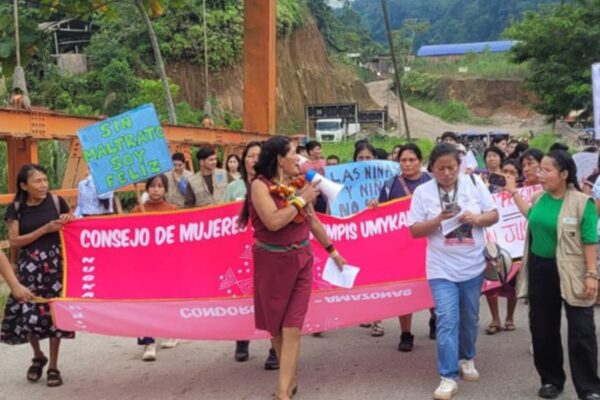
Across the Amazon, Indigenous peoples are leading the fight to keep oil in the ground and defend their territories. They’re winning legal battles, organizing resistance, and putting forward real solutions grounded in stewardship, not extraction. That is why their presence in Santa Marta is essential.
“We will always defend our territory, even if it costs us our lives. We want zero oil extraction. We will continue to stand and fight. Our elders always cared for our territory, and we will continue to protect and defend it for future generations.” – Marcelo Mayancha, President of the Shiwiar Nationality of Ecuador.
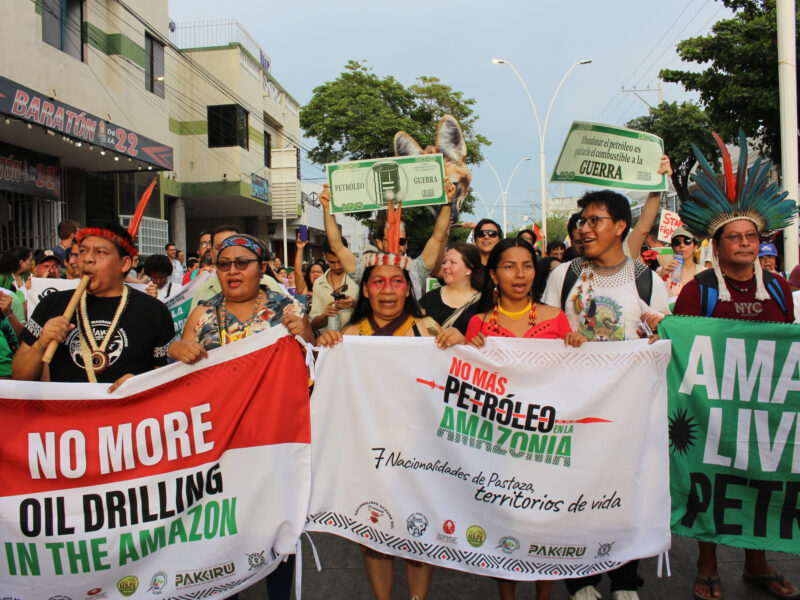
The conference includes spaces for Indigenous peoples, civil society, and grassroots movements, alongside high level events, as well as a People’s Assembly, a broader People’s Summit, and mass mobilizations in the streets in the days leading up to the high-level talks. These spaces are where the real pressure for change will come from.
Amazon Watch will be in Santa Marta alongside Indigenous leaders and frontline allies from across the Amazon basin because this moment demands it. We will accompany Indigenous leaders who are risking everything to defend their lands from oil expansion. We will amplify their demands so they cannot be ignored. We will push for a rights-based, just transition that keeps fossil fuels in the ground. And we will confront governments and financial institutions that continue to enable destruction.
A Moment of Reckoning
The Santa Marta conference could help shift the global conversation. It could build momentum toward a real phaseout of fossil fuels. A just transition must respect Indigenous rights, including Free, Prior, and Informed Consent. It must provide real reparations and remediation for impacted communities, bring an immediate end to fossil fuel expansion in critical ecosystems like the Amazon, and guarantee that frontline communities have real power in shaping climate decisions. That is why our End Amazon Crude campaign exists, to confront the companies, financiers, and governments driving this destruction, and to support the Indigenous leaders who are fighting to stop it.
The First Conference on Transitioning Away from Fossil Fuels will not determine the fate of the forest alone, but it will reveal something important: whether world leaders are finally ready to make the decisions that matter, or whether they will once again choose words over action. The Amazon cannot wait much longer for an answer.