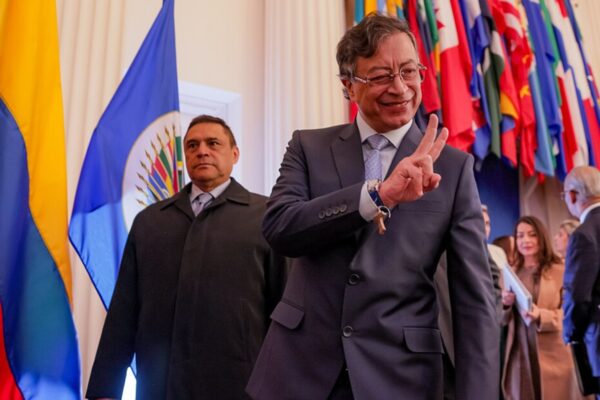

Washington, DC – Yesterday’s meeting between Colombian President Petro and Donald Trump offers hope but doesn’t guarantee an improvement in the relationship between the two leaders. It provided proof of the importance of interpersonal dialogue to resolve differences and ideally achieve more equitable relationships between the two countries. To this effect, Petro demonstrated international leadership not only for Colombia but for Latin America as a whole.
We appreciate President Petro’s insistence to find solutions to the global climate crisis. During the meeting, he offered to export clean energy from La Guajira for the reconstruction of Western Venezuela. Knowing the problematic history of wind farm mega-projects in that state, we underscore the importance of strict respect for human and territorial rights of impacted Indigenous Peoples, in this case the Wayuu People.
Regarding drug trafficking, Petro emphasized the need to pursue the main drug capos that don’t live in Colombia, along with the ineffectiveness of attacking small-holder peasants who cultivate coca leaves out of desperation.
Given that the organized crime mafias operate across borders, governments also need to cooperate to create a multinational response, for example between all the governments of the Amazonian countries. Beyond drug trafficking, they should address other illicit economies like gold mining and illegal logging. Consumer countries like the United States also must effectively implement harm-reduction policies to address demand for cocaine and other narcotics.
Colombia must continue to implement pragmatic and innovative crop substitution policies on the ground, as only through local community governance can security and economic alternatives be created. We insist on the centrality of individual and collective protection for social leaders, environmental activists, and human rights defenders for any effective strategy against environmental crimes.
An apparent “friendly vibe” during the meeting notwithstanding, the threat to Colombia posed by the Trump Administration is still latent through potential intervention in May’s presidential elections. The Monroe Doctrine remains a central pillar of U.S. national security strategy, and the Trump Administration will continue taking advantage of any opportunity to impose their geo-political and corporate interests on the hemisphere.