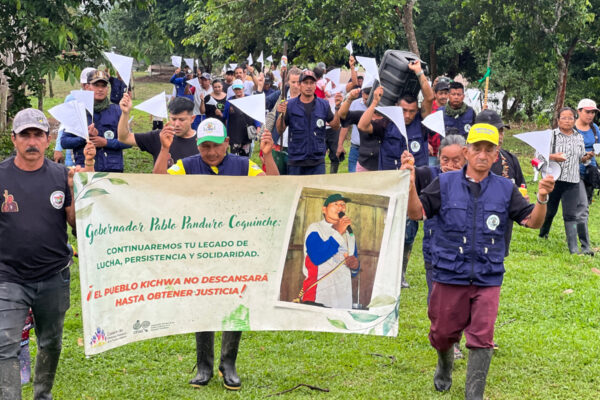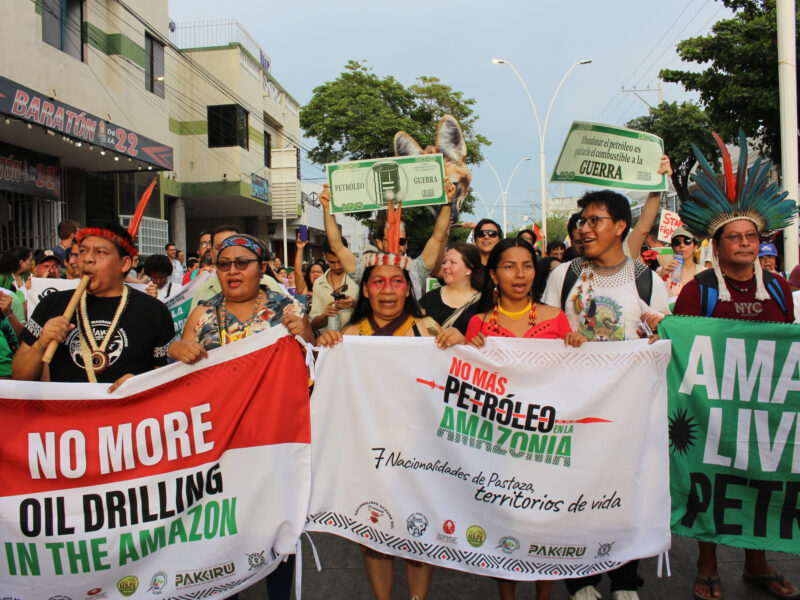

Quito, Ecuador – Indigenous communities and civil society have taken to the streets, now mobilizing in Quito since the launch of the “Paro Nacional,” or national strike, on June 13, 2022. A state of emergency – suspending multiple constitutional rights such as the right to assemble and allowing the police and military to use force with impunity – is in place across six northern provinces and Quito, and government repression continues. The government of Guillermo Lasso has encouraged counter-protests and marches and fanned flames of vigilante violence against those protesting the economic and social inequities exacerbated by the pandemic and years of the country’s economic dependence on the exportation of natural resources. Over the course of the mobilizations, protesters have also been subject to racial slurs and harassment.
Photos and videos of strikes in Ecuador
Leila Salazar-López, Amazon Watch Executive Director said, “Amazon Watch condemns the violence and calls on the international community to uplift demands from Indigenous communities and civil society to address economic inequities and end oil and mining extraction on Indigenous lands. Three lives have been lost – one killed by police in a video captured by protestors. The government must conduct a thorough investigation and the police must deescalate the violence, not fuel it. We call on President Lasso to cease the repression and violence against protestors.”
From June 13-22, the Alliance for Human Rights in Ecuador, of which Amazon Watch is a member, has reported 94 arrests (many of them without formal charges), 92 injuries, and 3 disappearances. Ecuadorians operating as vigilantes have also begun to kidnap protesters and turn them into the police. Three people have died, one person was found dead last night at 3 am and one was murdered by police according to video evidence.
The police are claiming that one of the young people, Byron Guatatuca, died because they were holding an explosive that went off. But the video footage is irrefutable (available unlisted for use by press only) and shows the police firing tear gas canisters at the crowd and directly at the deceased. In the video, several eyewitnesses can be heard yelling at the police, “You killed him!” The CT scan images and hospital records have since confirmed that the tear gas launched at his head was the cause of his death and that the police’s version of events is not corroborated.

Kevin Koenig, Amazon Watch Climate and Energy Director said, “We denounce the excessive force being deployed against civil society protests and we are in solidarity with the Indigenous communities and civil society demanding action from their government. President Lasso must respond to their long-term demands: No more mining or oil extraction expansion. Expansion not only goes against scientific consensus to avert the worst of the climate crisis, but the country’s dependence on extractive commodities has only led to a downward spiral of debt and dependency. Attempts to drill its way to prosperity over the last several decades has not alleviated poverty – it has exacerbated it.”
The current National Strike is in response to a dialogue held in 2021 between Ecuador’s Confederation of Indigenous Nationalities of Ecuador (CONAIE) and the Lasso administration over key issues of economic inequity, rising fuel prices, extractive industry expansion on Indigenous territories, neoliberal economic reforms, rights violations, among others. But after 8 months of inaction during which disparities were amplified by the ongoing global pandemic, CONAIE called for action.
“Right now, the entire world is feeling the economic injustices and pressure from global inflation, even in the Amazon. It’s our responsibility to build empathy, social consciousness, and solidarity among the international community for Ecuador. This is an uprising for economic justice, not unlike what we saw this past weekend in the UK,” shared Sofía Jarrín Hidalgo, Amazon Watch Ecuador Advocacy Advisor. She continued, “We are witnessing a human rights crisis being escalated by the Ecuadorian government, and the international community cannot diminish this movement to riots about oil prices – we reject this narrative. We need a just transition away from all fossil fuels. The price gouging by the oil industry and the increases in the cost of living are global issues. Other countries, like the U.S., rely on oil and mining commodities from Ecuador and must speak up for human rights and end their complicity as consumers.”
The United Nations, the Organization of American States, and over 300 institutions have also called on the government to deescalate the situation to reach an agreement with Indigenous leaders.
Background
What began as a strike blocking a handful of roads quickly escalated to a national uprising after government forces violently cracked down on Indigenous peoples in the streets exercising their right to protest as protected by the country’s constitution, and the Lasso administration’s illegal detention of CONAIE president Leonidas Iza within the first 24 hours of the strike. Iza’s targeted arrest and illegal detention sparked an increase in mobilizations toward Quito. Shortly after his release, Iza’s car was shot at by armed actors of unknown origin.
Ecuador’s constitution provides the inalienable right to protest and resist, and human rights organizations are uniting to denounce the violence and call on Lasso to respect Indigenous communities’ right to protest and not be attacked by police. The Lasso administration has also encouraged sympathizers to take to the streets in counter-protests, which has exacerbated the conflict. Swarms of vigilantes have been recorded via videos provided by Indigenous protestors. Non-Indigenous Ecuadorians are actively attacking Indigenous peoples and civil society on behalf of the government. The country is facing increasing unemployment affecting all Ecuadorian citizens.
Ecuador is saddled with $65 billion in public debt, much of which is in oil-backed loans from China. The country is facing default on an estimated $17 billion in bonds, while the tourism industry–a major source of non-commodity revenue–has dried up. Because the country operates on the U.S. dollar, its economic flexibility is further constrained, leaving it few options to provide public health and economic resources to Ecuadorians during the COVID-19 crisis.
Many of the loans that have trapped Ecuador into a downward spiral of debt and dependency for decades – and locked the country into export-driven commodity extraction – came via structural adjustment packages, pro-industry regulatory capture, and bailouts from the country’s previous economic and political turmoil.
Economic support for Ecuador to weather this crisis must include debt relief and forgiveness, not just new loans. Traditionally Ecuador hasn’t qualified for these types of packages because international funders deemed the country too rich in mineral wealth.
For a place that holds some of the most biodiverse tropical rainforests on the planet, essential for climate change mitigation, and home to people living in voluntary isolation, cancelation of debt or a debt swap with its largest creditors, like China, is essential. Given the climate crisis and the need for a rapid phase-out of fossil fuels, Ecuador needs global support to keep its billions of barrels of oil in the ground and shift to a post-petroleum economy.