
Quito, Ecuador – Ecuador’s government and oil executives are gathering today for the XXI Encuentro Anual de Petróleo y Gas (ENAEP 2026), the country’s premier oil and gas summit, to push for new investment, increased production, and favorable regulatory conditions for Ecuador’s oil sector. But the planned 2026 Amazon oil auctions have yet to launch. The proposed blocks, located deep in the Ecuadorian Amazon, overlap the territories of seven Indigenous nations who say the delay exposes the fundamental challenges facing the government’s plans: decades of Indigenous-led opposition, high development costs, uncertain returns, and significant legal, operational, and environmental risks.
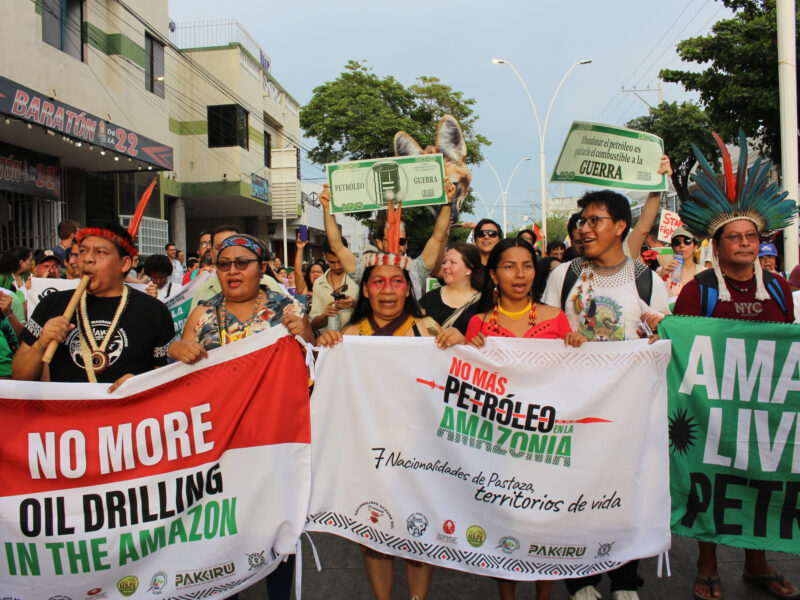
In response to today’s conference, the seven nations issued a joint declaration rejecting the proposed Ronda Suroriente and Ronda Subandina and warning companies and investors against pursuing oil extraction in their territories.
The government had announced plans to move forward with new Amazon oil auctions in 2026, but with the year entering its final quarter, neither has been launched. The delay is the latest development in a decades-long effort by successive governments to open the central and southern Ecuadorian Amazon to large-scale oil extraction – despite longstanding resistance from the Indigenous nations whose territories overlap the proposed blocks: the Ronda Suroriente, comprising 14 blocks (70, 71, 72, 73, 76, 77, 78, 80, 81, 82, 84, 85, 86, and 87), and the Ronda Subandina, comprising four blocks (20, 22, 28, and 29). Together, the 18 blocks cover approximately three million hectares – much of it remote, roadless rainforest.
In 2012, the government launched the XI Ronda Petrolera, or Ronda Suroriente, offering 13 blocks across the central and southern Amazon. Indigenous organizations mobilized from the Amazon to protest the launch in Quito and challenged government efforts to promote the round at industry events in Houston, Calgary, and Paris.
Despite an international campaign to attract investors, only three of the 13 blocks received bids: Block 29 from Repsol and Blocks 79 and 83 from Andes Petroleum. Repsol later relinquished Block 29, while Indigenous opposition prevented Andes Petroleum from carrying out its exploration program in Blocks 79 and 83, which were subsequently suspended under force majeure. Ultimately, not a single exploratory well was drilled in any of the three blocks.
“Successive governments keep repackaging essentially the same oil blocks and presenting it to investors as a new opportunity,” said Kevin Koenig, Climate, Energy, and Extractive Industry Director at Amazon Watch. “But the reality on the ground hasn’t changed. Indigenous nations have opposed oil extraction in these territories for decades, previous rounds have failed to deliver the promised expansion, and now another 2026 timetable is slipping. Investors should be asking why.”
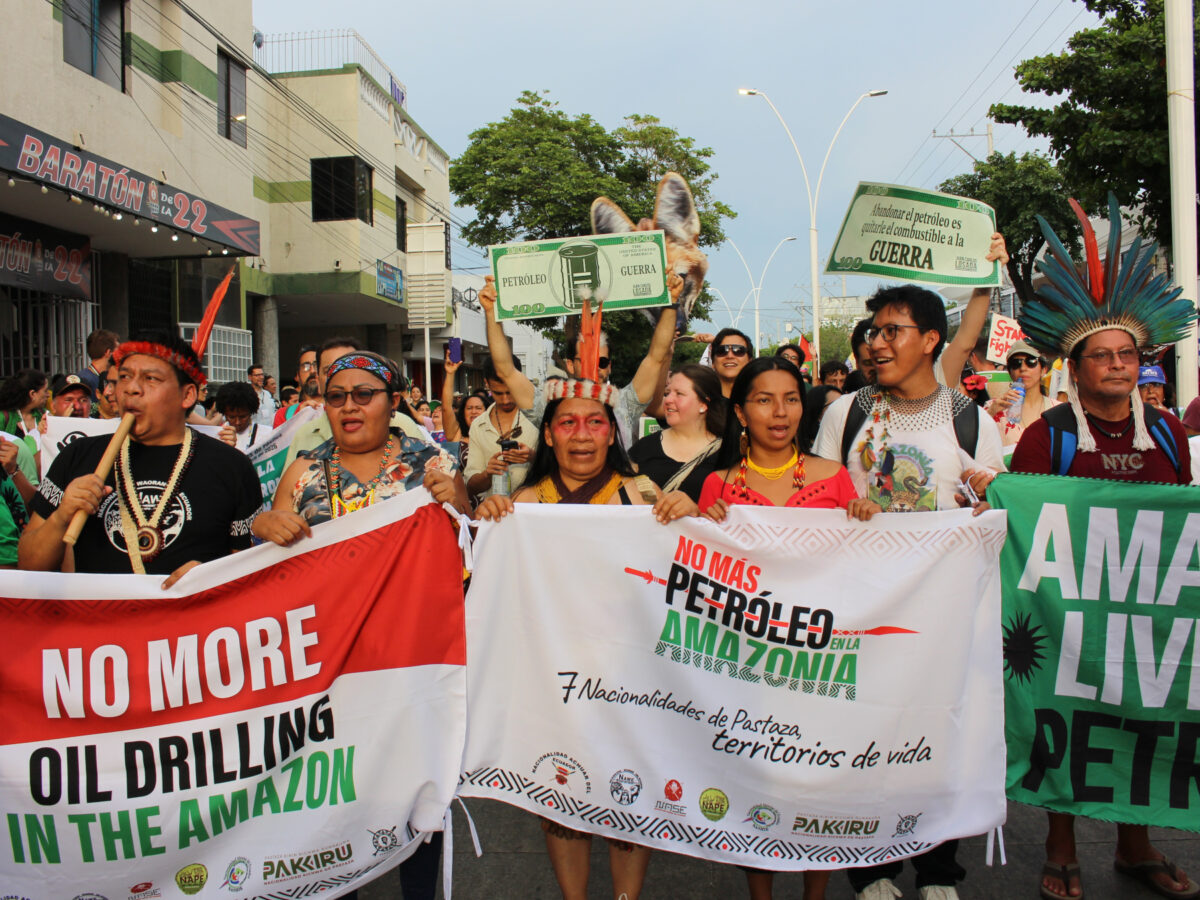
In 2026, Indigenous leaders expressed their opposition to new oil extraction directly into international discussions over the future of fossil fuels and what a just transition must look like. In April, representatives of the seven Indigenous nations traveled to Santa Marta, Colombia, during the first international conference dedicated to transitioning away from fossil fuels. At a press conference, Indigenous leaders rejected plans for new oil expansion in their territories and highlighted the contradiction between opening new Amazon oil fields and the growing international push to transition away from fossil fuels.
The issue was raised again in August at the XII Pan-Amazonian Social Forum (FOSPA) in Puyo, Ecuador, where Indigenous peoples and social movements from across the Amazon called for leaving crude oil in the ground through a just transition, reversing oil and mining concessions, and securing legal recognition of Amazonian territories as zones excluded from extraction.
The Ronda Suroriente and Ronda Subandina would open some of the Amazon’s most intact forests to new oil extraction. New drilling and infrastructure would increase greenhouse gas emissions, drive deforestation and forest fragmentation, release stored carbon, and weaken one of Earth’s most critical carbon sinks, adding to pressures on the Amazon biome which has already reached an ecological tipping point.
Oil operations would also bring increased risks of spills, water and air pollution, and health impacts for Indigenous communities, adding to the oil industry’s decades-long legacy of contamination across the Ecuadorian Amazon.
Much of the proposed expansion overlaps Indigenous territories whose peoples have repeatedly rejected oil extraction and asserted their rights to self-determination and Free, Prior, and Informed Consent. Those conditions could create significant legal, operational, financial, environmental, and reputational risks for companies entering the proposed blocks.
Indigenous leaders say the government’s inability to advance the rounds on its announced 2026 timetable is significant, but caution that a delay does not mean the proposals have been abandoned.
Ecuador continues to seek increased oil production and private investment, making the government’s plans for the Ronda Suroriente and Ronda Subandina particularly relevant as officials meet with oil companies and investors at ENAEP.
“The government is asking investors to bet on the future of Ecuadorian oil,” said Kevin Koenig. “They should look carefully at the history of this region before placing that bet. These are remote reserves requiring major investment in Indigenous territories where communities have resisted extraction for decades. Add uncertain returns, legal and territorial conflict, infrastructure requirements, and enormous socio-environmental liabilities, and the government’s vision of a new Amazon oil frontier simply doesn’t add up.”
The seven Indigenous nations are calling on the Ecuadorian government to cancel the Ronda Suroriente and Ronda Subandina, respect Indigenous territorial decisions and the right to Free, Prior, and Informed Consent, and support Indigenous-led alternatives and a just transition away from fossil fuels.