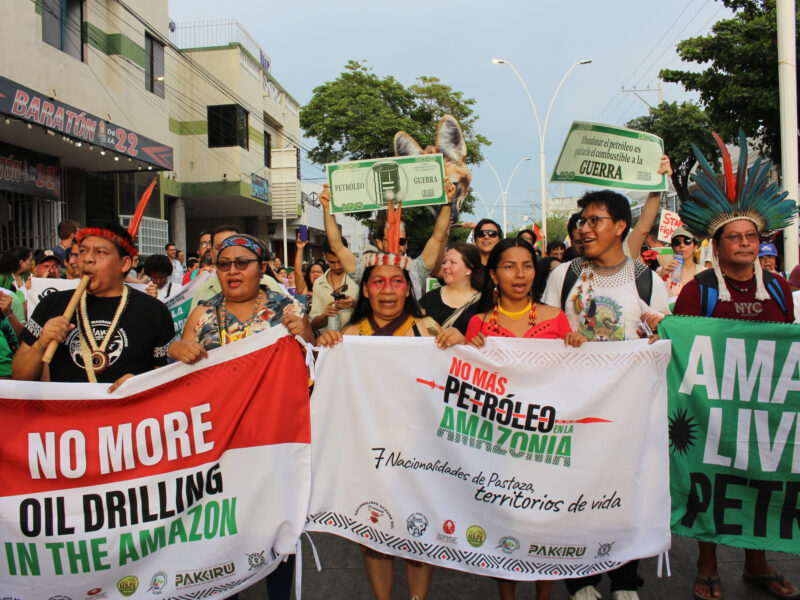

In May, Indigenous leaders brought the Amazon’s organized crime crisis to the U.N. in New York, demanding a meaningful role in fighting illegal mining, logging, and trafficking. Since then, developments have made the crisis more urgent, in both worrying and hopeful ways.
Our earlier landmark report found that criminal networks or armed groups now operate in 67% of Amazonian municipalities and compete for territorial control in nearly a third of them. These groups threaten the very existence and well-being of Indigenous Peoples in many ways. They threaten leaders, sabotage land titling, contaminate water and fish with mercury, traffic and recruit children, and drive homicide rates that make Colombia the world’s most dangerous country for environmental defenders.
Time is short. As violence expands, it further damages a rainforest that human activity has already pushed toward an ecological tipping point. And governments that intervene do not necessarily help. Corruption, absence of state services, and militaristic responses make matters worse.
A harder, more militarized turn
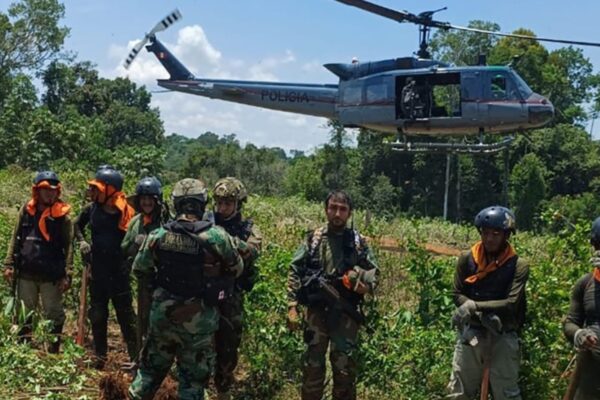
Over the last few months, several regional governments have swung far to the right, and the U.S. has increased its military involvement through Shield of the Americas (Escudo de las Américas). The pitch is simple: under American leadership, more troops will conduct more raids to fight “narco-terrorism.” The reality is more complicated and more dangerous for the Indigenous communities that live in the areas targeted by this strategy.
Our July report, Triple Trouble, examined the border region where Colombia, Ecuador, and Peru meet – one of the Amazon’s most disputed territories. Drawing on field visits and dozens of interviews, the report found that illegal gold mining has now overtaken coca as organized crime’s main economic engine in the region It also documented credible reports describing torture and forced disappearances carried out in the name of fighting crime. We explained these risks in an op-ed in El País. Militarization offers false security and puts the people already suffering the worst violence directly in the crossfire. In fact, the strategy’s main goal may be to expand territorial intervention and secure control over crucial natural resources, as American security doctrine has stated quite explicitly.
That threat is not hypothetical. On August 11, forces carried out an aerial bombardment near a community-built airstrip in Ucayali, Peru. The airstrip serves as a lifeline for medical evacuations. In June, a military operation in Sucumbíos, Ecuador, killed three Shuar community members. CONAIE has demanded a transparent investigation. These incidents are not isolated. They preview what happens when governments wage a “war on narco-terrorism” without consulting the people who live on the front lines.
There is no security without Indigenous Peoples
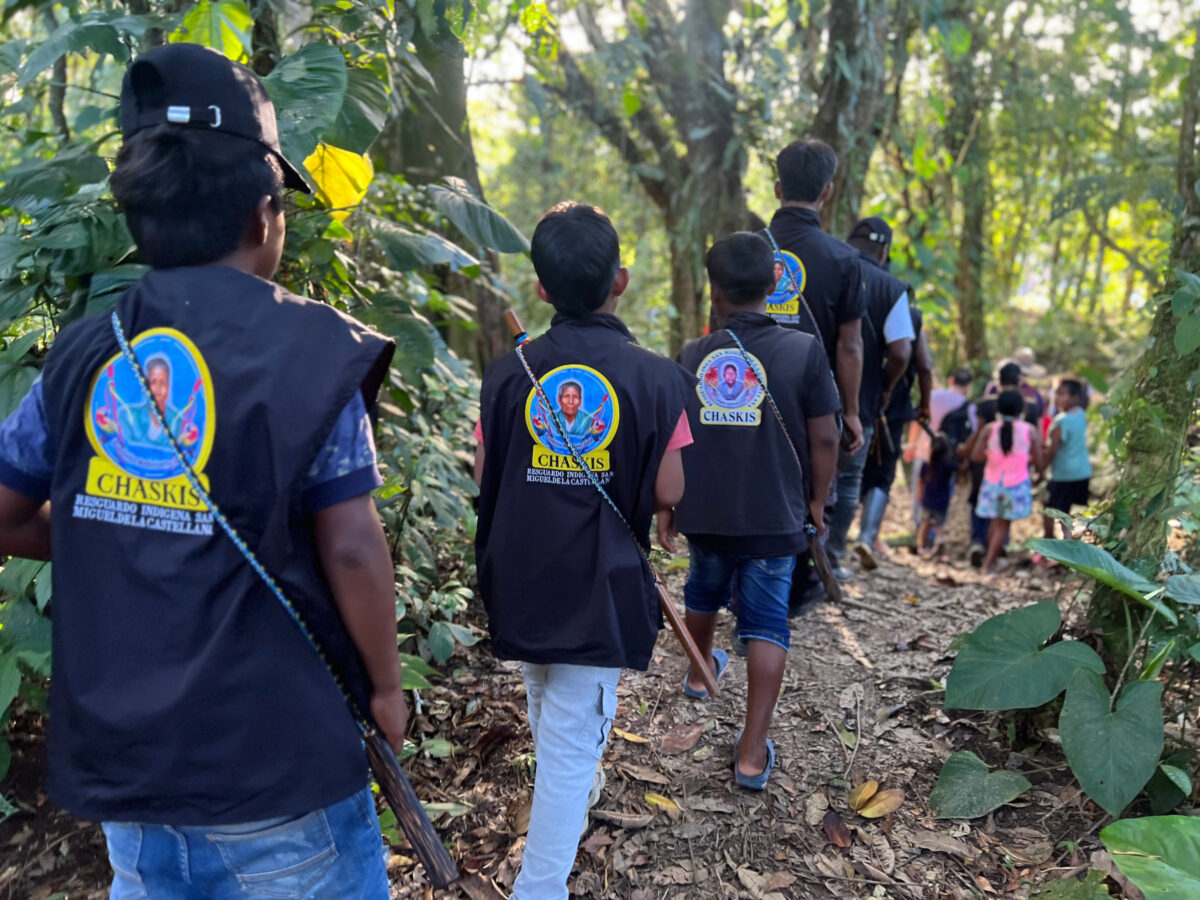
Despite everything working against them, Indigenous Peoples aren’t waiting for permission to defend their homes. In Peru, the Wampis Nation’s own territorial guard, known as the Charip Group, patrols their rivers and forests against illegal miners where the state has failed to act.
The documentary *Charip: Lightning in the River* tells the territorial guard’s story. We are helping the film reach wider audiences as part of our effort to persuade the Peruvian government to work with, rather than against, Indigenous self-determination. The film, co-produced with our allies at Mullu.tv, recently won an award at the Muyuna Festival of Amazonian Cinema, and audiences around the world have now seen it.
Indigenous Peoples resist these threats across the region. They publicly denounce abuses, build an evidence base to hold governments and criminal networks accountable, patrol their territories, and develop local economic alternatives to illegal mining and coca. These efforts help communities avoid having to choose between their survival and their land.
Leonidas Iza, president of Ecuarunari in Ecuador, explains: “For us Indigenous Peoples, security is not about weapons. It is about taking care of our territories. And that is not appreciated, as it means we want to stop contamination, extractivism, or any harmful activity. That is why we end up being criminalized.” Ingry Mojinajanisoy, the President of ACIMVIP, adds: “It is also up to us to maintain our own economies, spiritual practices and cultures to safeguard our future. But the external pressures are very big.”
Territorial protection is the answer
Indigenous Peoples cannot hold this line on their own indefinitely. They face both criminal networks and, increasingly, state forces that treat them as suspects. They need more national and international support – and they need it quickly
The Stop Amazon Crime campaign exists to build that support. We directly support communities on the ground by funding initiatives that range from territorial guards to solar-powered monitoring systems. One recent installation with the Autonomous Territorial Government of the Chapra Nation brought power, freezers, and satellite internet to twelve communities across roughly 80% of Chapra territory. As Chapra president Olivia Bisa put it, “having internet access saves lives. This is the first time we can respond collectively in real time as a territory when threats occur.”
We document events on the ground and share that information with journalists and the global public so the crisis does not remain invisible. We work alongside Indigenous organizations that push for change in their own countries. We also support calls for direct indigenous participation in international forums, where officials discuss security, illicit economies, and organized crime.
This summer, we brought together government officials, Indigenous leaders, regional experts, and United Nations officials to develop concrete policy proposals. We co-organized the workshop with the U.N. Human Rights Office, the U.N. Office Against Drugs and Crime (UNODC), and the Peruvian organization CooperAcción. The resulting ten key recommendations call on governments and institutions to:
- map crime risks with Indigenous organizations
- pursue the money behind illegal mining and trafficking instead of simply staging raids
- legally recognize and fund Indigenous-run guard patrols
- guarantee land titles
- fund viable economic alternatives to illegal mining
- protect Earth defenders
- give Indigenous representatives genuine decision-making power – not a token seat – at the table
Next stop: Vienna
Recent developments show some progress. The scale of the crisis and the flaws in government responses have become more clear. In direct follow-up to our Permanent Forum delegation, the U.N. has launched a global consultation and study to formally assess how organized crime affects Indigenous Peoples worldwide. This process will shape future U.N. policy.
The next big test will come at the U.N.’s Transnational Organized Crime summit (UNTOC COP13) in Vienna. We will bring a strong delegation of Indigenous leaders from the countries where we work to present two clear requests. First, the international community must make environmental crime – including illegal mining, logging, and the pollution they cause – a global priority by adopting a formal Protocol Against Crimes that Affect the Environment. Second, governments and international institutions must consult, fund, and protect Indigenous Peoples as central partners in fighting crime. They must not wait until they have already made their plans to bring Indigenous Peoples into the process. Thousands of you signed a petition about this issue earlier this year, and we formally delivered those signatures to UNODC as part of this campaign.
The bottom line
Indigenous Peoples still do most of this work themselves. They absorb risk from criminal networks and from anti-crime operations that too often treat them as suspects. The window to change course is closing, but it hasn’t closed. Real security in the Amazon will come only when governments and international institutions build it with Indigenous Peoples, not around them.