
The Peruvian government has changed its mind and decided it will not pay for an independent international investigation to assess the condition of the 750-kilometer pipeline that transports natural gas from the Amazon jungle to the Pacific coast.
Although Prime Minister Pedro Pablo Kuczynski publicly announced that the government would contract foreign auditors to guarantee the reliability and transparency of the pipeline inspection, it now will be paid for by the consortium that is itself the object of the investigation, Transportadora de Gas del Per£ (TGP).
TGP built the pipeline and is responsible for maintaining the flow of natural gas from Camisea in the Amazon jungle province of Cuzco to the processing plants on the southern coast.
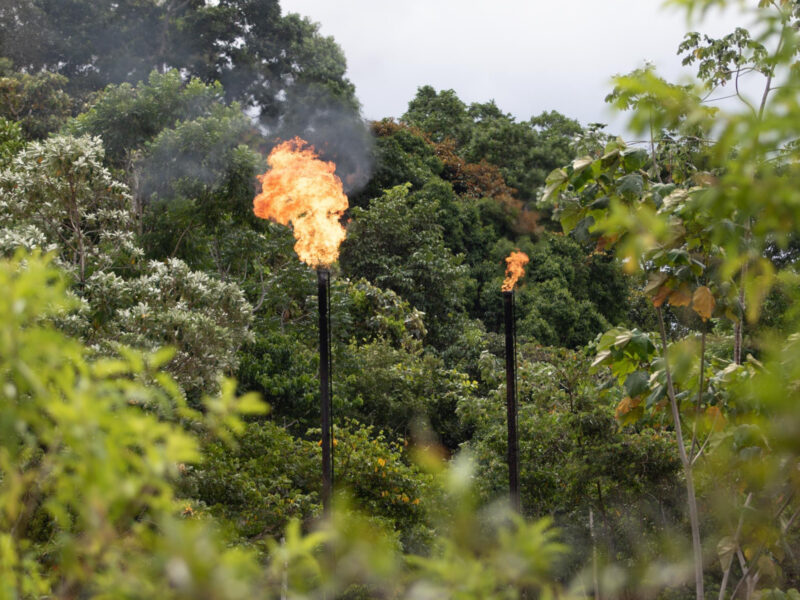
The government’s decision to inspect the pipeline was prompted by the latest leak, which caused a large explosion in the indigenous community of Kepashiato on March 4. The resultant fire injured a woman and her young son and destroyed an extensive area of crops.
The state will not hire external auditors because it would have to put the contract out for international bids, which would take more than six months, Alfredo Dammert, president of Peru’s energy regulator, OSINERG, told IPS.
“It isn’t a perfect solution, but it’s the best we can do,” said Dammert. “TGP will deposit the money into OSINERG’s account, so the consortium will have no influence over the audit procedures. It’s understandable that people may have doubts, but this was the best solution.”
Dammert said a committee made up of representatives of the Ministry of Energy and Mines, OSINBERG, and the Inter-American Development Bank (IDB) – the main source of public funds for the Camisea project – would select an audit company.
Was the IDB in agreement with the arrangements? “Yes,” Dammert replied. “We all want a comprehensive investigation, to make the operation of the pipeline safer. We are all concerned about the problems.”
Dammert admitted that since late 2003, TGP has set a new record for pipeline-related accidents. Five ruptures have occurred in the space of 18 months.
“It’s normal for there to be defects, but not so many in so short a time. We have to find out what is happening and correct them. That’s why the IDB is going to participate by having a representative on the committee that will select the audit company,” Dammert said.
Bill Powers, chief engineer at the California-based non-profit technical research organization E-Tech International, which recently investigated the pipeline, said the plan for TGP to pay for the audit would raise doubts about the reliability of its findings.
“The Peruvian state or the IDB should pay for the investigation,” said Powers, who has closely followed the Camisea project.
Powers pointed out that an international audit was included in the terms of the $135 million loan awarded by the IDB to the TGP consortium in 2003.
The consortium is made up of the Argentine firms Techint and PlusPetrol, Hunt Oil from Texas, the Algerian state-owned oil and gas company Sonatrach, South Korea’s SK Corp. and the Belgian-French company Suez-Tractebel, among others. The total cost of the Camisea project was $1.6 billion.
The year after the loan was granted, serious construction flaws in the pipeline were reported. Non-governmental organizations such as the Peruvian branch of the global conservation organization WWF, the Peruvian Society for Environmental Law, and the National Society for the Environment called on the IDB to contract the audit, but the bank turned a deaf ear, said Powers.
“The Peruvian civil society organizations had even reached an understanding with the Netherlands Commission for Environmental Impact Assessment to carry out the study, because it’s a reliable organization known for its honesty and frankness,” said the engineer. “The independent audit was to start in 2004.”
So why didn’t the audit occur?
“The IDB controlled the budget, and tried to manipulate the scope of the audit and its personnel,” Powers said. The bank “reduced the (audit) budget to a totally inadequate figure. Apparently it had no interest in a truly independent audit.”
The IDB wanted to pay only $40,000, when an audit of this type costs at least $1.2 million, according to estimates by the Peruvian state itself.
It took five liquefied gas spills, one of which caused a dangerous explosion, before the government of Alejandro Toledo, with its back against the wall, agreed to contract an international auditor.
TGP says the problems that have occurred in the pipeline are normal, because it runs across a very unstable area of jungle and Andean mountain territory. “There are no structural problems,” the consortium said in a communique.
But OSINERG found that the Aug. 29, 2005, pipeline rupture was due to problems with the welding, a defect that E-Tech International brought to light in a technical report delivered to the IDB at a public hearing in Washington on Feb. 27.
E-Tech documented the fact that Techint, the company that built the pipeline, used pipes left over from earlier projects in Brazil and Ecuador, which had been exposed to the elements.
According to E-Tech’s report, Techint hired unqualified personnel to do the welding, and some stretches of the pipeline were laid without studying soil instability. Furthermore, it said, the consortium rushed the work to meet the contract deadline and avoid a hefty fine, thus sacrificing rigorous fulfillment of technical standards.
TGP strongly denied the report’s conclusions.
E-Tech, however, has stood by the study. One of its authors, Carlos Salazar Tirado, is a certified pipeline welding inspector who examined sections of the Camisea pipeline during construction in 2002 and 2003.
Welding defects have been verified by OSINERG. Meanwhile, TGP lacks a proper system for detecting and blocking leakages, as evidenced by the thousands of barrels of liquefied gas that have been spilled, according to a new E-Tech report to which IPS had access.
The Canadian firm URS, hired as an erosion control consultant by the IDB, reported that TGP was overly hasty during construction, which explains why no soil erosion control system was put in place.
TGP acknowledged the accidents, but blamed the environment. However, a significant proportion of the piping used showed internal, not external, corrosion, the new document by E-Tech stated.
According to E-Tech, it is unprecedented for five ruptures to occur in a pipeline such a short time after start-up.
An independent review may find others to be at fault, apart from nature, said E-Tech, which stated that the aim of the audit should be to clearly identify the flaws and their causes, as well as the necessary steps to repair the pipeline and ensure that it will be reliable for 20 to 30 years.
With respect to the possibility of the Peruvian state attempting to renegotiate the contract with TGP, consortium executives said: “We have a 30-year contract, and we will leave when those 30 years are up.”