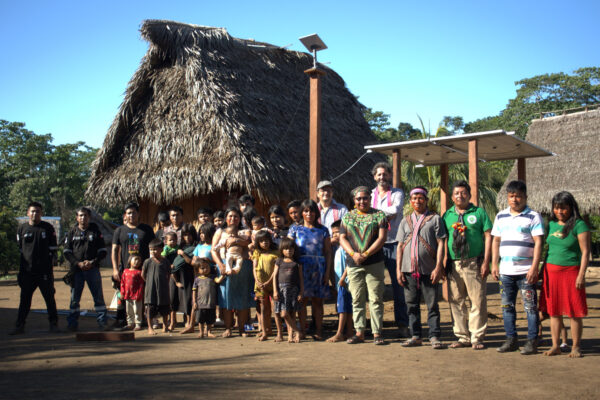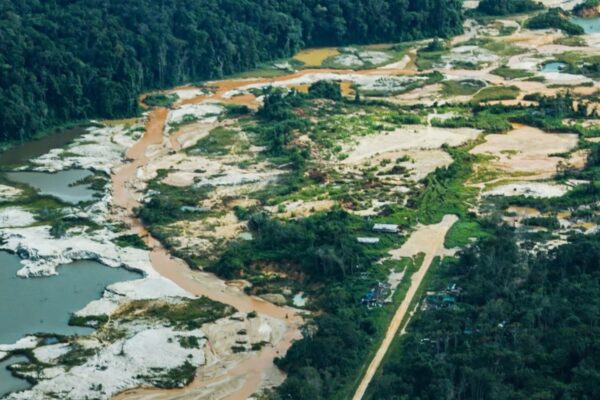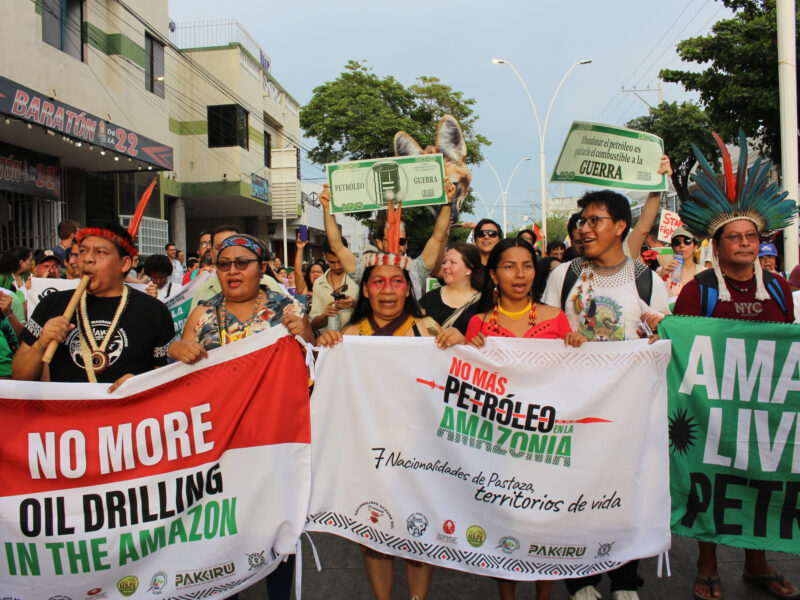

On August 23, Waorani people took to the streets of Puyo to mark the three-year anniversary of Ecuador’s historic Yasuní referendum and protest the government’s failure to carry out the will of voters. The government’s refusal to comply is putting Yasuní’s biodiversity and the survival of the Tagaeri and Taromenane Indigenous peoples living in voluntary isolation at risk, while exacerbating the threat of unwanted contact.
Three years after Ecuadorians voted overwhelmingly to keep the oil beneath Yasuní National Park permanently in the ground, oil is still flowing. According to government figures, fewer than a quarter of the wells have been shuttered. Waorani leaders say the actual number is closer to ten. With no independent monitoring, it remains unclear whether the wells have been properly closed according to standard industry practices or merely abandoned.
The fields continue to produce roughly 40,000 barrels per day, and Petroecuador, Ecuador’s national oil company, is pushing the full shutdown of oil activity to 2034 – a full eleven years after the vote – with plans to allow many of the wells to decline naturally. The administration of President Noboa has failed to meet court-ordered deadlines for ending extraction, putting at risk both the democratic mandate and the rights of the Indigenous peoples whose territories are affected.
The government has also failed to consult with or obtain the consent of the Waorani over the decommissioning process and has excluded them from meaningful participation and oversight.
The August protest was the latest chapter in a struggle over Yasuní that has spanned decades.
In August 2023, Ecuadorian voters went to the polls and made history. Almost 60% chose to keep one of the country’s largest oil reserves permanently in the ground.
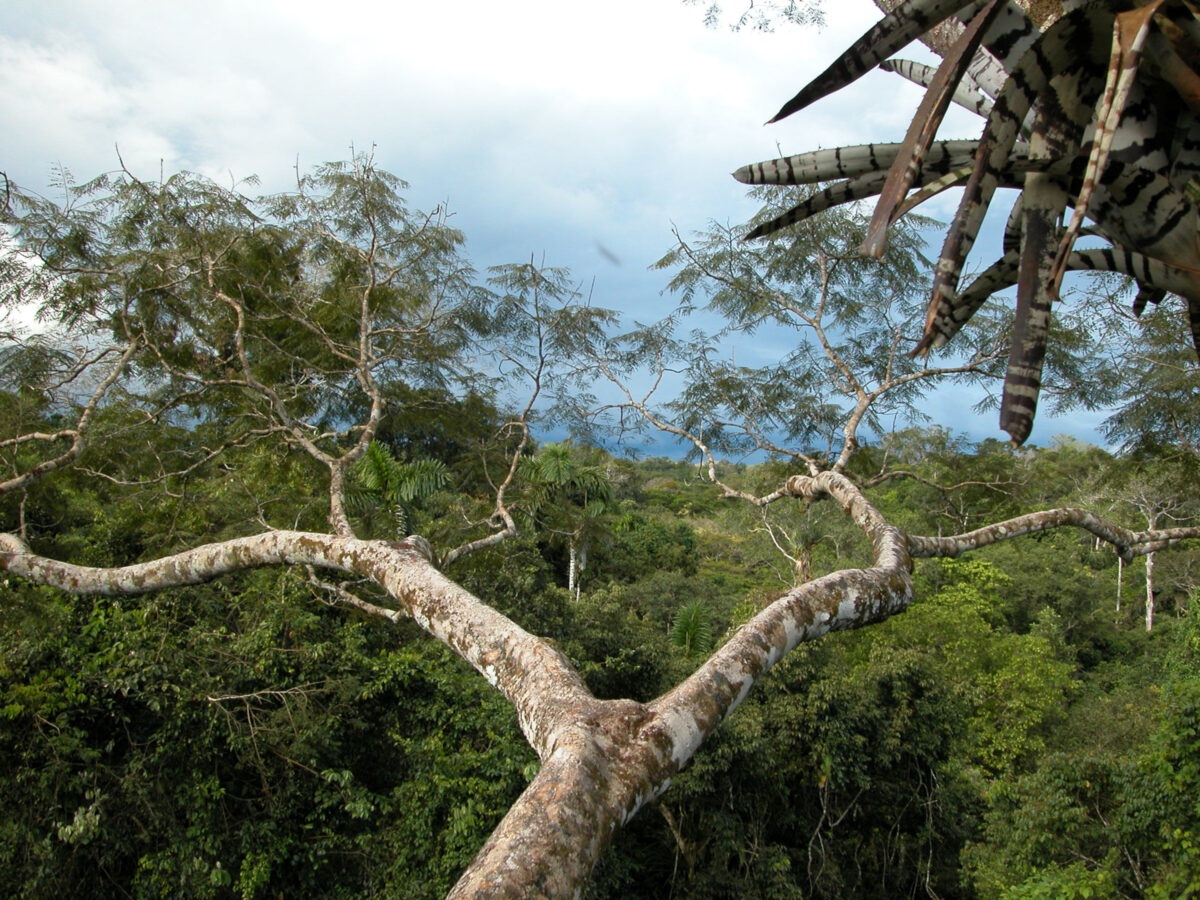
The oil lies beneath three fields – Ishpingo, Tambococha, and Tiputini (ITT) – that together make up Block 43, an oil concession located deep inside Yasuní National Park. A UNESCO World Biosphere Reserve, Yasuní is widely considered one of the most biodiverse places on the planet. It is also the ancestral territory of the Waorani Indigenous people and the Tagaeri and Taromenane, who live in voluntary isolation.
Together with groups on the ground like Acción Ecológica, Amazon Watch helped sound the alarm about plans to drill in Yasuní back in 2003. We later worked with NAWE (the Waorani Nation of Ecuador) to build momentum and international attention around Yasuní as a key place to keep oil in the ground, and worked on the original pioneering Yasuní-ITT proposal from a previous administration, which sought to keep the oil in the ground in exchange for contributions from wealthy countries most responsible for today’s climate crisis.
At the time of the referendum, Petroecuador had already drilled 247 wells, which were producing roughly 55,000 barrels per day, with plans to drill up to 600 wells in total. Following the referendum results, the government was legally required to carry out a progressive and orderly withdrawal of all oil extraction activity in Block 43 within one year of the official notification of the results. The Constitutional Court also prohibited the government from entering into new contracts to continue oil exploitation there.
It marked the first time a net oil-producing country would prematurely retire wells that had only recently been brought online, and the first time such a decision had been made by popular vote. In theory, the vote is an irrevocable mandate – much stronger than an executive decree, policy, or legislation that could be overturned with a change of government.
Yet the Noboa government has not only failed to implement the referendum. It is also flouting a binding decision from the Inter-American Court of Human Rights requiring Ecuador to take measures to protect the Tagaeri and Taromenane, including an immediate halt to oil activities.
The government’s failure to fully implement the referendum, decommission oil operations, guarantee Waorani participation in the process, and protect the lives and future generations of Indigenous Peoples living in isolation goes far beyond the fate of Yasuní. It raises fundamental questions about whether a historic democratic decision – and a precedent for keeping fossil fuels in the ground – will be respected, scaled, and replicated, and whether the rights of the Indigenous peoples whose territories made that decision possible will ultimately be protected.
It also comes at a critical moment for Ecuador’s energy future. While governments and civil society gathered in Santa Marta, Colombia, to identify barriers and advance action and international cooperation on transitioning away from fossil fuels, Ecuador was notably absent. Rather than developing a plan to manage its transition away from oil, the Noboa government is moving in the opposite direction, courting new investment and seeking to auction millions of hectares of titled Indigenous territories in remote, roadless rainforest.
Ecuador’s gambit to double down on oil as a future driver of its economy brings significant financial and political risks. As the global energy transition advances and oil demand is expected to peak in the early 2030s amid major growth in renewables and electrification, countries heavily dependent on crude exports face increasing uncertainty over future revenues, investment, and the long-term viability of new oil projects. Expanding the oil frontier today risks locking Ecuador into costly projects whose economics could deteriorate as global demand changes, while delaying the difficult but necessary work of planning for a more diversified and resilient economy.
Three years ago, Ecuadorians chose a different path. The Yasuní referendum created a mandate to keep oil in the ground and sent a powerful signal that Ecuadorians reject the long-standing myth that more oil extraction brings development and prosperity. Instead, the vote opened the door for Ecuador to lead the way toward a just transition away from fossil fuels, affirming that biodiversity, Indigenous rights, and a stable climate are worth more than the equivalent of just a few days of global oil consumption.
Three years later, that choice must be respected. President Noboa’s government should immediately end oil extraction in Block 43, permanently close and decommission the remaining wells and infrastructure, and guarantee meaningful Waorani participation and oversight in the process. It must also adopt measures that protect the survival of the Tagaeri and Taromenane and abandon plans to expand the oil frontier into other Indigenous territories across the Amazon.
The world is watching what happens in Yasuní. Three years after Ecuadorians voted to keep this oil in the ground, their decision must be respected. Join the Waorani and other Indigenous nations calling on Ecuador to implement the referendum, end oil extraction in Yasuní, and stop the expansion of the oil frontier across the Amazon.