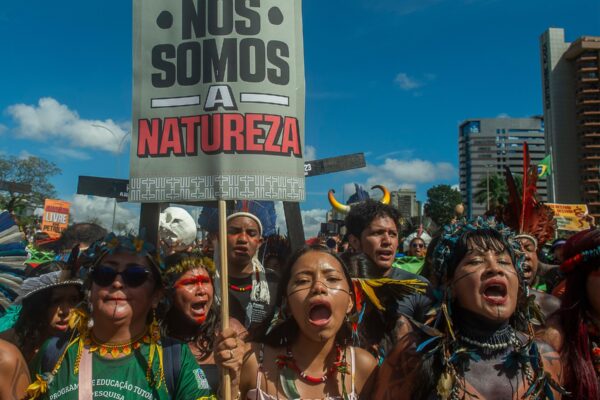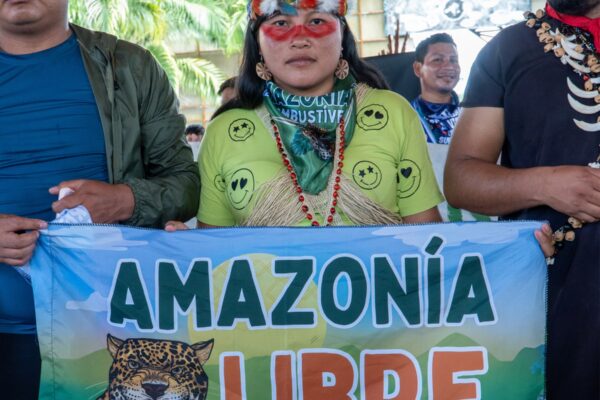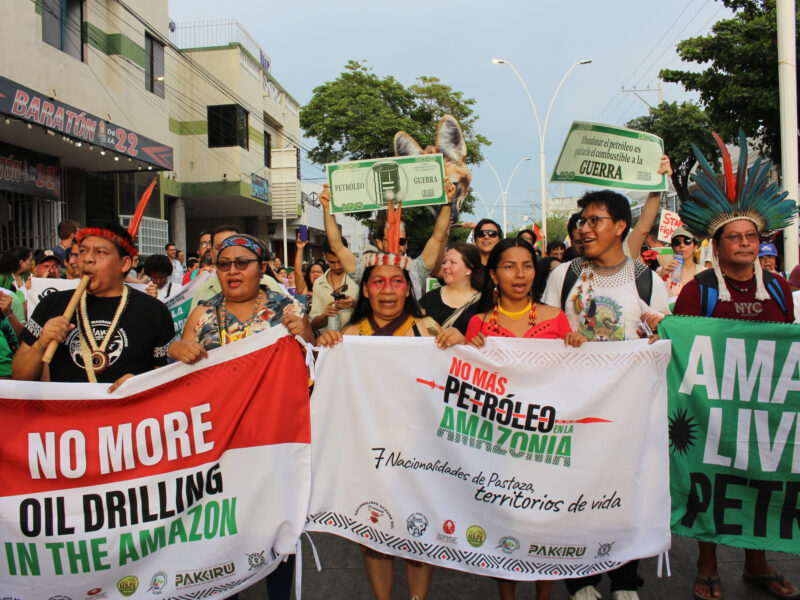

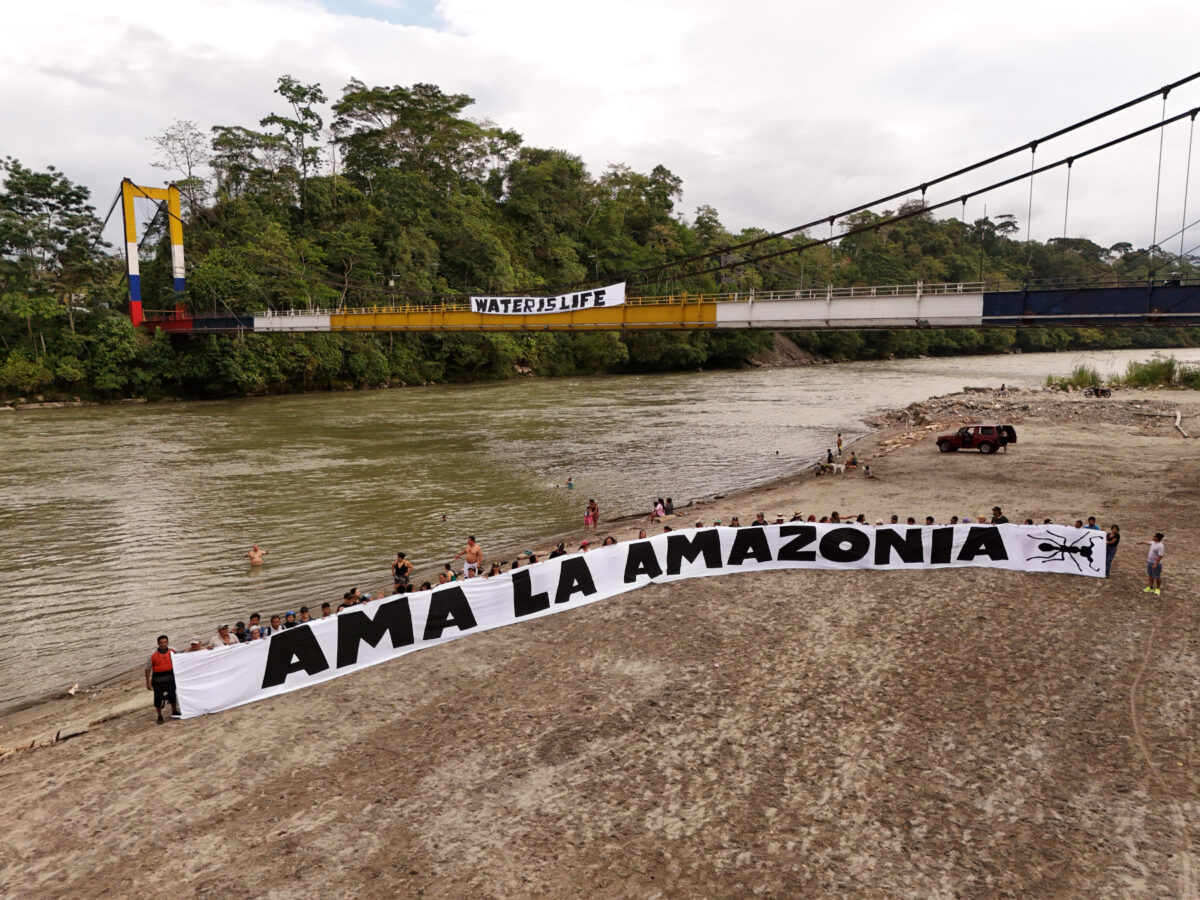

Today, August 20, 2026, we come together in the city of Puyuk¹ to denounce three years of non-compliance with the popular consultation to leave oil in the ground. The Yasuní mandate calls the peoples of the Pan-Amazon together at this XII FOSPA.
We live in a time of a global capitalist system unlike anything seen before in world history, amid a fiercely competitive multipolarity, where the old, declining U.S. imperialism and the Global North refuse to give up their unipolar power, relying largely on military force and fascist politics in a new version of Plan Condor in Latin America. Today, across the Pan-Amazon, the Amazonian countries, and all of Latin America, an aggressive wave of the far right and authoritarianism, driven by geopolitical economic powers and U.S. imperialism, is threatening and subjugating the countries of the region with aggressions of every kind against peoples and nature.
We cannot ignore that the XII FOSPA is taking place in a historic moment of multiple global conflicts — wars between empires over the reshuffling of planetary hegemony, and a bitter dispute for control of energy resources, minerals, rare earths, water, and biodiversity — which have in turn unleashed wars within the Amazonian countries: colonial invasion and occupation as in Venezuela, or the so-called internal wars taking shape or intensifying within countries like Ecuador, Colombia, and Peru, threatening to spread across the Pan-Amazon and the Amazonian countries — wars in which the “internal enemy” is none other than the peoples resisting dispossession.
The countries of the North and major corporations, most responsible for carbon emissions and the destruction of nature, must acknowledge and repair their historical and ecological debt. Recognition of industrialized countries’ differentiated responsibility cannot be limited to green financing commitments to countries of the Global South. Even those commitments have not been fulfilled, and there is an attempt to make these resources. which are insufficient against real needs, stand in as a response to the demands of Amazonian peoples, when in no way do they resolve the climate crisis. Moreover, this financing is difficult to access, arrives under conditions that violate territorial rights and the processes of Free, Prior, Informed, and good-faith consent, and is granted mainly in the form of loans that unjustly increase the illegitimate external debt already burdening our countries. We likewise denounce the advance of false solutions such as carbon markets, debt-for-nature swaps, and thematic bonds, among others, as well as the announcements by countries of the North that they are cutting climate financing in order to prioritize war over life. We demand the cancellation of illegitimate public debts and the dismantling of corporate impunity. We demand non-repayable climate financing and reject carbon markets, debt swaps, and other false solutions.
The forum expresses its solidarity with peoples fighting against colonial domination, such as the peoples of French Guiana. We demand that the UN recognize the need to decolonize these territories and respect the rights of their Indigenous peoples.
Opposing this wave, rooted in our territories, is an urgent necessity of our time. In response, we — Indigenous Peoples, Afro-descendant Peoples, fisherfolk, peasant communities, traditional communities, Montubio communities, Quilombola communities, civil society, social movements, academia, urban populations, women, gender and sexual diversities, feminists, children, adolescents, and youth — have called ourselves together to denounce and confront these threats against life, with all our rebelliousness, love, and self-determination.
We reaffirm that building a Pan-Amazon territory free of extractivism, in defense of an Amazon with rights, means reaffirming our position on the urgent need to abandon fossil fuel extraction, leaving crude oil in the ground through a just and popular transition, and to end all forms of mining, which violate rights such as Free, Prior, Informed, good-faith consent and the rights of nature under a predatory and unsustainable model. To bring extractivism-free zones into being, we are pushing for legal recognition of Amazonian territories as zones excluded from extraction, reversing mining and oil concessions and eliminating the use of mercury; this requires strengthening the autonomy and self-determination of our peoples through territorial control, territorial guardian patrols, Indigenous justice, and strategic Andean-Amazonian alliances, as well as an observatory for political and legal coordination and the protection of human rights defenders. The violence directed against defenders demands public policy and international backing for their protection. We must strengthen the battle of narratives in society over the importance of guaranteeing extractivism-free territories, and carry out the actions, mobilizations, and advocacy needed to bring about the action plan for free territories with guaranteed rights in the Amazon.
In contrast to the plunder of our territories, we promote community-based alternative economies grounded in ancestral knowledge and Indigenous and Afro-descendant knowledge systems, food sovereignty, and unrestricted respect for the Rights of Nature and Human Rights, demanding that States and corporations assume civil and ecological responsibility across the entire supply chain.
We will build strategic litigation, with an ecocentric approach and legal pluralism, around a regional case in which rivers and territorial struggles across different countries can demonstrate shared harms to the Amazon Basin and lay the groundwork for its protection — first at the local level, but with an eye toward a future debate within the Inter-American System. To this end, we will drive forward an Amazonian Community Environmental Monitoring Network that brings together ancestral, academic, and scientific knowledge, backed by a living atlas documenting cases of territorial harm — to defend and reclaim these rights across the Pan-Amazon.
Protecting the Pan-Amazon means protecting everything that makes it up, from the páramos to the rainforest, and everyone who inhabits and defends it — with particular emphasis on the disproportionate impact on women, children, and Indigenous peoples in isolation, who suffer these impacts the most. The strategies used by extractive companies have torn apart the social fabric of our communities, which is why we call for unity to prevent this disintegration of our peoples’ organizing. It is essential to strengthen coordination not only within the Pan-Amazon, but also with the peoples who live along the Andes mountain range, from Venezuela to Argentina.
We, the Indigenous Peoples and Nations, affirm that we preexist the creation of States. Since ancestral times we have inhabited, governed, and protected our territories, exercising our own forms of government, knowledge, and life. Our collective, territorial, and self-determination rights do not originate from State recognition, but from our existence as Peoples. The Amazon is a living territory, fundamental to biodiversity and to the planet’s climate balance. Yet today our territories face increasingly serious threats from the advance of extractivism, mineral extraction, oil exploitation, agro-industry, drug trafficking, illegal economies, road and hydroelectric project expansion, deforestation, and the impacts of climate change and its false solutions — pushing the Amazon closer to a point of no return. In light of this reality, we declare the Amazon in a state of emergency as a measure to protect against and prevent that point of no return. This requires guaranteeing our rights and strengthening our self-governance, our own economies, the defense of our territories, and a just transition grounded in our knowledge systems, along with guaranteeing full reparation and restoration of our territories when they have been harmed. We defend our culture, build our memory, and reclaim the ancestral heritage of our peoples. We deliver to the XII FOSPA the Mandate of the Indigenous Peoples and Nations in Puyuk 2026 as an expression of our priorities, demands, and proposals for the Amazon Basin, and we call for it to be taken up in its agendas and actions.
We, the original peoples who live in contact with the land, must strengthen the memory and wisdom of life — Kawsak Sacha, the Living Forest. We call for unifying a single front and upholding that the territory is a living being, Kawsak Sacha, and we therefore demand that governments, multilateral bodies, and the United Nations guarantee these rights.
This XII FOSPA expanded Indigenous participation and, at the same time, revealed the challenge of guaranteeing full and effective inclusion of peasant communities and Afro-descendant Peoples who inhabit, care for, and defend the Amazon. We therefore propose strengthening their effective participation in FOSPA’s planning, decision-making, agreements, and outcomes, promoting an intercultural and in-solidarity coordination that respects the distinct particularities, legal frameworks, and forms of organization of each people and community. This participation must actively recognize and incorporate the voices of children, youth, and women, strengthening the building of shared agendas and collective actions oriented toward the defense of the Amazon, our territories, and life.
The Afro-descendant People of the Pan-Amazon stand firm in defense of their collective and ancestral territories against the destructive dynamics of the extractivist model. Within the framework of the XII FOSPA, we demand effective power, autonomous territoriality, and binding participation, categorically rejecting the new forms of dispossession and marginalization imposed by mining, oil, forestry, agro-industrial, and infrastructure projects. We likewise denounce the carbon market and biodiversity credit mechanisms implemented in violation of our right to Free, Prior, Informed consultation. Our position is clear: we demand that States and financiers grant direct access to climate funds and sovereign control over our commons. We assert the leadership of women and youth as pillars of resistance and governance, and we demand an end to violence against our women’s bodies, as well as to the influx of substances that destroy and claim the lives of our youth. We urgently demand a comprehensive review of existing concessions, reparation for socio-environmental harms, and the immediate reform of key legislation in Ecuador, such as the Special Amazonian Territorial Circumscription Law, to guarantee our genuine inclusion. Finally, we demand FOSPA’s full backing to create a Pan-Amazonian monitoring and alert mechanism that legally and politically shields our territories as sovereign, extractivism-free spaces.
The Amazon is fundamental to life on the planet, yet it is very close to a point of no return due to the unchecked advance of extractivism, deforestation, biodiversity loss, and the impacts of the climate crisis. This crisis has intensified as a result of a hegemonic capitalist development model based on the commodification and appropriation of nature and the commons, fossil fuel burning, mineral extraction, agro-industry, capital accumulation, foreign debt, free trade agreements, unjust bilateral treaties, imposed international arbitration, the dismantling of judicial systems, multilateralism, jaguar bonds, false solutions, and the subordination of our territories for the benefit of a few countries and groups that concentrate power. This crisis disproportionately affects the countries of the Global South and, within them, historically excluded populations.
We, the Indigenous Peoples, Afro-descendant Peoples, and peasant communities of the Amazon Basin, further denounce that organized crime — drug trafficking, illegal mining, illegal logging, wildlife trafficking, human trafficking, smuggling, and money laundering — exercises growing territorial control over our region, linked to extractivism, state actors, companies, financial entities, international markets, and false solutions that keep hidden who is financing and benefiting, while violence and criminalization fall on our peoples. We face a humanitarian crisis and a sustained increase in violence, with particular harm to women, girls, boys, and youth. We reject both the expansion of organized crime and the extractivism that fuels it, and state militarization, which neither dismantles criminal structures nor returns territory to our peoples.
Economies for Life are both a present-day practice and a political horizon: a way of confronting extractive economies and the relationships that threaten life, while building territories where dignity, rights, diversity, care, autonomy, and ecosystem sustainability guide economic decisions.
The Pan-Amazon is a seedbed of transformative economies, and Economies for Life are economic, social, cultural, and political practices and relationships aimed at creating and sustaining the material, social, cultural, territorial, and ecological conditions necessary for a dignified life. They recognize the diversity of peoples and their ways of inhabiting their territories; they place care, human and collective rights, and ecosystem sustainability at the center; they strengthen the autonomy and sovereignty of communities; and they contest the relationships of exploitation, inequality, and extractivism that threaten life. In this sense, building Economies for Life means transforming the conditions under which we produce, exchange, care, inhabit, and collectively decide over our territories and over what makes life possible — and recognizing that community, subsistence, and care economies require justice and reparation from States for the harms caused by companies and by States themselves.
We cannot speak of democracy when the collective rights of Indigenous Peoples and the rights of Afro-descendant Peoples of the Pan-Amazon are violated, and even less so when women are not regarded as citizens or political subjects entitled to participate and decide on equal terms over our territories and our bodies.
There is a direct relationship between extractivism, the climate crisis, and structural violence against our bodies in its many forms. We — Indigenous, Afro-descendant, Quilombola, rural, peasant, community feminist, and women — have a deeper rootedness in our territory because of our relationship with nature and because we are the ones responsible for sustaining life. Yet today we are not only dispossessed of our territory and forced to abandon it, but criminalized, disappeared, and killed for defending it.
We agree that we face many challenges, and that violence against our bodies and territories, equal political participation, and the sustainability of life are three priority pillars to take up in the current context of the Pan-Amazon. In light of this, we have seen the urgency of not stopping at words, but moving to collective action.
Without care, no life is possible, and it is we who carry an unequal burden due to the unequal distribution of labor, the climate crisis, and traditional roles that limit our personal and collective development. We care for our daughters, our sons, our families, our rivers, and mother earth — often at the cost of our own well-being. Let us not forget that our bodies are our first territory of defense, and that we are not objects of sacrifice or reproduction. We reclaim the value of our ancestral knowledge to heal from racism and every form of discrimination and violence that harms us, and we recognize the role of the midwives and wise women who connect us to our ancestry.
The Amazon is not a resource, nor a frontier to be conquered: it is the living home where rivers, forests, animals, and peoples sustain one another. We, the youth of the Pan-Amazon, are part of that same fabric. We were born of the land, we learned to name the world in the languages of our peoples, and we owe the forest the words we raise today. To defend the living territories of the Pan-Amazon is to defend the life in which our peoples coexist. We are living through a critical moment in our history, and that is why FOSPA matters: it is the space that allows us to come together, to dialogue across generations and peoples, and to turn urgency into a shared proposal instead of isolation. For centuries, our peoples have resisted and have shown that another way of inhabiting the Earth is possible — one that listens to the river before damming it and that cares for the living territory. We receive that inheritance and make it our own. We do not ask permission to exist in the spaces where decisions are made about our territories: we occupy that place with our own voice, with memory, and with a future. We, the youth, take up the torch: we are here, now, despite our governments, despite those who would rather see us migrate than listen to us. Youth participation is not a decorative flourish in speeches: it is the condition for life to continue.
This declaration is a seed. We plant it today in Puyuk, amid song, fire, and shared words, so that it may take root in every community, in every defended river, in every young person who chooses to stay and fight. May our generation be remembered not for what it let slip away, but for what it dared to care for.
This FOSPA has already borne fruit. Faced with a political context so adverse to the Amazon’s future, the different peoples gathered at the XII FOSPA have decided not to wait on governments’ willingness to comply with rulings and mandates, but instead to assert their self-determination and move forward with processes that guarantee life and protect collective, human, and nature’s rights. The Forum is a permanent process of coordination and collective construction that seeks to guarantee broad, effective, and protagonistic participation. The XII FOSPA in Ecuador, built through the co-governance of Amazonian peoples, is the result of this ongoing process. However, this process is not finished, and much work remains to guarantee participatory and effective governance.
From the Forum, we take up this challenge as a priority and with openness. The process of inclusively rebuilding FOSPA’s governance has already begun, and we guarantee its continuity, so that all peoples of the Pan-Amazon see themselves reflected in the agendas of the Action Plan and of the Forum itself.
The voices of the Amazon rise, and our collective wills converge in building our plan of action; we embrace and endorse all the declarations shared at this XII FOSPA, and we stand with everyone persecuted and criminalized for protecting life. Those who are threatened and forced to abandon their territory must have legal accompaniment and access to shelter houses. Our actions stand above any authoritarian intent or imposition that would keep the Amazon’s dreams from flourishing. We call on the diversity of social processes to join in implementing the XII FOSPA Action Plan. We affirm that the Amazon and the Pan-Amazon are a living territory.
We express our solidarity with the peoples of Colombia, Peru, and Venezuela who have suffered the consequences of recent earthquakes. In particular, with local regions and their community and grassroots organizations, and with their inclusion in the action plan through anticipatory, ecosystem- and territory-based approaches to disaster risk reduction. A new earthquake is being registered in Peru at this very moment.
We denounce the genocide of the Palestinian people — men, women, and youth — carried out by Israeli Zionism, which seeks to expand into Latin America. We denounce the sexual violence carried out in Israeli prisons against men, women, girls, and boys.
We proclaim peace with sovereignty, peace with social justice, and peace with nature, as our mother earth.
Finally, we call ourselves together for the XIII Pan-Amazon Social Forum in Colombia.
In Puyuk, August 20, 2026
¹ Puyuk, the original name of Puyo.