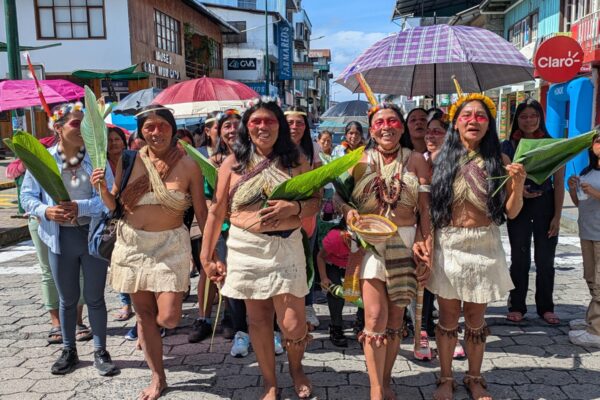

What: Amazon Watch will participate in the 16th Conference to the Parties (COP 16) of the United Nations Convention on Biological Diversity (CBD) alongside our partners, the Association of Brazil’s Indigenous Peoples (APIB), Association for the Integral and Sustainable Development of the Amazonian Pearl (ADISPA), Association of Indigenous Councils of the Municipality of Villagarzón Putumayo (ACIMVIP), Mujer Uwa, the Siona people, the Autonomous Territorial Government of the Chapra Nation (GTANCH), the Autonomous Territorial Government of the Wampís Nation (GTANW), and the Native Federation of Kakataibo Communities (FENACOKA) in Cali, Colombia from October 21 to November 1.
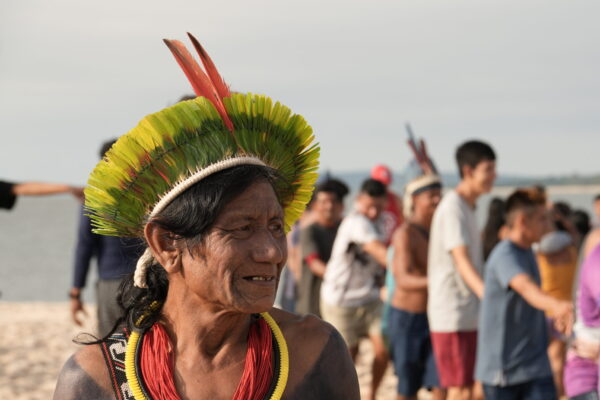
As the Amazon rainforest is engulfed in the worst fires in the past two decades and on the brink of its catastrophic tipping point, Amazon Watch is honored to amplify the voices, demands, and solutions of Indigenous land defenders who are delivering a clear message to world leaders in Colombia: Indigenous land rights must be protected to safeguard remaining global biodiversity and our collective future.
The Amazon rainforest is critical to global biodiversity and climate stability, as it is home to one-third of the Earth’s plant and animal species and produces one-fifth of all fresh flowing water. Yet, the vital biome – as well as the Indigenous communities that depend upon it for their livelihood – is facing existential threats from extractive fossil fuel and mining industries, industrial agribusiness, and expanding transnational networks of organized crime in the region.
Across the Amazon and the world, “Indigenous people are on the front lines of protecting biodiversity and fighting against climate change,” Andrew Miller of Amazon Watch emphasizes, as they steward 80% of the world’s remaining biodiversity while often putting their own lives at risk. On the path to the historic 30th UN Climate Summit (COP30), which will be held in the Amazon for the first time, COP16 is a unique opportunity for partner countries to take concrete action to defend Amazonian and Indigenous Earth Defenders and center their visions for a just transition.
A full list of Amazon Watch events, as well as recommended partner events, can be found here.
When: Indigenous leaders will be on-site in Cali, Colombia from October 21 to November 1, 2024.
The following Indigenous leaders and Amazonian policy experts will be available for on-site interviews about the role of the extractive oil and mining industries, organized crime, and Indigenous women’s leadership at COP16:
- Jani Silva, Colombian Campesina Leader, ADISPA
- Daris Tegria, Colombian Indigenous Leader, Mujer Uwa
- Olivia Bisa, first female President of the Chapra Nation in Peru
- Herlin Odicio, Kakataibo Peruvian Indigenous Earth Defender at risk
- Marcelo Odicio, Kakataibo Peruvian Indigenous Earth Defender at risk
- Leila Salazar-López, Executive Director, Amazon Watch (Indigenous women’s leadership issues)
- Ana Paula Vargas, Brazil Program Director, Amazon Watch (Brazil mining and agribusiness conflicts and Indigenous women’s leadership issues)
- Nathaly Yépez Pulles, Ecuador Legal Advisor, Amazon Watch (Ecuador oil and mining conflicts and Indigenous women’s leadership issues)
- Vladimir Pinto, Peru Field Coordinator, Amazon Watch (Peru organized crime and oil conflicts)
- Raphael Hoetmer, Western Amazon Program Director, Amazon Watch (Western Amazon oil, mining, and organized crime conflicts)
- Sofía Jarrín, Western Amazon Advocacy Advisor, Amazon Watch (Western Amazon oil, mining, and organized crime conflicts and Indigenous women’s leadership issues)
- Andrew Miller, Advocacy Director, Amazon Watch (Amazon oil, mining, and organized crime conflicts)
Interviews and multimedia
Andrew Miller at andrew@amazonwatch.org or +1.202.423.4828 is available on-site to coordinate interviews. Interpretation provided upon request.
Ricardo Pérez at rperez@amazonwatch.org or +51.94.399.2012 is available on-site to coordinate interviews. Interpretation provided upon request.
Background
The 16th Conference of the Parties (COP16) to the United Nations Convention on Biological Diversity (CBD) is a key space to advance international commitments that effectively protect biodiversity and address the climate emergency hosted in Colombia, a “megadiverse” country hosting 10% of the world’s biodiversity and that is also the most dangerous place in the world for environmental defenders.
Having declared the theme for COP16 as “Peace with Nature,” Colombian Environmental Minister Susan Muhamed has committed to centering the participation of Indigenous peoples and traditional communities at the gathering.
Held biannually, COP16 will be pivotal in implementing the 23 targets of the Kunming-Montreal Global Biodiversity Framework (GBF) that was adopted by the 196 participating countries at COP15 in 2022. As countries present their National Biodiversity Strategies and Action Plans (NBSAPs) for implementing the GBF, Indigenous communities and earth defenders must be honored as key decision-makers.
Amazon Watch will be advocating for the Parties of CBD to take bold action to:
- Establish “No-Go Zones” for fossil fuel and mining extraction in partnership with Indigenous and traditional communities. NBSAPs must incorporate urgent measures to achieve the rapid phase-out of fossil fuels and ensure a just and equitable transition. Likewise, the declaration of the Amazon Basin as a mining no-go zone developed in agreement with the Indigenous communities living in these territories where the protection of human and territorial rights are guaranteed is essential to ensure that this vital biome does not become a “sacrifice zone” for the renewable energy transition.
- Curb the rise of transnational networks of organized crime on Indigenous land, which drive deforestation, environmental degradation, and increasing violence against communities. Indigenous self-determination, land demarcation, and self-protection mechanisms must be at the core of any strategy to stop organized crime in the Amazon.
- Support Women Defenders of the Amazon, who are at the forefront of solutions to safeguard Amazonian biodiversity while facing formidable threats to their rights, safety, and ancestral territories. Countries must ensure that a rights-based, gender-sensitive approach is considered in the implementation of the GBF, ensuring participation in decision-making and financing, in line with Target 23 and the Gender Action Plan of the CBD.