
San Ramon – Adding a celebrity voice to a long-running battle, human rights activist Bianca Jagger plans to lead a delegation to ChevronTexaco’s annual meeting today to allege that a former subsidiary caused massive pollution in an Ecuadorian rain forest.
Jagger and some residents of the region who have unsuccessfully sought a meeting with ChevronTexaco Chief Executive Dave O’Reilly support a resolution asking the company to reconsider its responsibility for the situation in Ecuador.
ChevronTexaco spokesman Chris Gidez said that the company was a minority shareholder of an Ecuadorian concession from 1964 until 1992, ran the operations for most of that period, spent $40 million to clean up pollution and then turned over the project to its Ecuadorian partner. “We haven’t been there for 15 years,” said Gidez. “We can’t be responsible for the conditions that exist today.”
But Jagger denounced that stance as “totally unconscionable.” ChevronTexaco still has a legal and moral responsibility to clean up widespread pollution in the region where it once produced oil and discharged waste into open pits, she said. “People have been subjected to a slow process of poisoning and death,” she added in a statement at a news conference.
ChevronTexaco is one of the world’s four largest privately owned oil companies and, by virtue of the vast reach and heft of its $100 billion a year enterprise, a frequent target of critics who highlight its dealings with repressive governments and its huge environmental footprint.
Jagger, a slight, strikingly beautiful woman, was born in Nicaragua, educated in Paris and, for seven years in the 1970s, married to Rolling Stone Mick Jagger. Aware of the celebrity that comes with her past union with an entertainment superstar, she has traveled from Bosnia to Honduras, from Iraq to Zambia exposing human rights violations and publicizing grass-roots struggles for justice.
This week, Jagger spoke eloquently in English and Spanish about the effects of poverty and violence that she has witnessed. “I have visited many parts of the world,” Jagger said at a Monday news conference. “I was shocked by what I saw in Ecuador.”
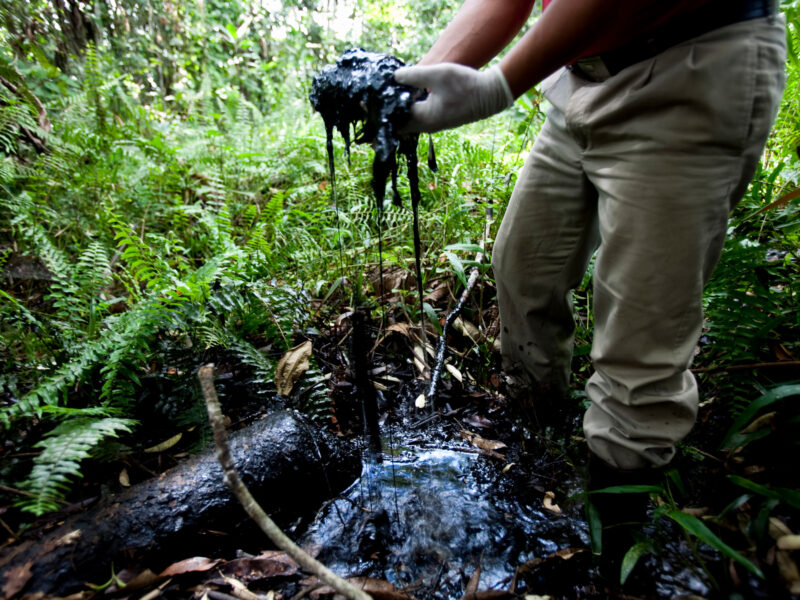
Judy Cannon, a nun from Burlingame, had a similar reaction. “It truly is awful to see,” she said of her recent visit to the polluted region. “Oil is in the water,” she said. “Oil covers everything.”
A few minutes later, tears welled up in the eyes of Rosa Moreno Chalaco, a member of Jagger’s delegation, as she displayed pictures of family members who died of cancer and detailed other ailments she has witnessed. Moreno, a nurse in the village of San Carlos near where the ChevronTexaco unit extracted oil for 20 years, is making her second visit to the Bay Area to publicize grievances against the company.
Gidez, the ChevronTexaco spokesman, said that the residents and their lawyers had failed to make a scientific link between the company’s operations and medical problems in the local population. Other contributing factors include the lack of clean drinking water, poor sanitation, low immunization rates and limited medical care, he said.
ChevronTexaco was formed in 2001, when San Francisco-based Chevron Corp. bought Texaco Corp., another oil giant widely known by its star logo. As part of that deal, ChevronTexaco acquired the defendant’s role in a 1993 class action lawsuit in U.S. District Court in New York City. The lawsuit sought damages from Texaco for pollution by its subsidiary in the rain forest of Ecuador, a country with 13.7 million people and a gross domestic product less than half of ChevronTexaco’s annual sales.
Two years ago, after ChevronTexaco promised to abide by a foreign court’s decision, a U.S. Federal Appeals Court sent the lawsuit to an Ecuadorian courtroom. There, in a pending case, 45 local plaintiffs say that the Texaco subsidiary was responsible for harmful practices that caused “the biggest ecological disaster in the nation’s history.” It asks the court to order ChevronTexaco to clean up open waste pools and to develop and implement plans to improve and monitor public health and to restore native plants, animals and fish in the region. The plaintiffs have introduced expert testimony that a full cleanup could cost $6 billion.
But ChevronTexaco says that in 1998 Ecuadorian authorities signed off on the cleanup efforts of its subsidiary, which had posted only $500 million in profits during 20 years of operations. The company says oil pools and discharges cited by Amazon Watch and other critics actually occurred after Texaco walked away from the Ecuador project in 1992. “In our view, the finger’s being pointed in the wrong direction,” Gidez said.
But with the support of Amazon Watch, a nonprofit advocacy group and others, including some local ministers who recently visited Ecuador, leaders from the Amazon seem determined to keep pursuing redress from the San Ramon-based energy giant.
Moreno, the Ecuadorian nurse, recalled that she was afraid when she began her earlier visit. “I wasn’t anything in this country,” Moreno said in Spanish. But now, Moreno says, she feels “brotherly respect” from local residents who hear her story.
This week, Jagger’s presence has added fire and drawn attention to the Ecuadorians battle. “Profit that is tainted with innocent blood is not worth it,” she said Tuesday at a news conference in San Ramon.
Added Moreno, “Although ChevronTexaco is a big entity, we’re not going to get tired or lose hope.”
– – – – – – – – – – – – – – – – – – – – – – – – – – – – – – – – – – – –
Rick Jurgens covers the housing, development and energy industries. Reach him at 925-943-8088 or at rjurgens@cctimes.com.