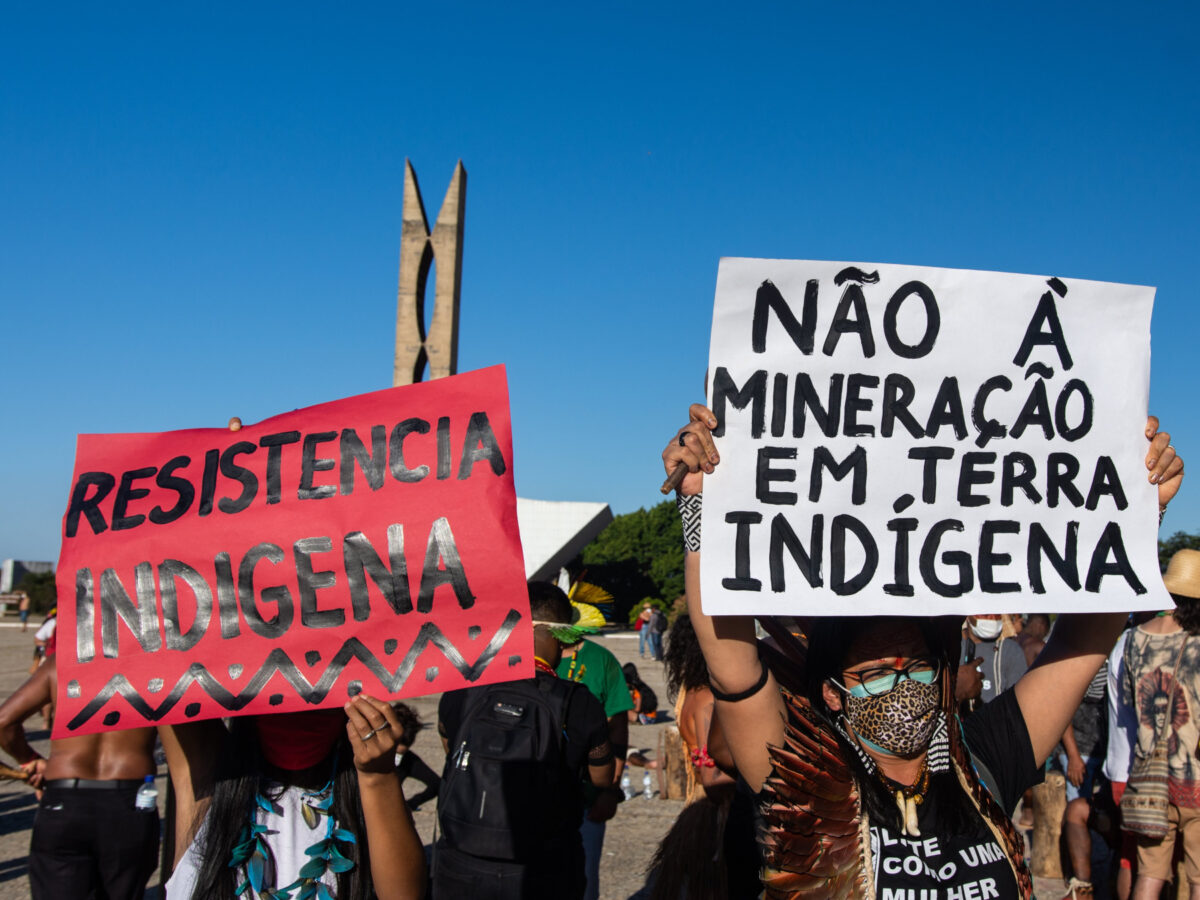
The threat posed by Canadian mining company Belo Sun to the Volta Grande do Xingu has reached Brazil’s Federal Supreme Court (STF).
Brazil’s Office of the Prosecutor General (PGR) has asked the Court to suspend, “with the urgency the case demands,” a provisional decision by the Federal Regional Court of the 1st Region (TRF1) that reinstated an installation license for the massive gold mine Canadian company Belo Sun plans to build in the Volta Grande do Xingu, one of the most biodiverse regions of the Amazon rainforest and an area already severely impacted by the Belo Monte hydroelectric dam.
The PGR is also asking that the suspension remain in place “until a final, unappealable judgment is reached in the underlying case.” In other words, until all appeals in the case have been definitively decided by the TRF1, Brazil’s Superior Court of Justice (STJ), and potentially the Supreme Court itself.
The PGR filed the request with the Supreme Court on September 1. It was signed by Deputy Prosecutor General Hindenburgo Chateaubriand Filho. Prosecutor General Paulo Gonet Branco informed the parties in the case that he considers himself barred from acting in the matter after SUMAÚMA revealed that Belo Sun had hired his son, Pedro Gonet Branco, as an attorney.
The PGR brought the issue before the Supreme Court through a legal mechanism known as a Suspension of Provisional Relief. Under the Court’s rules, requests of this kind are decided exclusively by its president – currently Chief Justice Edson Fachin, who has a record of rulings and votes favorable to Indigenous peoples. There is, however, no set deadline for Fachin to rule on the Prosecutor General’s request.
The risk to Indigenous communities in the Volta Grande do Xingu is precisely one of the reasons cited by Chateaubriand in asking the Supreme Court to intervene. In the 29-page filing, he summarizes the case and recalls that federal prosecutors had already demonstrated before the TRF1 that the right of affected Indigenous communities to free, prior, and informed consultation had been violated.
Even so, TRF1 Judge Flávio Jardim, the reporting judge in the case, concluded that Belo Sun had fulfilled its consultation obligations, having “apparently ensured adequate information, internal deliberation, and culturally appropriate participation.” In the decision validating the consultations and, consequently, the installation license issued by Pará State’s Secretariat for the Environment, Climate and Sustainability (Semas), Jardim uses the adverb “apparently” three times – a term that, in Portuguese, expresses uncertainty. He has also issued other controversial decisions involving Belo Sun, as SUMAÚMA has previously reported.
For that reason, the appeal to the Supreme Court is “the only avenue capable of ensuring, with the urgency the case demands, the immediate interruption of the effects of a decision that jeopardizes the legality of the environmental licensing process” for the gold mine “and the rights of the Indigenous communities involved,” Chateaubriand emphasized.
The gold mine, which Belo Sun has named the Volta Grande Project, is advertised as the largest open-pit gold mine in Brazil. If built, an area already heavily impacted by the Belo Monte hydroelectric dam would see the construction of a toxic tailings dam at least three times larger than Vale’s Brumadinho dam – whose collapse in 2019 killed 272 people and thousands of more-than-human beings.
The risks to Nature in the Volta Grande do Xingu also did not escape the deputy prosecutor general’s attention. “The ‘Volta Grande Project’ provides for the construction of a tailings dam with a capacity of 35 million cubic meters,” he states in the filing now before Fachin. To put that into perspective, 35 million cubic meters of water would fill 14,000 Olympic-size swimming pools meeting International Swimming Federation standards, each 50 meters long, 25 meters wide, and at least two meters deep.
The mine would also “involve the use of harmful substances such as cyanide” and would carve an enormous wound into an area that is an “ecological refuge of singular importance, classified as having ‘extremely high biological importance’ by Brazil’s Ministry of the Environment and Climate Change,” Chateaubriand observed. “The circumstances, as presented, call for caution.”
The Belo Sun case’s arrival at the Supreme Court was welcomed by movements opposing the Canadian mining company’s plans, after a series of decisions considered controversial at best by the Federal Regional Court of the 1st Region in recent months.
“We welcome with hope the arrival of the Belo Sun case at Brazil’s Supreme Federal Court. […] After so many years of violations and irregularities that have marked the project’s environmental licensing process, we hope the Supreme Court will examine the case with the attention and responsibility it requires,” said the Coalition for the Xingu, Life and Peoples’ Rights, a network of organizations and activists working to protect the river, in a statement.
Asked for comment by SUMAÚMA, Belo Sun said in a statement that it “understands that there are no grounds justifying an urgent measure to once again suspend the installation license for the Volta Grande Project, which was reinstated seven months ago.” The Canadian mining company said it “will continue participating in the conciliation process and the ongoing technical discussions, in dialogue with Funai, the other institutions involved, and Indigenous communities.”
Funai, however, has already publicly stated in a technical document issued in early August that “the installation license […] should be suspended or annulled until the issues” identified by its technical staff concerning the protection of Indigenous rights have been resolved.
The case comes before the president of the Supreme Court at one of the most delicate moments in the institution’s history, as Fachin deals with internal disputes – and an enormous credibility crisis – arising from suspicions that Justice Alexandre de Moraes may have acted on behalf of banker Daniel Vorcaro, owner of Banco Master. Suspicions of improper involvement with Vorcaro have also fallen on other Supreme Court justices – particularly Dias Toffoli – as well as on the sons of Luiz Fux and Nunes Marques.
In addition, there are allegations of politically biased conduct in the way Justice André Mendonça, the reporting justice overseeing the Banco Master investigations and once described as “terribly evangelical,” has handled the case. In reports published on September 10, piauí magazine revealed that Mendonça chose to make public suspicions raised by the Federal Police involving Moraes, a fierce opponent of Bolsonarismo, while keeping confidential a report by the same Federal Police concerning another justice, Dias Toffoli.
Fux and Nunes Marques – two justices who have aligned with Bolsonarismo in major rulings – have sons who are lawyers and who maintained ties with Banco Master. The law firm of Kevin de Carvalho Marques received more than 280,000 reais from a consulting company that did business with the bank. Rodrigo Fux, meanwhile, attended events with Daniel Vorcaro – including a whiskey tasting paid for by the banker in New York, to which Luiz Fux was also reportedly invited. The allegations involving Moraes and Mendonça are set to be reviewed by the full Supreme Court this Tuesday, September 15, and again on Wednesday, September 23.
Despite suspicions of unacceptable conduct involving some of its justices, the institution continues to be seen as a last source of hope for minority groups and for those confronting powerful political and economic interests.