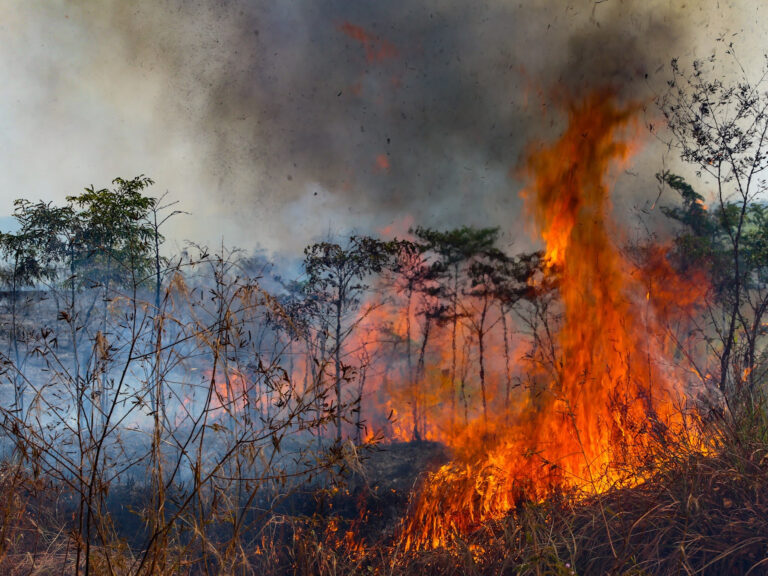
Primavera do Leste, Matto Grosso, Brazil – A coalition of Indigenous and civil society organizations is demanding that the International Finance Corporation (IFC), the private-sector arm of the World Bank Group, reject a proposed $100 million financing package for Agrícola Alvorada, one of Brazil’s major agribusiness companies. The coalition’s international petition, backed by 142 signatories, warns that investment could fuel deforestation across the Amazon and Cerrado, threaten Indigenous territories, and expand agricultural supply chains that already drive environmental destruction and social conflict. The IFC’s Board of Directors votes on the investment on Wednesday, November 25.
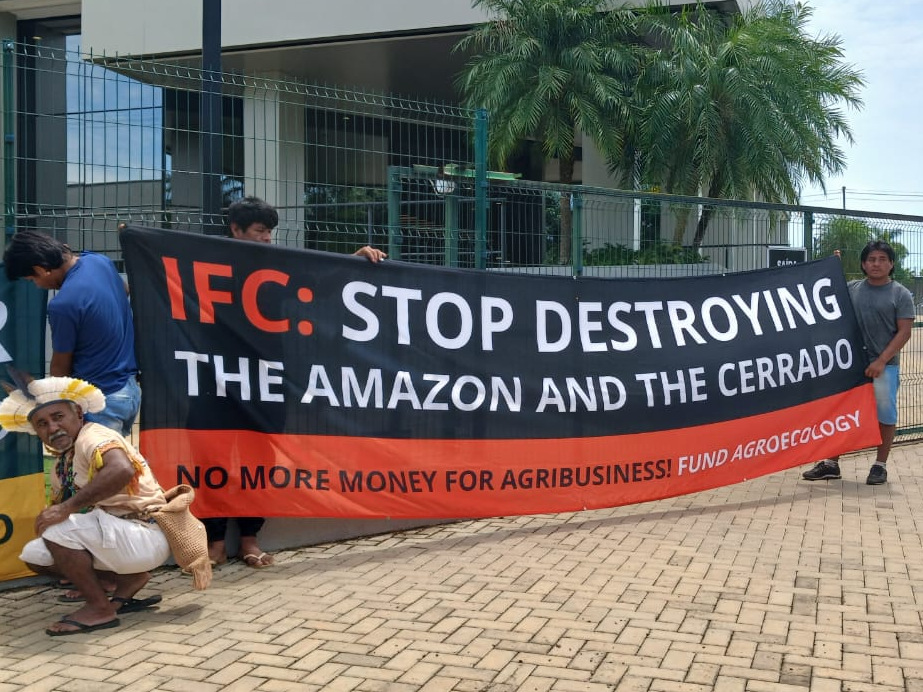
The international campaign has gained momentum as Indigenous Peoples mobilize across Brazil. Six Brazilian organizations sent a separate letter to the IFC, as Miriam Leitão reported in her column in the Brazilian newspaper O Globo, highlighting the risks of the proposed investment and noting that 18 Indigenous territories sit within a 300-kilometer radius of the project. On Tuesday, November 24, members of the Xavante people also protested outside the company’s headquarters in Mato Grosso.
The proposed financing would support grain procurement, ethanol production, and grain storage and logistics infrastructure. Yet the IFC’s own environmental and social assessment acknowledges that the company lacks full traceability of its indirect grain suppliers and does not restrict legally authorized clearing of native vegetation. The company will not implement critical environmental and social safeguards until 2027 and 2028. Furthermore, the IFC has left Performance Standard 7, which specifically addresses Indigenous Peoples, out of the safeguards that apply to the project.
“The IFC is considering financing the expansion of agribusiness in an area already deeply affected by soy monoculture, one of the main drivers of deforestation in Brazil, in flagrant violation of Indigenous local community rights,” said Pedro Charbel, Campaigner at Amazon Watch “Financing Alvorada fuels the expansion of export-oriented infrastructure that primarily benefits powerful international traders, while Brazil needs investment in agroecology, family farming, and infrastructure that strengthens socio-biodiverse local economies. The IFC must decide whose interests it serves: agribusiness billionaires or the majority of the Brazilian people. The choice should be clear.”
Bunge’s role as a shareholder in Agrícola Alvorada raises further concerns. Amazon Watch’s report Complicity in Destruction II documented how Brazilian environmental authorities identified Bunge in 2018 as one of five major grain traders purchasing commodities from farms under environmental embargoes. In 2023, an investigation by Repórter Brasil linked Bunge’s suppliers to the clearing of approximately 11,000 hectares of native Cerrado vegetation in just two years.
“The Cerrado is already under immense pressure from agribusiness expansion and has far weaker legal protections than the Amazon,” said Hiparidi Toptiro, A’uwe-Xavante Indigenous leader and General Coordinator of Rede Cerrado, one of the organizations supporting the petition. “Our territories are surrounded by large-scale plantations, and we live with the consequences of this agricultural model every day. When an institution like the World Bank finances this expansion without consulting Indigenous Peoples, it puts our health, our autonomy, and our children’s future at risk. If the Bank is truly committed to sustainable development, it should invest in the peoples who have protected biodiversity, water sources, and native seeds for generations, rather than in an economic model that threatens our very existence.”
The campaign comes just one month after the IFC withdrew a proposed $20 million loan to Brazilian agribusiness company Grupo Agronorte, responding to pressure from the Apinajé people and civil society organizations. Now, facing a proposed investment five times larger, the coalition is calling on the IFC to reject the financing or, at the very least, postpone its decision until the company demonstrates, through independently verified evidence, that it can prevent deforestation and uphold Indigenous rights.