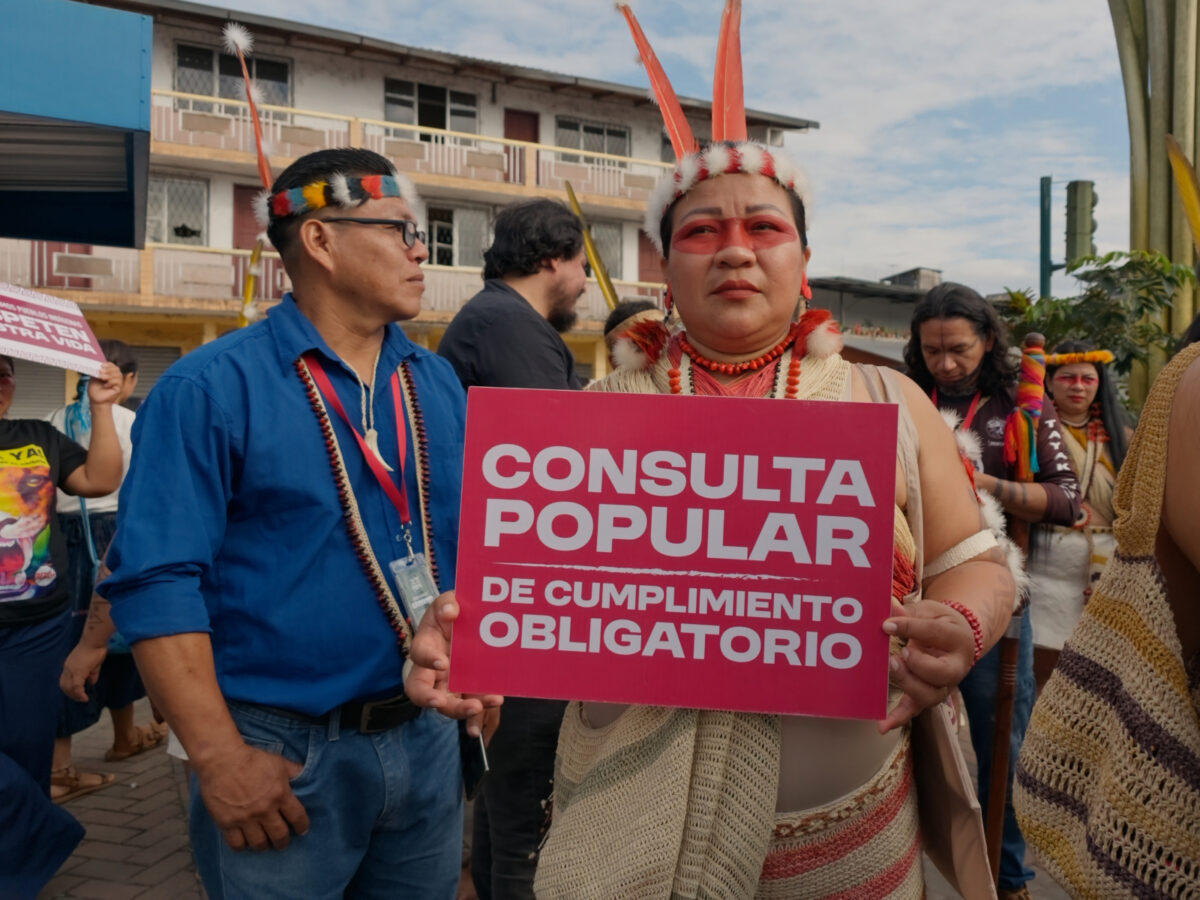
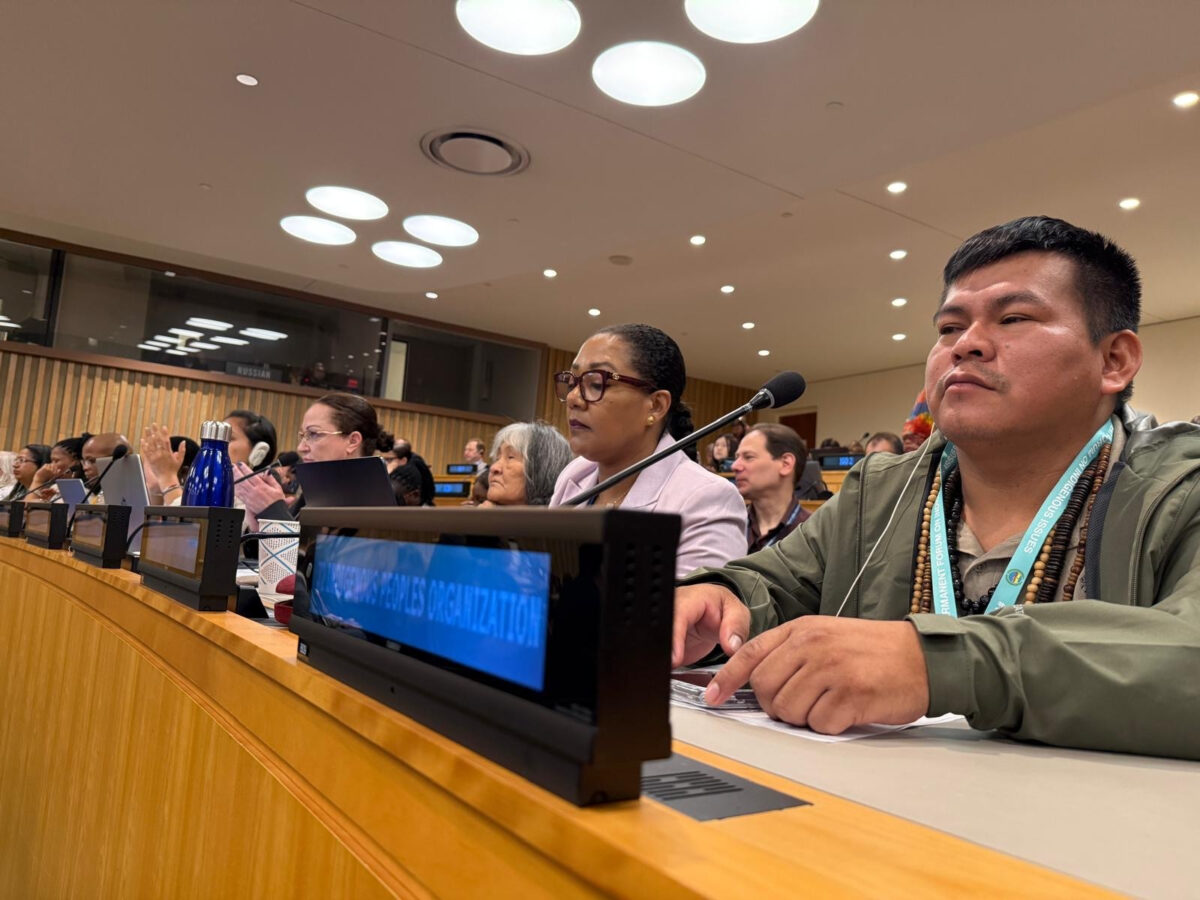
Vienna, Austria – Indigenous leaders from Brazil, Colombia, Ecuador, and Peru are in Vienna to demand recognition of their role in combating transnational organized crime in the Amazon. They represent Indigenous Peoples directly resisting illegal gold mining, logging, and drug trafficking fueled by global markets. Their arrival comes at a critical moment, as governments consider launching negotiations on a new international protocol addressing environmental crimes.
Amazon Watch and the delegation will participate in the 13th Conference of the Parties to the United Nations Convention against Transnational Organized Crime (UNTOC COP13), taking place October 19–23, pressing governments in Europe, the Americas, and beyond to recognize that there is no security in the Amazon without Indigenous Peoples. One of the most significant decisions at COP13 is whether governments will launch negotiations toward a fourth protocol under the U.N. Convention Against Transnational Organized Crime, one that would directly address crimes affecting the environment. The push comes as governments across Europe, North America, and Latin America redefine their strategies against transnational criminal networks, with the European Union making organized crime a shared security priority and pushing for closer cooperation with Latin America.
A growing coalition of governments and international organizations are pressing hard for negotiations to open, arguing that stronger international cooperation is essential to investigating, prosecuting, and preventing crimes such as illegal mining, wildlife trafficking, and illegal logging. Yet Indigenous leaders warn that none of these strategies are reaching the communities confronting criminal economies on the ground.
“Because this crisis is fueled by global markets, it demands a global response. That’s why we support a binding UNTOC Protocol to close the dangerous legal gaps that organized crime syndicates exploit. To succeed, cross-border law enforcement must trace illicit money and supply chains, while putting frontline communities at the center–recognizing Indigenous self-protection mechanisms and ensuring Indigenous Peoples are consulted as equal partners”
Sofía Jarrín, Advocacy Advisor, Amazon Watch
Criminal networks operating across borders and international supply chains are tightening their grip on the Amazon, linking illegal gold mining, drug trafficking, logging, human trafficking, and other illicit activities into increasingly interconnected systems. Research highlighted by Amazon Underworld shows that criminal organizations or armed groups operate in 67% of municipalities across six Amazonian countries, while multiple criminal organizations contest control in 32% of Indigenous territories.
The consequences reach far beyond South America. These networks are dismantling Indigenous territorial governance and driving deforestation and biodiversity loss in the most protected areas of the Earth’s biggest rainforest.
A new international protocol to close gaps in the fight against environmental crimes
For Indigenous Peoples in the Amazon, the outcome could not be more consequential. Criminal networks exploit gaps in law enforcement and operate freely across national borders, while Indigenous communities bear the cost on the ground. The delegation arriving in Vienna is demanding that governments support the opening of negotiations and commit to meaningful Indigenous participation throughout the process.
“A protocol on crimes that affect the environment must also protect those who defend the land. If negotiations begin, the process must guarantee the participation of Indigenous peoples, and their Free, Prior, and Informed consent to the territorial responses that states implement against the expansion of illicit economies in the Amazon.”
Galois Flores, Territorial Autonomous Government of the Wampís Nation
Indigenous territories are central to global security
Coordinated by Amazon Watch through its Stop Amazon Crime campaign, the delegation includes Patricia Gualinga of Ecuador, a member of the UN Permanent Forum on Indigenous Issues; Galois Flores, Vice President of the Autonomous Territorial Government of the Wampis Nation in Peru; Francisco Da Silva Piyako, an Indigenous leader from Brazil’s Juruá region; and Ingry Mojinajisoy, an Inga Indigenous leader from Colombia.
In the Brazil-Peru border region, Indigenous Peoples have built a binational guard to resist drug trafficking. The Wampis Nation’s Indigenous Guard is actively defending its territory against illegal gold mining. These initiatives show that Indigenous territorial governance and community-led protection are not peripheral to the fight against organized crime; they are central to it.
The delegation arriving in Vienna is pushing governments to recognize this reality in their international strategies and to confront the global markets for illicit gold, rare metals, and drugs that sustain criminal economies in the Amazon.
“Illegal gold and drug networks are ravaging the Amazon, government responses rely on militarization that endangers local populations, and are seriously compromised by corruption and complicity. Real security requires backing Indigenous land rights and community protection. Safeguarding Indigenous defenders is our strongest defense against environmental crime, and they must not be left to fight it alone.”
Rapha Hoetmer, Western Amazon Program Director, Amazon Watch
At COP13, delegates will press diplomats, international organizations, and civil society on a fundamental reframe: Indigenous Peoples are not merely victims of organized crime. They are essential partners in confronting it and must be recognized and supported as such.
Indigenous leaders and Amazon Watch experts will be available for interviews in Vienna and remotely throughout the conference.