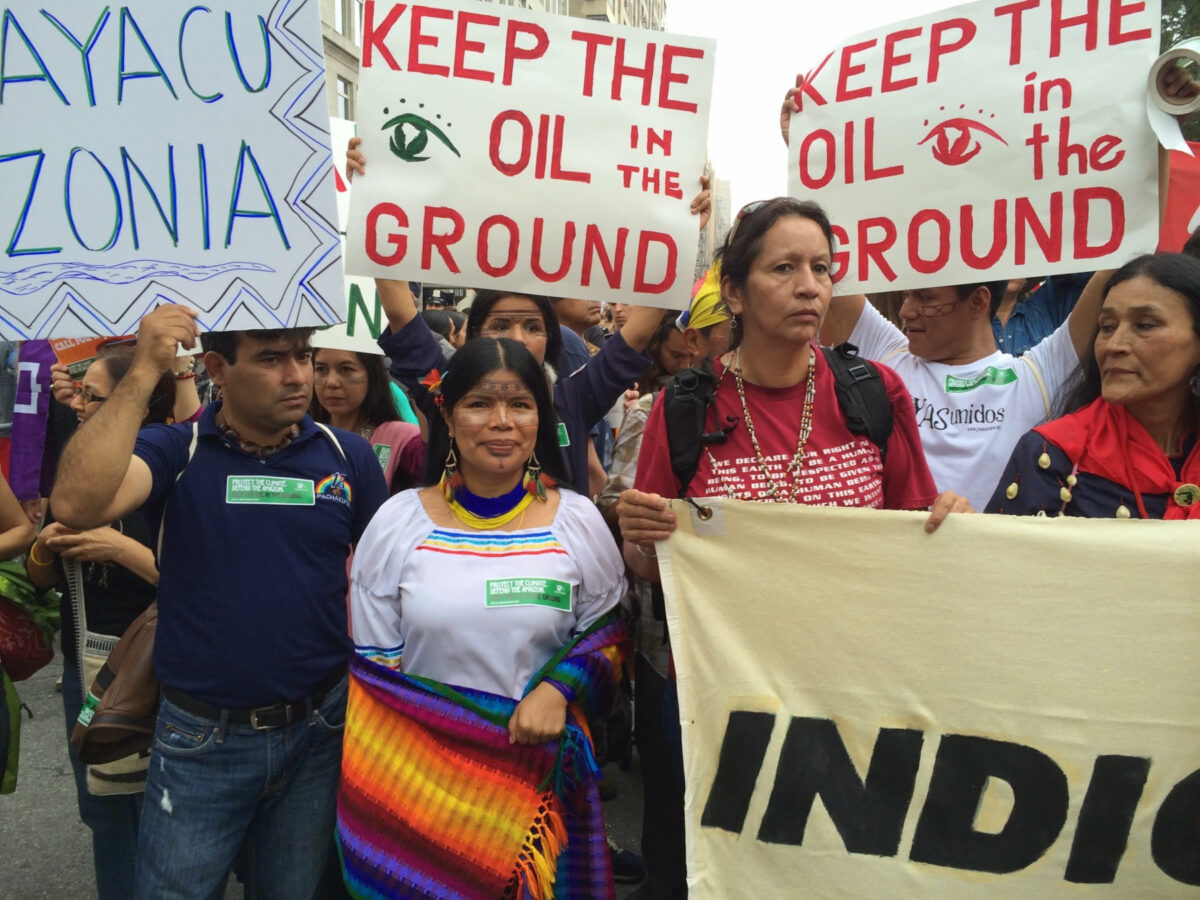
In 2013, in a drab downtown Houston hotel conference room, the Ecuadorian government held a briefing for energy investors on the “incredible opportunity” that oil blocks in the country’s southern Amazon represented. But the scene outside said something else. In the lobby of the hotel, dozens of activists had taken over, bringing business as usual to a stop.
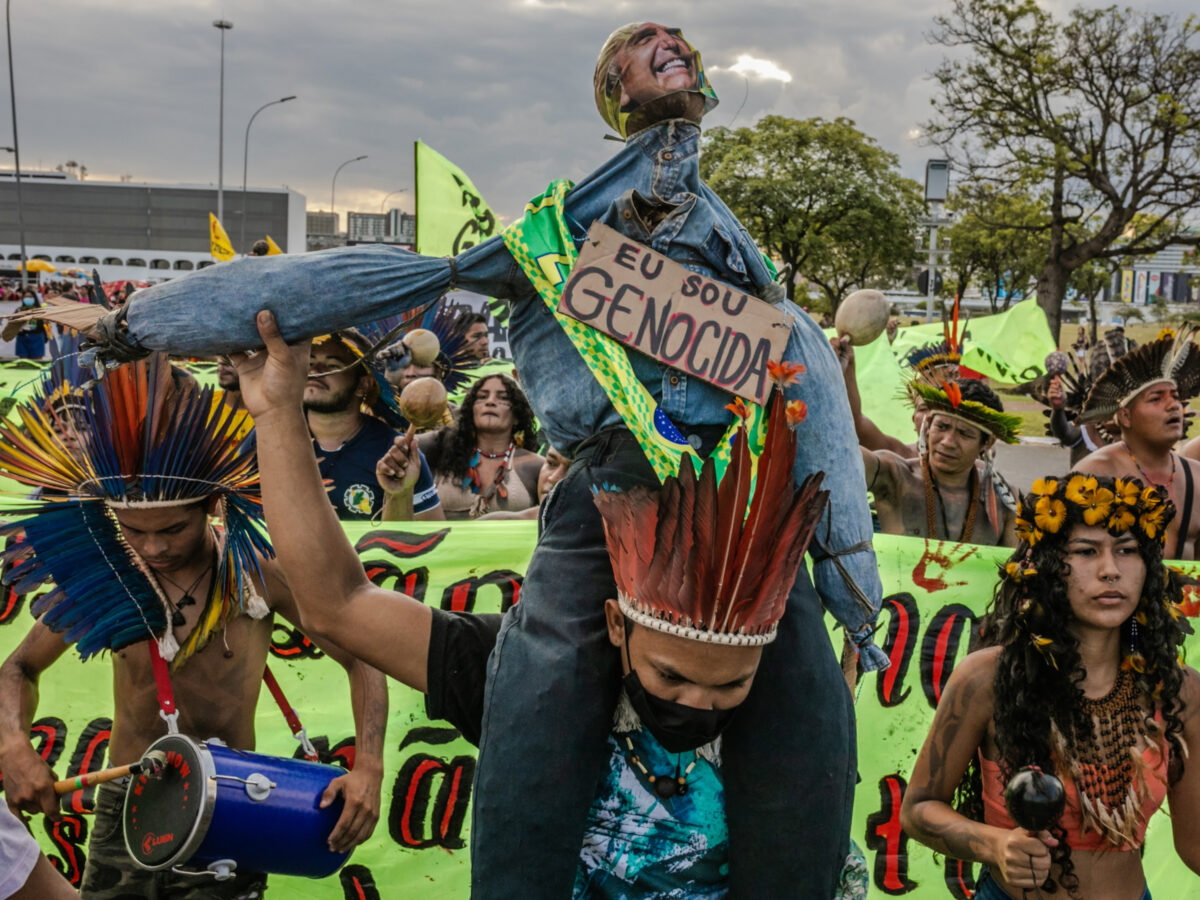
They were joined by Indigenous leaders who had traveled for days by canoe, taxi, bus, and plane to denounce government plans to expand oil extraction against the will of Indigenous Peoples and into fragile, frontier forests along the border with Peru. Indigenous leaders had traveled days from the Amazon to call out the Ecuadorian government and companies for negotiating their lands without their consent. The oil auction was ultimately scrapped due to Indigenous opposition.
But the government has dusted off those same plans, and it is hoping industry forgets that the blocks are some of the most controversial and contested in the Amazon.
Earlier this month, at the Annual Oil and Gas Summit in Quito, Ecuador made official its ambitious plans to launch a new oil auction,something we here at Amazon Watch have been warning about for the last two years.
The “Optimization and Exploration Round” opens 14 Amazonian oil blocks to new exploration in the remote southern rainforest along the border with Peru, puts 11 Petroecuador-held fields in northern Ecuador on the table, and targets Pungarayacu, a giant extra heavy crude oil field in the central Amazon. The Minister of Energy and the Environment has set a December 2026 launch date for the auction, with bidding rights up for acquisition in February 2027, offers due in Q2, and contracts signed by end of 2027.
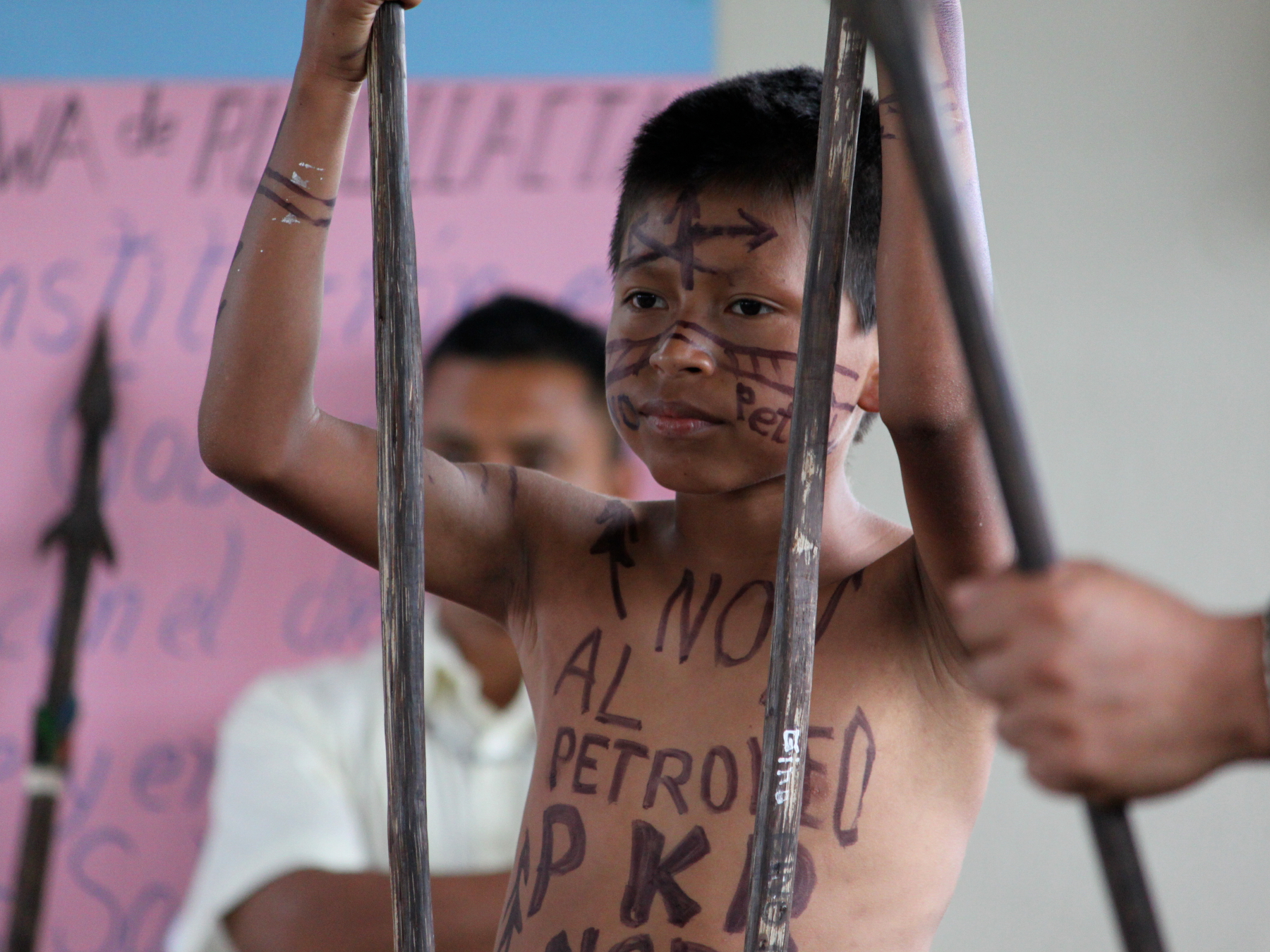
But much of the “new” oil round is anything but new. Indigenous Peoples whose territories overlap with the concessions have adamantly opposed them for over two decades. The 14 southern blocks cut across the titled territories of seven nationalities – the Achuar, Andoa, Kichwa, Sapara, Shiwiar, Shuar, and Waorani. And when the news broke that the government had revived plans threatening their rights, lands, and cultures, these nations rejected them immediately, highlighting the fact that the Indigenous nations have not been consulted nor provided their consent.
The administration of President Daniel Noboa is hoping to attract billions of dollars in private investment to expand oil production, despite global efforts to transition away from fossil fuels and estimates that global demand will peak by 2032, threatening economies heavily dependent on oil revenues.
The round combines new exploration, optimization of underproducing wells, and 11 offshore oil blocks, positioning Ecuador to tap into the wave of speculation around offshore drilling sweeping other Amazonian countries including Brazil, Guyana, and Suriname.
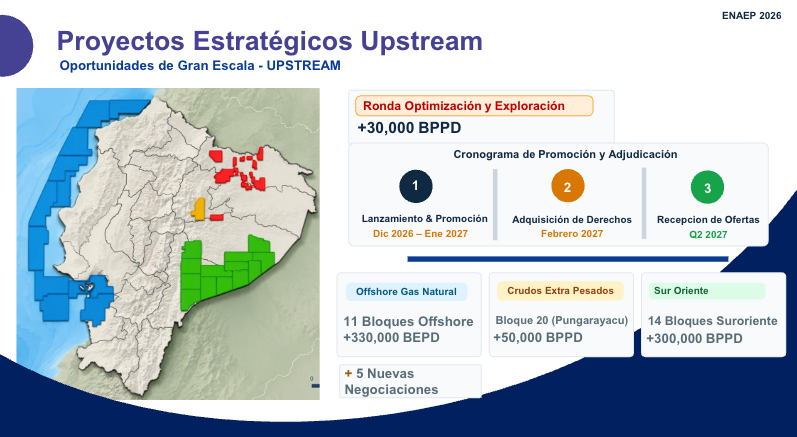
The government estimates that new exploration across the 14 Amazonian oil blocks would require some $4.5 billion in capital investment and claims production could eventually reach as much as 300,000 barrels of oil per day. But the plans remains a pipe dream.
Beginning with the 8th Oil Round in 1995, repeated attempts to auction this remote region of Amazon rainforest have encountered sustained Indigenous opposition, limited industry interest, and projects that failed to advance.
In the 1990s, the government gave drilling rights to Argentine company CGC to drill on the territories of the Kichwa people of Sarayaku, which consequentially led to conflict and rights abuses against the community. Ultimately, the community forced the company out and took the government to the Inter-American Human Rights Court, winning compensation and establishing important jurisprudence on the right to Free, Prior, and Informed Consent (FPIC).
Further south, American oil company ARCO received drilling rights in Shuar and Achuar territory, and it met strong resistance. Despite military threats and government and corporate attempts to divide and fracture their unity, the communities held firm. Unable to advance the project, ARCO sold the block to Burlington Resources, which fared no better. Oil giant ConocoPhillips tried next, met the same wall of resistance, and ultimately pulled out of Ecuador entirely.
The concessions were renamed and repackaged and launched en masse in 2012 as the 11th Oil Round, which was met with major protests in Quito, Houst, Paris, and Calgary as the government promoted the auction at oil conferences around the world.
In all of the government attempts over the last thirty years, no new wells have been drilled, demonstrating the sheer strength of Indigenous resistance to protect the Amazon.
Ecuador’s upstream expansion also targets the massive Pungarayacu oil field in Block 20 – the country’s largest, with an estimated 4.5 to 7 billion barrels of oil in place. Covering 1,100 square kilometers, the block sits at the intersection of the Andean-Amazon corridor and the headwaters of the Napo River basin, a major Amazon tributary, surrounded by an extensive network of rivers and streams that sustain Indigenous territories and protected areas. Much of it overlaps with the ancestral and titled territory of the Kichwa of Rucullacta and sits adjacent to the Sumaco Napo-Galeras National Park, the Sumaco Biosphere Reserve, and major cultural and archaeological sites.
Without the consent of the 17 Rucullacta communities, the Ecuadorian government awarded Canadian company Ivanhoe Energy a 30-year contract in 2008 to drill using technology that would allegedly upgrade the extra heavy, highly viscous crude that is both technically challenging, energy intensive, and expensive to extract.
Amazon Watch joined Rukullakta and Accion Ecologica in a major public campaign rejecting the drilling operation, the lack of FPIC, and the environmental impacts of a massive heavy oil project at the gateway of Napo River basin. Rukullakta built alliances with local tourism companies and downriver communities, along with Indigenous communities affected by Ivanhoe’s tar sands operations in Canada, and petitioned the Inter-American Commission on Human Rights to halt the project and revoke the contract.
Community organizing and opposition repeatedly complicated Ivanhoe’s ability to advance exploration and development. By 2014, after more than five years without moving beyond the evaluation stage, Ivanhoe pulled out of the project and left Ecuador.
Investors should not be fooled by Ecuador’s attempt to repackage and resell these problematic projects that have repeatedly failed to produce oil. The seven Indigenous nations remain united in their opposition, and neither the Amazon nor the global climate can afford more extraction. With global demand approaching its peak, Ecuador should not bet its economic future on more new oil exploration. It is time for Ecuador to join the countries building a just energy transition away from fossil fuels and toward an Amazon free from extraction.