

Eye on the Amazon: The Official Blog of Amazon Watch
Solidarity with Brazilian Social Movements
Marchers protest against Brazil's backsliding on environmental and human rights policies
April 10, 2012 | Felipe Milanez
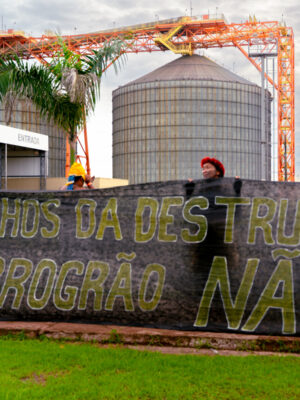
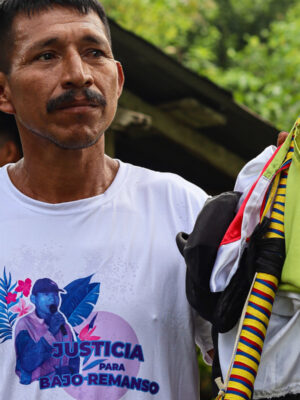
The Embassy of Brazil in Washington, DC – a modernist building that contrasts with the classical buildings of the beautiful Embassy Row, embassy sector of the United States capital – was the scene of a march yesterday that brought together about 100 people. In attendance were students, activists, and Brazilians who live in the region that expressed their concerns during President Rousseff's visit to the city. The participants protested against four central themes: violence in the countryside, especially in the Amazon, and impunity of the leaders and executors of these crimes; land reform; changes in the Brazilian Forestry Code; construction of large dams in the Amazon. Posters displayed images of José Cláudio Ribeiro da Silva, his wife Maria do Espirito Santo da Silva, both killed in May 24, 2011, Dorothy Stang, Chico Mendes, and a scene of the burial of 19 landless workers killed in the massacre of Eldorado dos Carajás, in 1996.
"The Amazon and its people want to live. Stop the violence!" said one of the banners, referring to a dramatic situation in the Amazon: the politically motivated assassinations in the region. Photos of Laisa Santos Sampaio, sister of Maria, and Nilcilene Miguel de Lima were paired with their recent statement: "I want to live." The same words were spoken by Chico Mendes, shortly before his death. Nilcilene is under protection of the National Force, ending soon. Laisa, who also receives death threats, continues without any official protection.
Marguerite Hohm, sister of the missionary Dorothy Stang who was assassinated in Pará in 2005, participated in solidarity with activists who receive death threats in the region. "Enough with the violence in the Amazon," she said. After serving only part of their sentences, some of those involved in the assassination of Dorothy Stang, such as Bida, one of the leaders, and Fogoió, one of the executors, are already free.
The slogans of the mobilization included social and environmental phrases, against the damming of Belo Monte Dam ("Stop Belo Monte"), against the Forest Code being voted on by the Brazilian Congress ("Veto it, Dilma!"), as well as "Don't be afraid to say NO to the Agrarian Elite”, and in defense of traditional forest peoples: “Indians, gatherers and farmers: doctors of ecology. "
Dilma Government Backsliding on Environment
As Rio+20 nears, Brazil’s Dilma shouts down critics and undermines her case
April 6, 2012 | Christian Poirier
Are those of us concerned about the growing and dire threats to the Amazon and its peoples fantasizing about President Dilma Rousseff's dismal socio-environmental policies? She seems to think so. This week she belittled the critiques of leading Brazilian human rights and environmental organizations calling their objections to her government's disastrous plans to extensively dam the Amazon's rivers a "fantasy."
Telling assembled representatives of 36 NGOs that their concerns about her government's unprecedented backsliding on socio-environmental issues are "absurdly ethereal or fanciful", Dilma has launched a counter-offensive to the growing and well-deserved criticisms that she is presiding over a catastrophic dismantling of the hard-won social and environmental gains enshrined in Brazil's 1988 constitution.
The timing of this vitriol is not accidental: in the months preceding the Rio+20 conference the Brazilian government urgently needs to reinforce its credentials as a country that has balanced economic growth and poverty reduction with respect for environmental sustainability and human rights. However, Dilma may find it challenging to keep the wool pulled over our eyes; disasters like the gutting of Brazil's conservationist Forest Code and the illegal construction of the Belo Monte dam on the Amazon's Xingu River irrefutably undermine her government's socio-environmental record.
The Trial and the Road to Justice
March 30, 2012 | Mitch Anderson
The courthouse stands four stories high along the main drag of Lago Agrio. Like all other buildings in the town, the weather has gotten the best of it; it is tropically dilapidated. The colors, off-white with yellow trim, are ruined; the cement shows signs of crumbling; and from up close the black mold appears to be winning against all else.
The townspeople refer to the building as "la corte", though in actuality the court itself is only a series of offices on the third floor. The first floor is a credit agency, a copy and print shop, and an appliance store; the second floor is the government tourism office, full of brochures; and the fourth floor is a vacant, dark and unused terraza.
At the courthouse on the third floor, the people move slowly, deliberately. The air conditioning does not work. The air is stale and sticky. Just as any other provincial court, there are the usual characters – the judges, prosecutors, defenders, administrative workers – who shuffle in and out of rooms, swamped with any number of local civil or criminal cases. There are also, of course, the plaintiffs and the defendants, who come and go, huddle with their lawyers, wait, come and go again, always hoping never to return. In general it is an average courthouse scene.
Amid Growing Challenges the Battle Continues to Defend Kayapo Territory
March 29, 2012 | Maíra Irigaray and Christian Poirier
On March 20th fourteen Kayapo leaders traveled to the headquarters of Brazil's indigenous agency FUNAI to discuss the demarcation and regularization of ancestral indigenous lands known as Kapot Nhinore, and to denounce the serious conflicts taking place between Kayapo and Juruna peoples and those who have occupied their traditional lands.
"I don't want to go back home only with words, I want to go back home with a solution," said Daniel Apinama, one of the Kayapo leaders on the delegation. "The area was traditionally always ours, but now there are all sorts of invasions by farmers, fishermen, and businessman building hotels. If there is no adequate response, there will be conflict."
Endeavors to demarcate Kapot Nhinore started thirteen years ago but the process has been foiled by unfulfilled promises from FUNAI, leading to a protracted struggle. Terry Turner, an anthropologist that has worked alongside the Kayapo for over 45 years, participated in a technical study on the process of demarcation and delivered his working group's full analysis in 2003. However, FUNAI has claimed that there were documents missing, indefinitely stalling the demarcation process.
Indigenous Groups Fight for Recognition and Illumination in Peru
March 26, 2012 | Patrick le Flufy
"Shh, wait here," Wilson told me. I ducked down behind the buttress of a large tree to wait. We had been walking through the jungle for a few hours. At first we followed a path through the undergrowth, a wet world of ferns, trunks and lianas speckled with the sunlight that made it down through the canopy and understory, but soon we simply walked along a route Wilson picked out. I had been trying to concentrate on the myriad sounds: cicadas were the background and various small birds tweeted from different points. We were listening and looking for signs that would lead us to prey – perhaps the calm whistle of a perdiz or the scent – marking of a boar – but just before Wilson became excited I had heard nothing. He stopped and said, "Red monkeys," pointing ahead. I saw a reddish shape that might have been an animal in the treetops ahead, so nodded vaguely. A few paces on he turned to me, "Only two, but some woolly monkeys as well – 2 groups." Then I heard the telltale swishing of branches as the monkeys leapt through the branches. Now we were close and Wilson had gone ahead without the lumbering gringo. A few moments later there was a loud bang and a thud on the ground. We would have full bellies tonight.
Wilson is not just an expert hunter. Two weeks earlier, he'd been helicoptered out to Nueva Vida, a village upriver on the Rio Corrientes, to record and assess a 1 kilometer long oil spill using GPS and video. Wilson is an assessor of the environmental monitors for FECONACO, the Federation of Native Communities of Rio Corrientes.
In the FECONACO office in Iquitos, where Wilson works a third of the time, he uses the Internet daily to ensure the leaders of FECONACO, Pluspetrol and the government are up to date on the environmental state of Rio Corrientes and to report any new spills, which happen with terrible regularity. While he insists he is not yet used to the city (he has worked in Iquitos for just two months) and much prefers the tranquility of jungle life – where you do not have to pay for everything – he clearly knows a lot more about the urban world than I know about life in the jungle.