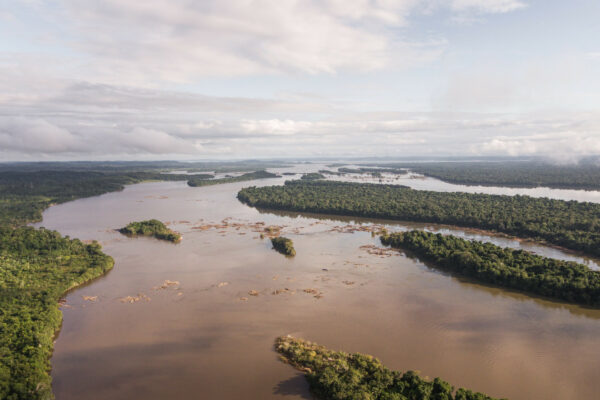

The Madeira River Complex—an enormous mega-project
including the construction of four hydroelectric dams, extensive river dredging
and opening of channels—is currently under way in Brazil's western Amazon. The
Complex threatens the ecological stability of the entire Madeira River and the
livelihood of local communities. The
Madeira River Complex is part of two larger initiatives: the Integrated
Regional Infrastructure for South America (IIRSA), an effort by the national
governments to construct a new infrastructure network for the region, and the
Accelerated Growth Program (PAC), the flagship "development" program of Brazil’s
former president Lula.
Despite being heavily promoted as a necessary
hydroelectric project for Brazil to meet its increasing energy demand, the underlying
justification for the Madeira River Complex is that it will serve to promote
raw material export, particularly soybeans, timber and minerals. Through the
installation of navigation locks and dredging to open the river channel, the
Madeira River Complex will connect the western part of Brazil with highways
being built in the Peruvian and Bolivian Amazon to the Pacific, facilitating the
export of raw materials to Asia and North America.
Amazon Watch continues to monitor the
Madeira River Complex and supports the local and international campaigns to
protect the region’s environment and communities.
The construction of both the Jirau and
the Santo Antônio dams is currently underway, with a planned start of operation
in 2012. The Madeira River Complex was initially
conceived in the early 2000s by the energy company Furnas Centrais Elétricas
S.A. and the construction company Norberto Odebrecht S.A., soon after Brazil
experienced a major energy crisis, during which the electricity system suffered
severe shortages. Furnas and Odebrecht
prepared an environmental impact assessment (EIA), which was submitted to
IBAMA, the Brazilian environmental protection agency, the government body that has
jurisdiction for licensing projects of the scale of the Madeira River Complex.
In March 2007, IBAMA questioned
the environmental feasibility of the Madeira project and decided that they had
insufficient data from the EIA to be able to issue an environmental license.
The body demanded
detailed responses from the project proponents regarding what the agency
considered the most critical issues, including the need to carry out a new, more comprehensive environmental
impact study in domestic and cross-border areas.
Observations
made to the EIA from scientists show that the area to be flooded by the Jirau
dam would be much larger than suggested, leading to a decrease in biodiversity
and an increase in methane gas released from the flooded forest. The EIA, thus,
dismissed Brazilian environmental legislation (CONAMA Resolution 01 / 86),
according to which the limits of the geographical area to be directly or indirectly
affected by a project must be defined.
The
EIA also underestimated changes to the velocity of the river and tributaries,
suggesting an underestimation of the amount of sedimentation built up by the
Santo Antônio and Jirau dams. Higher sedimentation would extend the area
flooded by the dams, and could shorten their effective life. The dams would
block the migration routes of important fish species, affecting the food
security of indigenous peoples, farmers, and urban citizens who depend on the
consumption of the Dourada and the Piramutaba, two
of the staple fish species of the region.
Environmental
license
Despite the recommendations
of IBAMA’s technical team and its then-Licensing Director, political
authorities in Brazil placed pressure for the Preliminary License for the Santo
Antônio and the Jirau dams to be approved. This culminated with the President
of IBAMA being replaced and the License Director resigning from his post. In
July 2007, after months of deliberation, IBAMA approved the EIA for the Santo
Antônio and Jirau dams under strong political pressure. The environmental
license was granted on the condition that 33 demands were met in relation to
the construction and functioning of the two dams. Included in the demands were
proposals for the construction of channels to allow for fish migration on the
lateral sides of the dams, permanent monitoring of mercury levels and
accumulation of sediments behind the dam propellers, and social support
programs for local riparian communities.
The
auctions
With the Preliminary License for the
dams approved, the auctions for their concession were scheduled. In December 2007,
the consortium led by the large construction company Construtora Norberto
Odebrecht, the state-owned company Furnas Centrais Elétricas, engineering
company Andrade Gutierrez Participações, mixed economy company Cemig and a
financial fund made up of Santander and Banif banks won the bid for the
construction of the Santo Antônio dam. Then, in May 2008, the Jirau dam was
auctioned and the winning consortium included GDF Suez, the energy company
partially owned by the French government, Brazilian conglomerate Camargo
Corrêa, and the state-owned electricity companies Eletrosul and Chesf.
Cross
border impacts
Not only did the Environmental Impact
Assessment underestimate the size of the area of influence of the Madeira Complex,
but it also dismissed the potential impacts extending beyond Brazilian
territory. Part of the watershed of the Madeira River is located in Bolivian
and Peruvian territories. The projects are expected to have far-reaching
environmental and social impacts beyond Brazil and into the tri-border region
with Peru and Bolivia. The dismissal of cross-border impacts yielded a
diplomatic crisis between Bolivia and Brazil. The Bolivian government sent a
number of official letters and statements to the Brazilian authorities, but
none generated any effective response.
Environmental
Impacts
The
Madeira is the largest tributary of the Amazon, representing 23 percent of all
hydrological resources in the Amazon basin, and contributing 15 percent of the
water volume and half of the sediments and nutrients that flow into the Amazon
River and out into the Atlantic Ocean. The region is considered to be a “mega-biodiverse”
home to an estimated 750 fish and 800 bird species.[1]
In addition, the construction of the dams will likely change the water levels
of the Madeira River during both the dry and rainy seasons.[2]
This could potentially have an impact on lowland agriculture practiced by
indigenous peoples and other traditional populations that live in the region.
The
Environmental Impact Assessment that was carried out before the auctions for
the dams contained a series of flaws (link to the EIA flaws sections). In addition, after the
bidding, the winning consortium of the Jirau dam, Energia Sustentável do
Brasil, relocated the project to a new construction site without performing new
environmental impact studies.
Social Impacts
The
Santo Antônio and Jirau dams are expected to cause extensive negative impacts
on the region's local populations and ecosystems. Possible effects include the
displacement of families and communities, the potential extinction of migratory
fish species, the increased spread of malaria, increased erosion of riverbanks,
and stronger pressure on already lacking social services due to the migration
of families in search of jobs.
The
Instituto Madeira Vivo (The Living Madeira Institute) in the city of Porto Velho
collected testimonies from local communities that demonstrate how the social
implications of the dams’ construction have not been properly addressed.
Problems range from the lack of consultation with local communities to the inadequate
provision of alternative housing, as conveyed in these statements:
“The
company decides everything without asking people if that is what they want, and
they are building houses made from thin metal sheets in the settlements.”
“We
only know that we will have to leave our homes, but we don’t know what the
compensation will be or if everyone will receive compensation.”
“It is
a model that does not work with the Amazon reality, because the region is very
hot and will be unbearable to live in these houses, what’s more, the quality
(of houses) is not good at all and we don’t want to live in those places.”
“Dozens
of these houses have fallen down, even before they’ve been occupied.”
Indigenous Peoples' Rights
Lack of free, prior and informed consent
Different indigenous peoples
live in the area where the Madeira Complex is being built. A number of
documents, such as Brazil’s Federal Constitution, Convention 169 of the International
Labor Organization and the United Nations Declaration on the Rights of
Indigenous Peoples stipulate that indigenous peoples must be adequately
consulted before the implementation of any project that could negatively affect
them. The companies involved in the Madeira Complex have failed to do so. As an example, the ESBR consortium responsible
for building the Jirau dam, points to the inclusion of indigenous leaders in
the opening panel of a public hearing on the construction as in indicator of “consultation”
with the local indigenous communities. This sort of interaction does not
constitute free, prior and informed consent. [link to FPIC section]
Isolated indigenous peoples
The
National Indian Foundation (FUNAI), the government indigenous affairs
department, has strong evidence that indigenous peoples in voluntary isolation [link to section on isolated
peoples] live in the region of the Madeira Complex. These groups of
traditional indigenous peoples reside in remote forest areas with little or no
contact with outside people. They depend
on the forest and rivers for their sustenance and wellbeing, and are extremely
vulnerable to disease—even simple colds can be deadly—because of their limited
exposure to the outside world over the generations. Several official documents
confirm that FUNAI alerted IBAMA (the federal environmental agency) and the
consortiums responsible for building the dams about the presence of these
people in the area during the environmental studies. However, IBAMA and the two
consortiums disregarded FUNAI’s warnings.
In
late 2009, an expedition led by FUNAI and the Brazilian NGO Kanindé, among
others, confirmed the presence of four communities of isolated indigenous
peoples in the area where the Madeira Complex is being constructed. The report
issued by the expedition concluded that the groups are likely to have already
fled their territory due to noise coming from the construction sites. As has
frequently happened in the past, the contact between isolated indigenous
peoples and outsiders could decimate the indigenous peoples because of their
lack of immunity.
Project Finance
In January 2007, Brazilian
President Luiz Inácio Lula da Silva announced the Accelerated Growth Program
(PAC), the largest investment package to spur economic growth in Brazil in the
past 40 years. Among the PAC projects, the Madeira Complex is one of the
largest and most harmful development projects planned.
Brazil’s Economic and Social
Development Bank, BNDES, [link
to BNDES profile in the Finance section] has approved R$7.2 billion in
financing to build the Jirau dam, while the Santo Antônio dam will receive
R$6.1 billion. Clearly, without BNDES financing, the Madeira Complex would not
be put into practice, as the risks and enormous costs of the project would not
attract sufficient investment from private institutions.
Founded in 1952 to support
the country’s industrialization process and plan long term development, BNDES,
a public bank, has been become one of the largest financial institutions in the
world over the past years. Using subsidized funds, it finances both public and
private companies, including multinationals. BNDES is currently present in
almost every large business negotiation in Brazil and critics have stated that
the institution is working as if its resources were unlimited. In the case of
the Madeira Complex, as well as in many other operations, BNDES has committed
to use public funds to finance a highly costly project of unprecedented scale.
The investment risks, therefore, have been placed on the shoulders of the
Brazilian taxpayer.
The Madeira Complex is also
part of IIRSA, the most ambitious plan to
integrate the region via investments in
highway construction, widespread dredging, and dams. The initiative, if
completed, will connect areas containing natural resources (such as timber) and
agricultural regions (such large-scale soybean farms) with ports in
metropolitan areas, facilitating transportation of raw materials to the world’s
largest markets. The initiative has received technical and financial support
from the Andean Development Corporation, the Inter-American Development Bank, the
United Nations Development Program, and others. [link
to each bank in the Finance section]
The projected costs of the
two main dams of the Madeira Complex have risen substantially since the project
was initially presented, from US$5.5 billion to US$12.6 billion, a 129% increase.[3]
Project Monitoring
Illegal deforestation
In February 2009, Energia
Sustentável do Brasil (ESBR by its acronym in Portuguese), the consortium
responsible for building the Jirau dam, was fined twice by the Brazilian
environmental agency IBAMA for serious violations of environmental law. Both
cases involved illegal deforestation. Both fines, which total R$ 1,375,000
(Reais), remain unpaid.
Labor
conditions
In September 2009, Brazilian
authorities found 38 people working in slave-like labor conditions in the
construction site of Vila Mutum, the transfer site for families when flooding
begins from the Jirau dam. As it is common in situations of this type, workers
had come from a distant location, and had been attracted by promises of high
salaries. The Brazilian authorities found the workers living under subhuman
conditions, in an overcrowded wooden shelter, where they had no beds. The
shelter had no adequate electricity or sanitary facilities[4].
In early 2010, Brazilian
authorities also reported finding inadequate working conditions in a
construction site for the Santo Antônio dam. The construction site, responsible
for clearing forest areas that will be flooded by the dam, was suspended for
two months due to a number of violations. Problems ranged from inadequate
sanitary facilities, poor food provision, lack of appropriate medical care,
uninhabitable shelters, among others[5].
In June, workers involved in the construction of the Santo Antônio dam broke
silence and reported further abusive labor conditions they are being subjected
to[6].
Workers reported the frequent occurrence of accidents (some culminating with
the death of workers), which are covered up by the Santo Antônio consortium,
led by construction company Odebrecht. These accidents are often caused by lack
of training and the very intense work pace imposed by managers.
GDF
Suez
French
company GDF Suez is the main target of a campaign led by an international
coalition of civil society organizations from Brazil, Europe and the United
States. As the majority stakeholder in the dam-building consortium ESBR (Jirau
dam), the coalition identifies GDF Suez as directly responsible for the serious
social and environmental impacts and risks related to the dam.
In
early 2010, the coalition of civil society organizations sent a letter to Mr.
Gérard Mestrallet, the President of GDF Suez criticizing the company for its
involvement in the construction of the Jirau dam. The letter was also sent to French
President Nicolas Sarkozy and other authorities in the French government, as
GDF Suez is owned in part by the government. The coalition called on GDF Suez
to immediately suspend all activities related to construction of the Jirau dam
on the Madeira River.
GDF
Suez was nominated to the 2010 Public Eye Awards, a critical counterpoint to
the annual meeting of the World Economic Forum in Davos. The Awards’ aim is to
remind “the players of the global economy who impact people and the environment
with destructive business practices that actions have consequences – in this
case for the image of the company”. GDF Suez was shortlisted for the Global
Award.