
Eye on the Amazon: The Official Blog of Amazon Watch
Ecuadorians Shake Up Chevron Shareholder Meeting
May 29, 2012 | Paul Paz y Miño
At its Annual General Meeting in San Ramon on Wednesday, Chevron executives gave a good show – and a chillingly hard line. CEO John Watson told the assembled shareholders and activists from around the world that all was well, the company was raking in money and there was nothing to worry from those pesky multi-billion-dollar legal judgments and threatened fines against the company.
Watson showed a series of slick videos about Chevron's global business, including one purporting to show how the $18 billion Ecuador judgment against Chevron was a "fraud." For an in-depth and truthful expose on their disaster see chevrontoxico.com.
Pressed by shareholders and large institutional investors who urged Watson to settle the case, Watson dug in his heels and took the hardest line he has yet taken publicly in the 18-year-old case.
Taking it to Chevron's Doorstep
May 29, 2012 | Paul Paz y Miño
Tomorrow, May 30, Chevron will be practicing the elaborate rite of corporate public relations known as the Annual General Meeting for shareholders. At the company's headquarters in San Ramon, California, there will be plenty of image-buffing and apple-polishing for top executives and the board of directors, plus praise for the company's obscene profits.
Of course, denial of reality also will be part of the show. Chevron executives are likely to make only passing mention of their dire legal situation internationally, from Ecuador to Brazil to Nigeria, where the company faces tens of billions of dollars in fines for environmental crimes.
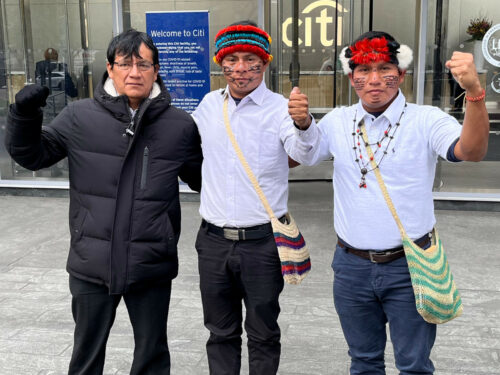
That's where Amazon Watch comes in. As in previous years, we will be accompanying indigenous leaders from northeastern Ecuador to speak truth to power.
Fight Oil with Water: Chevron's Embarrassment in Ecuador
May 23, 2012 | Paul Paz y Miño
Take Action Now!
Help spread the word about ClearWater! Share this video with your friends and family.
Shame on Chevron. Actions speak louder than words and it's incumbent upon the global community to take action where Chevron refuses to. Today a community-led initiative – ClearWater – is providing clean drinking water to tens of thousands of Ecuadorians left with nothing but Chevron's toxic contamination.
"Development" vs. Indigenous Communities
May 23, 2012 | Iara Lee
In every corner of the world, we see unfathomably huge hydroelectric dams that destroy entire ecosystems and indigenous livelihoods. The notorious Three Gorges Dam in China has its rivals on all other continents, from the proposed Grand Inga in the Democratic Republic of the Congo to the James Bay Project in Canada. In these and many other examples, the results have been similar: thousands are displaced from their homes, species are going extinct, farmland is flooded and rendered useless, and water-borne diseases flourish. Despite the many alternatives to these projects and the potential for improving energy efficiency, the mega-dams of the 20th century are only growing bigger and more popular in the 21st.
The Belo Monte Dam and the Xingu River
A few years ago, my film crew had the opportunity to travel to the Xingu River, a tributary of the Amazon, where the Brazilian government has for decades tried to build the Belo Monte, which would be the world's third largest hydroelectric dam. Our crew's visit coincided with a summit in the city of Altamira, where 1,000 people from various indigenous communities joined national and international supporters to express their unequivocal opposition to the project. The broad mobilization was inspired in part by credible estimates that 20,000 people would be displaced from their traditional territory. Some experts say that 40,000 would be affected if the dam were built.
We produced a short film, Battle for the Xingu, in which we interview some participants in the summit and visit some of the affected communities. Advocacy groups have used the film to inform the international community about the project's implications and it has screened at many short film festivals worldwide.
The film explores the tension between violent and nonviolent tactics in resisting this project. In particular. indigenous activists used a symbolic act of violence in which they cut a dam advocate's arm to represent their commitment to preventing the dam's construction. While we applaud the movement's decision to overwhelmingly embrace nonviolent tactics, in this film we wanted to show the tensions that arise when communities feel they have few options in preventing the destruction of their homeland.
Protests for Healthy Water Policy in Peru Link Highlands and Jungle
May 31 to be Day of National Solidarity
May 21, 2012 | Darrin Mortenson
From the Andes to the Amazon, indigenous and mestizo groups across Peru plan to mobilize on May 31 to resist industrial development projects that they say would destroy vital natural water sources and threaten community survival.
Organizers say the simultaneous marches and blockades will send a clear message to national leaders in Lima and erect a symbolic bridge between regional resistance movements, including ongoing protests against a U.S. owned mine in the highlands of Cajamarca, Newmont Mining's so-called Conga gold mine, and a rapidly mounting movement against another giant American company, ConocoPhillips, which plans to dig some 48 exploratory oil wells at the headwaters of the Nanay River, the principal source of drinking water and main fishing grounds for the half-million residents of the jungle city of Iquitos.
ConocoPhillips's consortium partners include Canadian drillers Gran Tierra and Talisman Energy. Talisman has recently made headlines as Achuar indigenous leaders have ordered the company out of their Peruvian territories.