

Eye on the Amazon: The Official Blog of Amazon Watch
Chevron's Leadership is an Oxymoron
November 11, 2011 | Paul Paz y Miño
The theme for this year's Business for Social Responsibility (BSR) conference in San Francisco last week was "redefining leadership". I have no qualm with that, for when I realized that Chevron was not only a major sponsor but a featured speaker on a panel about "community engagement," I agreed. Indeed, that is a new definition of leadership – appallingly bad leadership.
Inviting the oil company that was found guilty of deliberately dumping 18 billion gallons of toxic waste into the pristine Ecuadorian Amazon – poisoning over 30,000 people who live there – to lead a session on community engagement is like asking the Taliban to chair a conference on women's rights. Is this really the message that BSR wants to send to its members?
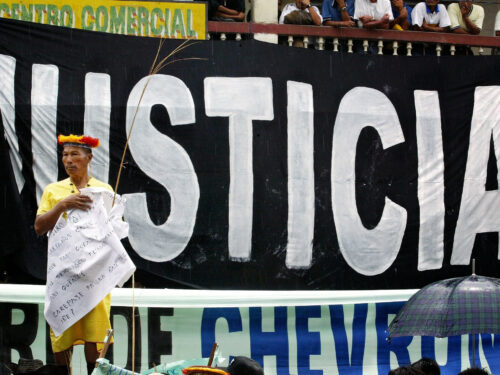
We are confronted by hypocrisy every day, and yet somehow there's a fundamental disconnect here that defies explanation. The jury is no longer out. Chevron has lost an 18-year legal battle, been found guilty and fined $18 billion in a venue of its own choice. Because they refuse to accept responsibility and pay for a clean-up, Chevron is now the "poster-child" for corporate irresponsibility. Adding insult to injury (and these are not metaphorical injuries), Chevron filed a RICO suit against the plaintiffs earlier this year accusing them of extortion. That case was eventually laughed out of court, but Chevron's strategy remains the same: delay, disrupt and deny. Is this a new definition of leadership? I'd call it the same tired tactics on which corporate criminals spend millions each year.
How does Chevron go from such infamy to sharing the stage with Aron Cramer, President and CEO of BSR (and on the 18th anniversary of the launch of the epic lawsuit against Chevron, no less)? During the panel, Chevron spokesperson Rhonda Zygocki, VP of Policy and Planning, actually said that there's no longer a CSR Department at Chevron because corporate responsibility is integrated into every aspect of the company's operations. Why would they need a department to evaluate how they treat communities and the environment, since everybody at Chevron so completely loves community and the environment? That would be silly. Mr. Cramer, who according to the BSR site is, "recognized globally as an authority on corporate responsibility by leaders in business and NGOs and by his peers in the field," did not question this position. It certainly seems like a colossal step backward to us. On the other hand, eliminating the CSR department at Chevron may be the first honest thing they have done in a long while.
Occupy Belo Monte!
November 4, 2011 | Christian Poirier
"Our resistance against this destructive project called Belo Monte remains unshakable. The occupation has sent a clear message to President Dilma Rousseff's administration that the fight for the Xingu is more alive than ever. If the Brazilian government continues to insist on violating our rights, other resistance actions shall come."
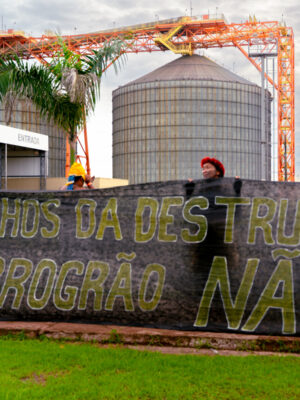
As I landed in the tumultuous city of Altamira last Thursday I was greeted with breaking news from my colleagues at the Xingu Alive Forever Movement: The massive Belo Monte work camp and Trans-Amazon highway had been closed in a daring early morning occupation led by a diverse coalition of indigenous peoples, local farmers, fisherfolk, and members of social movements from across Brazil. In a direct action that was unprecedented in its scale and impact, the occupiers paralyzed works on a portion of the monstrous Belo Monte Dam complex, sending a strong signal of resistance to a belligerent federal government determined to bulldoze their river and their rights.
In a collective statement protesters stressed, "In the face of the Brazilian government's intransigence to dialogue and continuing disrespect, we occupied the Belo Monte construction site and blocked the Trans-Amazon highway. We demand a definitive cancellation of the Belo Monte Dam."
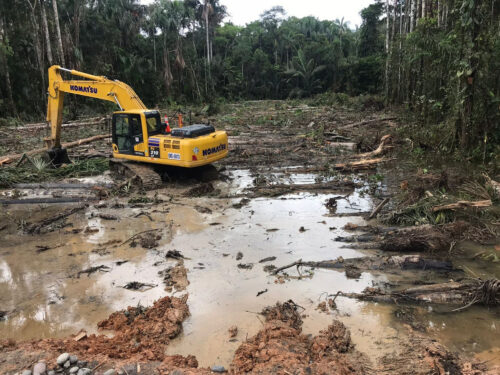
Meanwhile, construction of another set of the project's work camps continued at breakneck speed, using a fleet of heavy machinery to carve wide roads through felled and burnt out forests, forcing people from their homes to make way for Belo Monte's strategic installations. Quite the opposite of heeding the call of protesters to immediately halt construction, the project consortium NESA continued its destruction unabated, confident that overwhelming and seemingly impervious political support for Belo Monte – backed by a ruthless security apparatus – would protect their objectives. But the protest occupation laid bare a basic fact: resistance to the dam is growing as fast as its popularity among local communities and the Brazilian public is falling.
18 Years of Fighting Chevron
November 3, 2011 | Mitch Anderson
Lago Agrio, Ecuador – The sprawl of scorched pavement and crumbling cement buildings in the heart of the Amazon rainforest. This city, once a small oil boom town founded by Texaco in the late 1960s (and given, appropriately, the name "Sour Lake" after Texaco's hometown in Texas) is now a bewildering and feverish mess of oil workers, drug-traffickers, street children, shop owners, impoverished farmers, and indigenous people stripped of their ancestral territory and forced to survive, as the Cofán people say, in the kokama kuri sindipa ande (the white man's world of money).
Just several days ago, at the edge of the pavement on the outskirts of the city, where the Cofán people have recovered (yes, purchased) a narrow tract of their ancestral territory, I spent the afternoon with Marina Aguinda Lucitante, an elder of the tribe. She was born along the banks of the Agua Rico river. She was married at a young age to a Cofán Shaman, Guillermo Quenama, who died, she says, "because the oil company poisoned him with alcohol." She remembers when the forest was filled with animals. And she remembers when the river ran black with crude oil. She seems to remember everything – and all of her memories are divided: Life before the oil company and life after the oil company.
It has been nearly 50 years since Texaco began oil operations here in the northeastern Ecuadorian Amazon. Nearly 50 years since the death of Marina's husband, Guillermo Quenama. And over that time, the impacts of Texaco's (now Chevron's) reckless pump and dump oil operations have been well documented. The abandoned oil pits littered throughout the rainforest, the billions of gallons of toxic wastewater dumped into rivers and streams, the felled primary forest, the noxious gases rising into the sky from 24 hour-a-day flaring, the crude oil sprayed on the roads, the towering black plumes of smoke from spilt and burning crude, the resultant public health crisis racking indigenous and mestizo farmer communities, including cancer, spontaneous miscarriages, and birth defects.
But what has not been documented – what cannot possibly be understood by anyone who has not been here to endure the last 50 years of oil operations – is how the oil conquest has affected the spiritual life, the inner world, of those who live here.
Bolivian Indigenous March a Success
President Morales cancels road through TIPNIS reserve
October 22, 2011 | Andrew Miller, DC Advocacy Coordinator, and Diana Garzón, Advocacy intern
Yesterday, Bolivian President Evo Morales announced that he would cancel the road project that previously was planned to cut through the heart of the TIPNIS indigenous reserve in the Bolivian Amazon. This followed the Wednesday arrival in La Paz of hundreds of Amazonian indigenous protesters.
Over the course of 65 days, the marchers suffering health problems, cold, fatigue and even violent police repression on September 25th. They were undeterred, however, and garnered increasing national and international support as they steadfastly walked to the country's capitol city. Upon arrival, several hundred settled into Murillo Plaza where they waited to meet with President Morales and have a true dialogue about the construction of the TIPNIS road.
On Saturday, President Morales and his cabinet entered into direct negotiations with leaders of the protesters. According to Bolivian news sources, they concluded that a joint commission will visit the TIPNIS reserve, within 30 days, to inspect the current situation and to expel illegal colonists within the reserve.
Also, as of this coming Monday, the Bolivian Congress will convene to review the law, passed by the Bolivian Senate on October 13th, which attempted to deal with the situation. The new version should void the so-called second section of the Villa Tunari – San Ignacio de Moxos road.
"The Amazon is Life"
Q&A with Sheyla Juruna, Indigenous woman warrior from the Brazilian Amazon
October 20, 2011 | Leila Salazar-Lopez
If you've heard of the Belo Monte Dam and have signed a petition to stop it, you've probably seen a picture of Sheyla Juruna, Indigenous woman warrior from the Xingu River Basin of the Brazilian Amazon, who's spent the last 20 years working to stop this dam from being built on the Xingu River in the heart of the Brazilian Amazon.
Sheyla was recently in the United States on a tour of NY, DC and San Francisco to expose what she calls, "the project of death" and make appeals to activists, concerned citizens, foundations and global leaders to support the struggle to defend the Amazon and our entire planet from unchecked and unsustainable "development" that will decimate Indigenous peoples, the true stewards of the Amazon, unless we stop it and promote alternative development and renewable energy for ourselves and our future generations.
During her visit Sheyla spoke at various public events including the Amazon Watch 15 year anniversary luncheon and an evening presentation at the Earth Island Institute. Before she returned to Brazil, I had a chance to ask some specific questions to better understand what was really happening on the ground in Altamira and what we can really do at this time to show our support.