

Eye on the Amazon: The Official Blog of Amazon Watch

AIDESEP Visits Washington, DC

An Indigenous Organization's Fight for Community-Based Conservation

March 4, 2012 | Caitlin Doughty

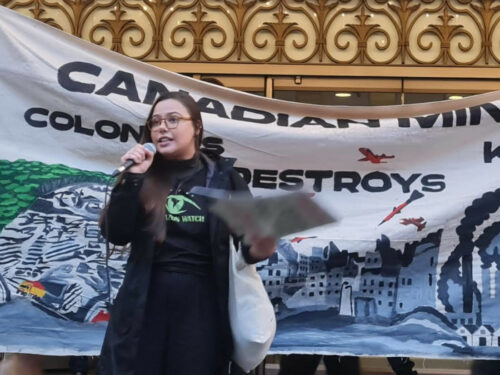
Daysi Zapata

Imagine you live in a tropical forest teeming with the flora and fauna, the very resources of your own subsistence. The trees that provide you and your family with fruit and materials for your home, however, represent something completely different to international developers: money. If you were asked to sign a legal document written in a foreign language, regarding the future use of land and resources on which you depend, would you? What if the contract was written in your own language but required that 50 percent of the potential income made from "conserving" the forest went to an international developer with no liabilities for any potential losses?

These are just two of the options given to indigenous communities by what rights advocates call "carbon cowboys." These international developers and investors are looking to make a profit by financializing carbon and taking advantage of those living in carbon rich forests.

On the ground in Peru, there are already 35 pilot projects being implemented as a part of United Nations Reducing Emissions from Deforestation and Forest Degradation (REDD+) program. To date, these projects encompass roughly a tenth of the 70 million hectares of rainforest in Peru. The questions posed above are not deranged notions of an indigenous rights activist but actual situations and terms of contracts for several of the pilot projects that have been initiated in Peru.

Read more »


Dignity Incarnate

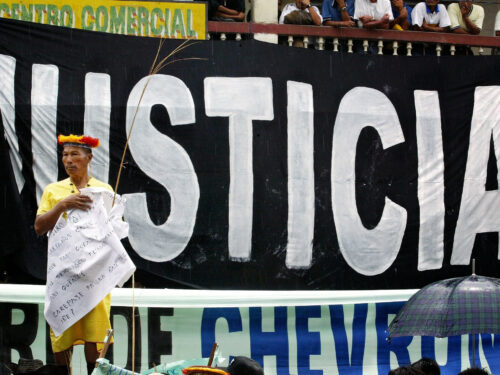
Inside Journey, Ecuador’s Cofán Still Standing Strong Against Chevron

March 2, 2012 | Mitch Anderson

Emergildo Criollo traveling to Quito

This morning I accompanied Emergildo Criollo, leader of the Cofán people, from his home in the dusty outskirts of Lago Agrio (the oil camp turned boom town that Texaco founded) to a press conference in Quito regarding a ruling issued late yesterday afternoon by the Appellate court in Sucumbios rejecting Chevron's latest attempts to block enforcement of the $18 billion judgment against Chevron for massive environmental crimes in the Ecuadorian rainforest.

6:15am: Torrential rain in Lago Agrio. Dim grey sky. We are standing outside the Lago Agrio airport, only 1/2 mile from the well site Lago Agrio 1 where Texaco first struck oil in 1967, setting in motion decades of industrial scale oil operations that would lead to one of the largest environmental disasters on the planet. Emergildo is silent. The airport has yet to open. Suddenly, as if a memory appeared to him in the distance, he begins to recount:

"Sometimes I don't recognize my own territory, Mitch." We are looking out at the pavement of the parking lot. "I remember I was six years old, and we had seen the helicopters in the sky (we thought they were metal birds), and then we went to where they landed. We heard awful noises there. And there were white people with big machines that we had never seen before. They were doing all sorts of strange things there…strange things…cutting down the forest, setting trees on fire, making explosions; and there were smells that we didn't recognize. Bad smells. And we didn't know why they were destroying the forest. What were they looking for?"

7am: We are worried about the weather conditions. It is still raining outside. We are inside the airport now drinking Nescafe with sugar. I ask Emergildo about the first time he drank coffee:

Read more »


Guilty, Again and Again

Ecuadorian Appeals Court Ratifies Chevron Ruling

March 2, 2012 | Paul Paz y Miño

Plaintiffs' chief attorney, Pablo Fajardo

The Chevron case marked an important turning point yesterday when an Ecuadorian appeals court issued its final ruling, ratifying its historic $18 billion judgment against the oil company.

The ruling was the latest in a recent whirlwind of international legal news in the case, which is becoming a major test case to determine the boundaries between corporate investor rights, human rights and national sovereignty.

In a press conference Friday in Quito, indigenous leaders and plaintiffs' chief attorney Pablo Fajardo said that their legal team would soon initiate legal actions in several countries to attempt to seize Chevron's assets to pay the judgment.

Read more »


Inspiration from the Xingu, A Final Stand

February 28, 2012 | Maira Irigaray

Finding inspiration in the people of the Xingu

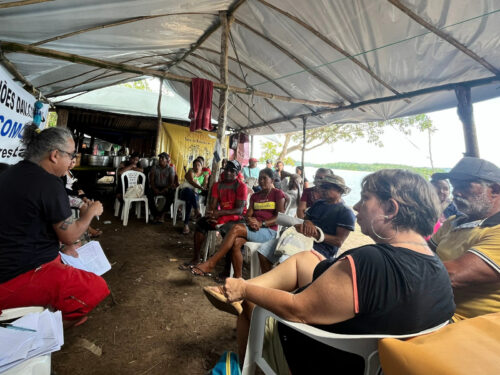
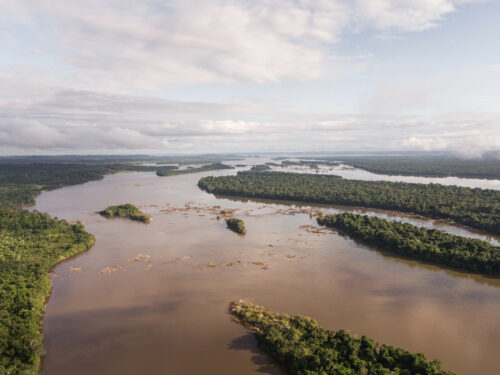
In early February, I visited the Xingu region of the Brazilian Amazon with colleagues from Amazon Watch. It took me a week to process what I experienced there and I thought it was important to share some thoughts, and memories, so you get a better understanding of how important your support for our work is.

I am Brazilian. I came to the U.S. four years ago with a dream: To find a place where I could really do what I love and believe in, helping to protect the Amazon rainforest and its traditional people. I thought that in my country nobody cared, or the ones who did were unable to be effective, and so I started looking for this magical place where people do care, and do make the difference. I walked a long way to find this place, and here I am working for Amazon Watch.

It's been a year and half since I was last in the Xingu. I was there as a lawyer, helping to gather information in preparation for the case for the Inter-American Commission of Human Rights. Now I was back there as a representative of Amazon Watch and as a friend, fighter in this struggle. It was a deeply powerful, but disturbing visit. I cried...a lot!

Since the last time I was there everything changed... Altamira is a different town now. What was suppose to be a "new world" as it was sold by the government and the companies is only a messy chaotic town crowded with people, noise, and issues. One hospital and no infrastructure turned Altamira into a sad "black and white" portrait of what so-called "development" means for real to those affected by it.

Read more »


Notes from Bogotá: The U'wa Solidarity Campaign

February 24, 2012 | Andrew E. Miller

"It's like Bagdad," the taxi driver comments as we bump past concrete rubble, protruding rebar, and unruly pedestrians darting in and out of snarled traffic. Bogotá's roads have been under seemingly interminable construction in recent years, in part due to a huge corruption scandal. "They took the billions on up-front payments. Some are in jail now, but where's the money?"

The taxista, in true Colombian form, launches into a colorful and detailed analysis of the political situation. He tells me his country is an "Empire of Corruption," a product of a small number of elite families that have monopolized political power through the centuries. Their attitude? "You rob, I rob. Let's rob together!"

He chalks the situation up to criminal ingenuity on one hand, and a generalized cowardice on the other: people see things they know are wrong but are unwilling to speak up. A dozen exceptions to that uncharitable characterization of his countrymen flash through my mind. Exiting the taxi in the city's colonial Candelaría district, I'm about to meet with some of them.

Up 11 flights of stairs, a panoramic view greets me out the conference room windows, Bogotá's mountains rising to the East and downtown to the North. The rubble is nowhere to be seen, though regular horns and revving engines permeate the windows, a reminder that the chaos below is never far.

Read more »


Current Highlights